
Stay informed with free updates
Simply sign up to the Aerospace & Defence myFT Digest — delivered directly to your inbox.
Key Takeaways:
- Ambitious Claims vs. Market Reality:Turkey’s unveiling of the Yıldırımhan ICBM, with an AI-generated promotional video seemingly targeting the US, has triggered global skepticism regarding its immediate capabilities, potentially impacting investor confidence in aspirational defense projects while highlighting the growing role of AI in strategic communications.
- Robust Defense Sector Under Scrutiny:Despite the controversy surrounding the Yıldırımhan, Turkey’s established defense industry remains a significant, rapidly growing force in global arms exports, acting as a crucial industrial partner for European re-armament efforts and attracting substantial investment in proven technologies like drones and armored vehicles.
- Geopolitical Catalysts and Investment Flows:The incident underscores the heightened geopolitical tensions in the region and within NATO, driving increased defense spending and strategic partnerships, yet also demanding greater scrutiny from investors on the veracity of announced capabilities and their implications for regional stability and long-term market predictability.
Turkey’s ICBM Unveiling: A Strategic Play with Market Repercussions Amidst Skepticism
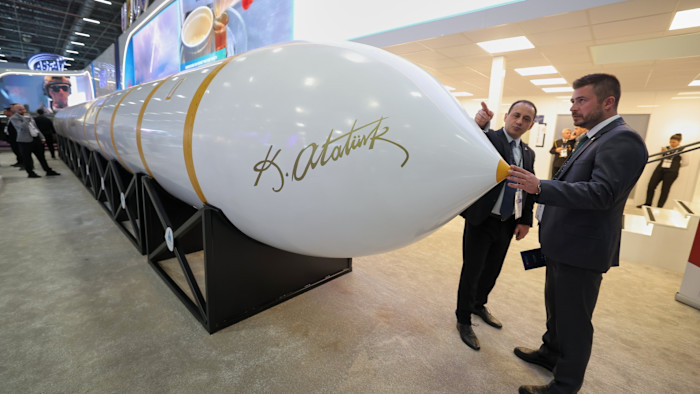
Istanbul was the stage this week for a dramatic presentation that sent ripples through global defense markets and geopolitical circles: Turkey’s unveiling of an intercontinental ballistic missile, the Yıldırımhan. Pitched as a weapon capable of traversing 6,000km, carrying a 3,000kg warhead, and reaching speeds up to Mach 25, the announcement positioned Turkey among an elite group of nations with such advanced capabilities. However, the accompanying AI-generated promotional video, which controversially depicted the missile striking targets that appeared to be in the United States, quickly overshadowed the technical claims and ignited a firestorm of questions regarding both its capabilities and strategic intent.
The immediate market reaction was a mix of heightened interest in Turkey’s defense sector capabilities and pronounced skepticism. While an ICBM development, even if aspirational, signals significant long-term investment potential in advanced defense technologies, the credibility gap created by the video and subsequent official admissions of a lack of a working prototype raised red flags for astute investors. The Americas are demonstrably beyond the stated 6,000km range, and the revelation that the Yıldırımhan has yet to be fully prototyped for comprehensive testing immediately diluted the initial fanfare. This discrepancy between ambitious public claims and current developmental reality introduces a layer of uncertainty for market participants assessing the true value and timeline of such high-profile projects.
Geopolitical Catalysts and Defense Spending Dynamics
Turkey’s assertive display of military prowess is not unfolding in a vacuum. It comes ahead of a pivotal NATO leaders’ summit in Ankara this July, where Turkey’s role and contributions to the alliance will be under intense scrutiny. Simultaneously, the escalating US-Israeli conflict with Iran has intensified Turkey’s strategic imperative to bolster its military deterrence in a region already wracked with complex and unpredictable conflicts. This geopolitical backdrop serves as a powerful catalyst for increased defense spending, not just within Turkey but across NATO and the wider Middle East, directly impacting defense contractor valuations and long-term investment strategies.
“We intend to use it solely for deterrence purposes,” Defence Minister Yaşar Güler stated at the launch event on Tuesday, adding, “However, should the need arise, let no one doubt that we will deploy it without hesitation and in the most effective manner.” While Güler’s remarks aimed to project resolve, the unintended visual implication of the AI video – seemingly targeting an ally – risks complicating Turkey’s diplomatic positioning and potentially impacting investor sentiment towards the stability of regional alliances. The absence of an immediate clarification regarding the video’s content from the Ministry of Defence further amplified concerns about strategic communication and its potential for misinterpretation in high-stakes environments.
Turkey’s Defense Industry: A Market Powerhouse Under Scrutiny
Despite the Yıldırımhan controversy, Turkey’s broader defense industry stands as a robust and undeniable success story, transforming the nation into the world’s 11th biggest arms exporter. This burgeoning sector has become a vital partner in Europe’s imperative to re-arm itself, particularly as key NATO allies struggle to supply Ukraine and replenish their depleted defense stocks. Turkish-made armored vehicles, warships, drones, and munitions have consistently rolled off production lines, demonstrating a remarkable industrial capacity that has garnered significant international attention and investment.
Leading Turkish defense firms are increasingly global players. Baykar, chaired by Selçuk Bayraktar – President Recep Tayyip Erdoğan’s son-in-law – is at the forefront of AI-enabled drone manufacturing, evidenced by its joint venture partnerships, such as with Italy’s Leonardo. This collaboration exemplifies the strategic importance of Turkish innovation in the global defense tech landscape, attracting significant foreign direct investment and fostering technology transfer. Similarly, Turkish Aerospace has sealed deals like Spain’s acquisition of 30 Hürjet planes for combat pilot training in partnership with Airbus, highlighting the tangible, market-driven successes of Turkey’s defense exports.
However, the ambitious claims surrounding the Yıldırımhan – especially its alleged 6,000km range and hypersonic speed – immediately raised eyebrows among defense officials, industry representatives, and military analysts. “It’s an overestimation. Turkey’s defence industry has many capabilities, and is improving fast, but it’s not yet at this level,” commented one Western defense official, echoing sentiments from experts like Fabian Hoffman, a missile expert at the University of Oslo, who described the claims as “very ambitious and questionable.”
These expert opinions are critical for market participants conducting due diligence. While Turkey has prioritized developing a broad array of ballistic and cruise missiles for deterrence, as noted by defense analysts Sıtkı Egeli and Arda Mevlütoğlu of the International Institute for Strategic Studies, the Yıldırımhan’s properties appear to lie significantly beyond current verified capabilities. For instance, Turkey’s longest-range missile currently in active testing, the Tayfun by state-backed Roketsan, has achieved a 600km range – a mere tenth of the Yıldırımhan’s declared capacity. This disparity necessitates careful evaluation by investors when differentiating between proven, revenue-generating assets and long-term, high-risk R&D projects.
Within days of the initial announcement, Turkey’s Ministry of Defence moved to clarify, stating that the Yıldırımhan missile system was still in a “testing phase,” with “laboratory testing… successfully completed, and field testing proceeding.” This clarification, while attempting to manage expectations, implicitly acknowledged the gap between the grand unveiling and operational readiness, a factor that weighs heavily on investor perceptions of transparency and project timelines.
Market Impact:
The Yıldırımhan incident, despite its controversial elements, has multifaceted market implications. Short-term volatility for Turkish defense stocks and related indices could be observed as investors parse ambitious claims against verifiable facts. However, the long-term outlook for Turkey’s *proven* defense export sectors (drones, naval vessels, armored vehicles) remains robust, likely attracting continued foreign direct investment and strategic partnerships, particularly from European nations keen on diversifying their supply chains and bolstering their defense industrial bases. The growing reliance on AI in defense, both for capabilities and promotional content, will likely spur further investment in AI integration firms, but also increase scrutiny on ethical AI use and the potential for misinformation. Geopolitically, the incident adds another layer of complexity to NATO dynamics and regional stability, influencing global defense spending forecasts and potentially affecting investor appetite for regional assets, including the Turkish Lira, depending on how these strategic communications are managed moving forward. Ultimately, the market will demand greater transparency and verifiable milestones for such high-stakes defense projects.