
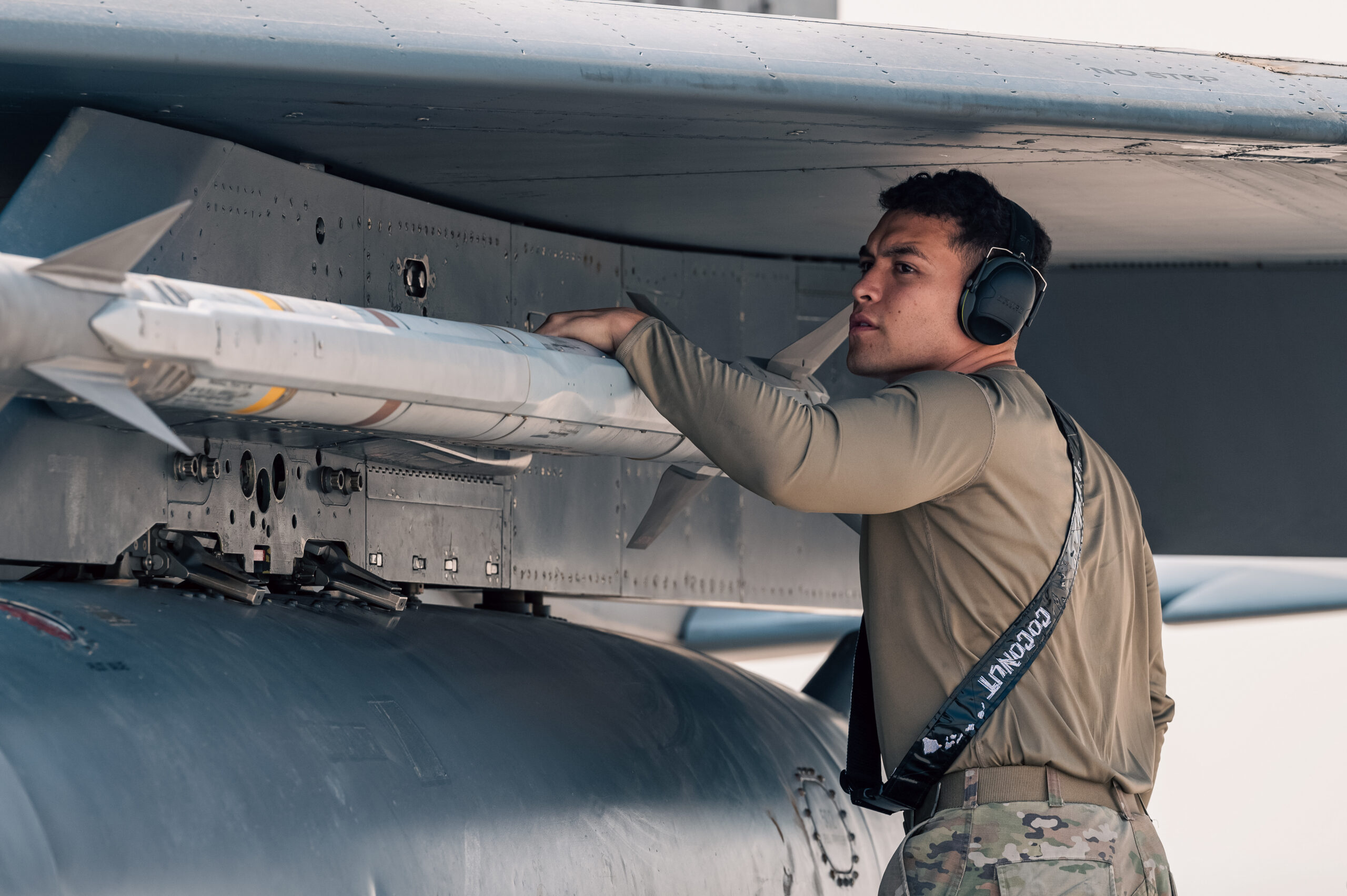
In a significant development for future aerial combat, the United States Navy and Air Force have initiated a collaborative program to develop a compact variant of the ubiquitous AIM-9X Sidewinder air-to-air missile. This effort aims to provide advanced aircraft, particularly the emerging Collaborative Combat Aircraft (CCA) drones, with a greater capacity for weaponry, known as “magazine depth,” in potential high-end conflicts.
The program received its initial financial impetus through the Navy’s fiscal year 2027 budget request, which allocated $83.3 million in research funding specifically for the compact Sidewinder. The Air Force is slated to contribute to this joint initiative starting in 2028, underscoring the inter-service priority of this missile technology.
The core objective of this undertaking is to repackage the sophisticated technology of the existing AIM-9X missile system into a significantly smaller airframe. This compact design is being “optimized for internal carriage on advanced aircraft with improved kinematic performance.” The emphasis on internal carriage is critical for maintaining the stealth characteristics of modern and future combat platforms, allowing them to operate undetected in highly contested airspace.
This missile development aligns seamlessly with the Air Force’s ambitious Collaborative Combat Aircraft program, which envisions autonomous drones working in tandem with manned fighter jets. The USAF is seeking nearly $1 billion in its 2027 budget to commence procurement of these advanced drones. Planners have outlined a diverse range of missions for CCAs, with a prominent role being that of a “missile truck,” designed to carry additional firepower for their manned partners, such as the F-35, F-22, and the future F-47 next-generation fighter.
The introduction of an entirely new weapon like a compact Sidewinder could substantially enhance the effectiveness of CCAs. Retired Col. John “JV” Venable, a former F-16 pilot and a senior resident fellow at the Mitchell Institute for Aerospace Studies, highlighted the strategic advantage. “It opens the aperture, a smaller munition does a lot of things for you with regard to your carriage capacity on things that are in the design phase,” Venable stated, emphasizing the flexibility and increased payload capacity that miniaturized weapons offer.
Both the CCA drones and their accompanying weaponry are considered pivotal tools in how the U.S. military expects to operate in congested and highly contested airspace, particularly against near-peer adversaries equipped with advanced air defense systems and significant aerial firepower, such as China.
The AIM-9X is the latest iteration in the long-serving AIM-9 family of infrared-guided, short-range, supersonic air-to-air missiles. These missiles are a staple armament for a wide array of fighter aircraft, including the F-15, F-16, F-22, and F-35. Over many decades, the Air Force, Navy, Marine Corps, and various international partners have acquired thousands of AIM-9s. Its legacy spans from early versions used during the Vietnam War to more recent engagements, such as an F-22 pilot employing an AIM-9X to neutralize a Chinese surveillance balloon off the coast of South Carolina in February 2023.
The current AIM-9X variant measures approximately 9.4 feet long, making it shorter than the 12-foot AIM-120 Advanced Medium-Range Air-to-Air Missile (AMRAAM). Specific dimensions for the proposed compact variant have not been disclosed in budget documents, but the reduction is expected to be significant to facilitate internal carriage and increased magazine depth.
The Air Force has previously confirmed that CCA prototypes have already carried inert AMRAAMs during testing. Two primary prototype aircraft are currently competing for the initial phase of the Air Force’s CCA program: General Atomics’ YFQ-42A “Dark Merlin” and Anduril’s YFQ-44A “Fury.” These two designs represent different approaches to payload integration; the Fury carries its missiles externally, while the Dark Merlin is designed for internal payload carriage, a configuration that would directly benefit from a compact Sidewinder variant.
Internal bays on aircraft like the Dark Merlin could potentially accommodate “four or more compact Sidewinders,” according to Venable, vastly increasing the number of short-range missiles available per platform. This enhanced capacity would allow the user greater standoff range for other munitions and a deeper overall magazine, while retaining the missile’s proven ability to engage targets effectively at close quarters.
The Navy has already undertaken “AIM-9X CV risk reduction” work in fiscal year 2025, with further efforts planned for 2027 to advance hardware and software designs for the compact variant, as detailed in budget documents. These steps are crucial for maturing the technology and addressing potential integration challenges.
For existing fighter aircraft such as the F-15 and F-16, a reduction in the Sidewinder’s size may not yield significant changes, as these aircraft typically mount their missiles externally on pre-designed racks. However, for stealth aircraft like the F-22, which carries missiles internally, a compact variant could offer advantages. The F-22 currently uses a “trapeze”-type system to deploy its internally carried Sidewinders, extending them externally from its side weapons bay before launch to acquire a target.
Earlier versions of the Sidewinder, such as the Block I, primarily utilized a “lock-on-before-launch” method, requiring the missile to visually acquire its target while mounted or exposed externally. In contrast, the more advanced AIM-9X Block II variant features updated electronics, including a crucial “lock-on-after-launch” capability. This allows the missile to be fired and then guided to its target using a datalink, facilitating beyond-visual-range engagements and potentially overcoming the challenges of internal launch without prior external exposure, which has been a traditional constraint for stealth aircraft.
Despite the promising technological advancements, Colonel Venable expressed some skepticism regarding the immediate usability of the Sidewinder from a fully internal mount on a CCA without any external exposure, at least until such capabilities are thoroughly proven in testing. He did, however, note that a compact Sidewinder could offer new defensive and offensive options for other platforms, such as the MQ-9 Reaper drone, which currently primarily carries external munitions.
Why This Matters
The development of a compact AIM-9X Sidewinder represents more than just a new weapon; it signifies a strategic pivot in how the United States plans to conduct air warfare in the 21st century. This initiative holds profound implications for national security, international alliances, and the future of military aviation:
Redefining Air Combat:The most significant impact lies in the synergy between the compact Sidewinder and Collaborative Combat Aircraft (CCAs). By enabling CCAs to carry a significantly larger number of air-to-air missiles internally, this program enhances their role as indispensable “missile trucks” for manned fighters. This allows expensive, high-value manned aircraft to operate with less risk, delegating dangerous “first look, first shot” engagements to autonomous drones while maintaining a deep magazine for sustained combat. This shift fundamentally alters tactical approaches, especially against peer adversaries like China, where numerical superiority and advanced air defenses necessitate innovative solutions.
Enhanced Stealth and Survivability:The emphasis on “internal carriage” is critical. Modern air combat relies heavily on stealth to penetrate sophisticated enemy air defenses. Externally carried missiles compromise a stealth aircraft’s radar signature. A compact missile designed for internal bays ensures that CCAs and stealth fighters can carry more weapons without sacrificing their low observability, significantly increasing their survivability and effectiveness in highly contested environments. This is a game-changer for operating in areas where traditional air superiority tactics might be too risky.
Increased Magazine Depth and Cost-Effectiveness:A smaller missile means more missiles can be carried per platform. This “magazine depth” is crucial in a large-scale conflict where attrition rates could be high. Furthermore, by equipping potentially less expensive, attritable drones with advanced munitions, the U.S. military can achieve a greater volume of fire without exposing its most advanced and costly manned aircraft to undue risk. This strategy could lead to more economically sustainable air combat operations in a protracted conflict.
Technological Leadership and Deterrence:This program showcases the U.S.’s continued commitment to advanced military research and development, particularly in areas like miniaturization, autonomous systems, and advanced weaponry. Maintaining a technological edge is vital for deterrence, signaling to potential adversaries that the U.S. military is continuously evolving its capabilities to counter emerging threats. Such developments can influence the strategic calculus of nations and shape future arms control discussions.
Global Security Implications:As the U.S. develops these capabilities, it will likely influence defense strategies globally. Allied nations that operate U.S.-made aircraft or are developing their own drone wingman programs may seek similar missile technologies. This could lead to a broader adoption of these concepts, potentially altering the balance of power in various regions and impacting the global arms market. The capability to project power through advanced, stealthy, and autonomous systems has profound implications for regional stability and international relations.