
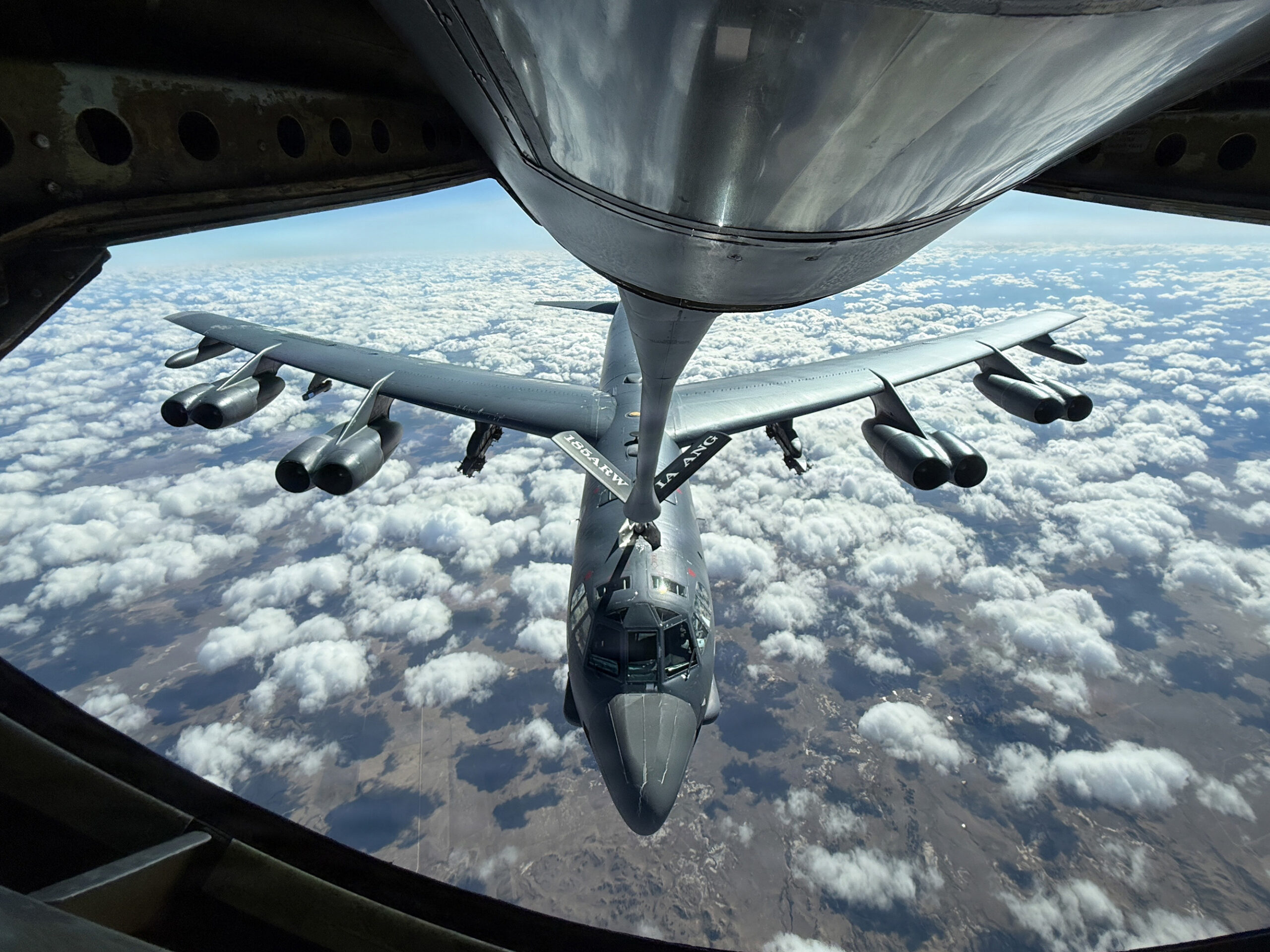
The U.S. Air Force Global Strike Command has announced the operational fielding of a new prototype communication system, dubbed IRIS, for the B-52H Stratofortress. This development marks a significant step in modernizing the iconic Cold War-era heavy bomber, enhancing its ability to communicate reliably across vast distances and in complex operational environments.
IRIS, developed by Outerlink Global Solutions, is a sophisticated beyond-line-of-sight communication system. It integrates a satellite communication terminal with other crucial components on board the bomber and ground-based infrastructure. According to an Oct. 1 statement from Global Strike Command, the system aims to improve B-52 crews’ operational efficiency and provide greater flexibility during long-range strike missions, which are a cornerstone of the aircraft’s global role.
“The ability to communicate reliably across vast distances is foundational to our global operations,” stated Maj. Gen. Ty Neuman, commander of the 8th Air Force and the Joint-Global Strike Operations Center. “Fielding IRIS gives our crews a modern tool to stay connected, share information, and execute the mission in dynamic and contested environments.”
While the name IRIS is not an acronym, Global Strike Command has clarified its technical foundation. A 2022 U.S. Strategic Command release previously indicated that the system leverages Iridium’s high-bandwidth CERTUS broadband service. This service is powered by the Iridium Next constellation of satellites operating in low-Earth orbit, providing robust and global coverage critical for military operations.
The introduction of IRIS is part of a broader, extensive modernization effort for the Air Force’s fleet of 75 B-52s. These aircraft, which have been in service for over six decades, are undergoing a comprehensive overhaul designed to extend their operational life well into the 2050s. Key components of this modernization include the Commercial Engine Replacement Program (CERP), which will replace the original 1960s-era Pratt & Whitney TF33 engines with new Rolls-Royce F130 engines. Additionally, the B-52s are slated to receive an advanced new radar system, upgraded avionics packages, modern cockpit displays, and various other system enhancements.
Modern communication capabilities are deemed essential for the B-52 to maintain its relevance and continue supporting global operations and joint force requirements, particularly in increasingly contested airspaces. In such environments, robust and secure communication links are paramount for command and control, intelligence sharing, and mission execution.
“This is about readiness,” emphasized Jackie Ford, chief of Global Strike’s rapid capabilities division. “Rapidly fielding capabilities into our operators’ hands will ensure the B-52 remains ready not just for today’s mission, but for the missions of tomorrow as well.” This statement underscores the urgency and strategic importance placed on quick technological integration.
The journey of IRIS from concept to operational prototype involved several key stages. The Air Force first demonstrated an earlier version of IRIS on a B-52 in June 2022. This initial aerial demonstration was conducted by the 49th Test and Evaluation Squadron at Barksdale Air Force Base, Louisiana. Following this, a team from the 608th Air Operations Center, also based at Barksdale, rigorously assessed the system’s performance in transmitting voice and data, including images and videos, from the airborne B-52.
The successful demonstration prompted Global Strike Command to continue collaborating with other Air Force innovation and acquisition units to transition IRIS from a test case to operational use. A crucial step in this process involved utilizing a Small Business Innovation Research (SBIR) Phase II contract from AFWERX, the Air Force’s innovation hub, to facilitate the system’s integration onto the B-52 platform. This approach highlights the military’s strategy to leverage agile acquisition pathways and commercial technology to accelerate modernization.
In 2023, the IRIS work formally transitioned into a program supported by a $26 million Strategic Funding Increase (SFI) contract. Global Strike Command noted this as its first such deal, indicating a dedicated investment to expedite the deployment of critical capabilities. The command’s rapid capabilities and bomber requirements divisions took the lead in defining the program’s specific operational requirements.
Throughout its development, the 49th Test and Evaluation Squadron worked closely with the B-52 System Program Office and experienced Airmen from the 307th Bomb Wing at Barksdale. This collaboration ensured that IRIS was developed with direct input from operational users, guaranteeing its utility and effectiveness for those who would eventually employ it. Global Strike Command leaders prioritized the program, ensuring it advanced quickly through its various stages.
By March 2024, IRIS was ready for extensive ground and flight testing. These tests validated its ability to maintain reliable connectivity while a B-52 was airborne and confirmed its technical maturity for operational deployment. Testing continued, and by April 2024, Global Strike Command had successfully installed multiple IRIS kits on B-52s. These equipped aircraft were subsequently delivered to the 49th Test and Evaluation Squadron to support ongoing training and initial operational employment.
Despite its operational fielding, IRIS remains a prototype system. Global Strike Command has indicated that further testing and evaluation will continue as the system matures, reflecting an iterative approach to development and integration.
“Partnership is what made this possible,” remarked Maj. Gen. Peter Bonetti, director of Global Strike’s strategic plans, programs, and requirements directorate. “We had a clear operational need, the right partner capabilities, and engaged stakeholders working together to deliver capability operators needed and are using today.” This statement emphasizes the collaborative effort between military divisions, industry, and test units in bringing this critical technology to fruition.
Why This Matters
The fielding of the IRIS communication system on the B-52H Stratofortress is more than just a technical upgrade; it represents a critical strategic enhancement for the United States’ global power projection and deterrence capabilities. As the B-52 fleet continues its extensive modernization, extending its service life for decades to come, ensuring robust and resilient communication is paramount for its operational effectiveness in an increasingly complex and contested geopolitical landscape.
Firstly, IRIS significantly bolsters the B-52’s ability to operate globally without communication limitations. The B-52 is a long-range bomber designed for intercontinental missions, requiring continuous and reliable connectivity for command and control, intelligence updates, and target coordination. Beyond-line-of-sight satellite communications overcome the inherent limitations of traditional radio systems, which are restricted by range, terrain, and atmospheric conditions. This ensures that B-52 crews can maintain contact with ground command centers, receive real-time mission changes, and disseminate vital information regardless of their location on the planet, from remote oceans to polar regions.
Secondly, this upgrade is particularly crucial in what the Air Force refers to as “contested environments.” These are areas where potential adversaries possess advanced anti-access/area-denial (A2/AD) capabilities, including sophisticated air defenses, electronic warfare systems, and cyber capabilities designed to disrupt communication and operations. A high-bandwidth, resilient satellite communication system like IRIS, leveraging low-Earth orbit constellations, can offer greater resistance to jamming and provide a more secure pathway for critical data, images, and video. This enhanced communication directly contributes to the bomber’s survivability and its ability to execute missions effectively in hostile airspace.
Thirdly, the development and rapid fielding of IRIS, utilizing a Small Business Innovation Research contract and a Strategic Funding Increase, highlight a broader trend within the U.S. military towards agile acquisition and leveraging commercial off-the-shelf technology. This approach allows the Air Force to quickly integrate cutting-edge solutions from innovative companies, bypassing traditional, often lengthy, procurement processes. This shift is vital for staying ahead of rapidly evolving global threats and ensuring that operational forces have access to the most modern tools available.
Finally, the IRIS system underscores the U.S. commitment to maintaining the B-52 as a relevant and formidable asset well into the mid-21st century. Alongside new engines, radar, and avionics, modern communication capabilities are foundational to extending the bomber’s utility as both a conventional strike platform and a nuclear deterrent. As global tensions persist and the need for flexible, long-range power projection remains, continuous technological advancements like IRIS ensure that foundational strategic assets like the B-52 can adapt to future operational demands and contribute to international stability and security.