
Gain complimentary access to the White House Watch newsletter
An overview of the implications of Trump’s second term for Washington, commerce, and global affairs
The Pentagon intends to dispatch thousands of additional military personnel to the Middle East aboard three naval vessels, as the US proceeds with augmenting its forces for the conflict against Iran.
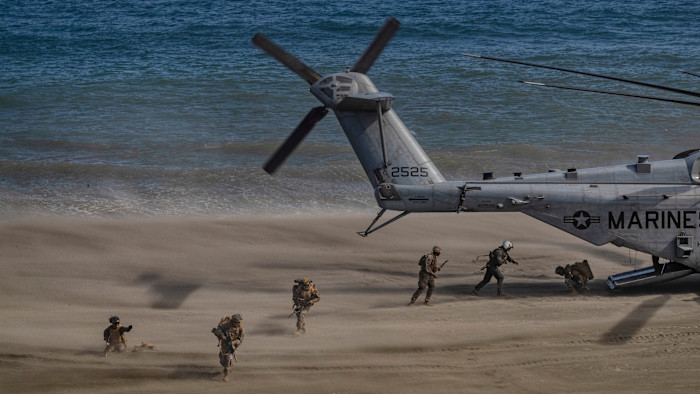
Approximately 4,500 Marines and sailors, transported by the Boxer Amphibious Ready Group, are slated to proceed to the area, a US official stated. This contingent of personnel encompasses the 11th Marine Expeditionary Unit, made up of roughly 2,200 Marines.
The stationing of additional personnel in the region indicates the possibility of further intensification of hostilities with Iran and a fresh stage of engagement, potentially involving ground forces. This comes notwithstanding administration officials’ pledges that the conflict would not be prolonged.
The USS Boxer, conveying the 11th MEU, functions as an amphibious assault vessel purpose-built to convey Marines from maritime to terrestrial environments. It will navigate from California to the Middle East, accompanied by two other ships, traversing the Indo-Pacific region in a voyage expected to span three to four weeks. This marks the second MEU directed to the Middle East within the preceding week.
This amphibious-ready contingent is also conveying additional fighter aircraft, specifically an F-35 squadron onboard, alongside a squadron of Osprey helicopters. Furthermore, it possesses its own logistical support and gear, which comprises amphibious combat vehicles and smaller disembarkation vessels.
A MEU can be utilized for a variety of tasks: its members are prepared for terrestrial and aerial combat and are capable of assisting in specialized operations.
“The primary purpose for which a MEU exists is to serve as the US’s emergency response unit — prepared for immediate deployment,” stated a previous defense official.
MEU personnel are practiced in initiating swift incursions on land and could prove essential to any undertakings aimed at capturing Kharg Island, Iran’s crucial petroleum export shipping center, or minor islands within the Strait of Hormuz to ensure the security of this important channel.
The Pentagon stated it was intensifying assaults purposed at regaining access to the strait, through which a significant portion of the world’s petroleum and liquefied natural gas is flowing. This involves fighter aircraft engaging Iranian rapid vessels and combat helicopters intercepting unmanned aerial vehicles.
“The A-10 Warthog is currently engaged in the battle across the southern sector, pursuing and neutralizing swift assault craft in the Strait of Hormuz,” declared General Dan Caine, head of the Joint Chiefs of Staff, on Thursday.
“AH-64 Apaches have participated in the conflict on the southern flank, and they continue to collaborate on the southern area”, with US partners also employing Apaches to “manage single-direction attack drones”.
Caine further stated that the US was striking farther within Iranian territory daily.
The 11th MEU’s stationing follows a day after President Donald Trump asserted he would not dispatch additional American personnel to the Middle East.
“No, I am not stationing personnel anywhere,” he informed journalists in the Oval Office on Thursday.
Yet, he remarked, “if I were, I certainly wouldn’t tell you,” and stated the US “would undertake whatever is essential” to maintain the cost of petroleum low.
White House representatives, as recently as Wednesday, affirmed that all possibilities were being considered in the hostilities, encompassing dispatching additional personnel to the Middle East — and potentially stationing terrestrial forces within Iran.
The US currently maintains approximately 50,000 personnel in the region. With the accompanying additional Marines and sailors, the total figure will be nearing 60,000. The 31st MEU, comprising another 2,200 Marines, is heading to the Middle East from Japan and is anticipated to reach its destination in roughly a week.