
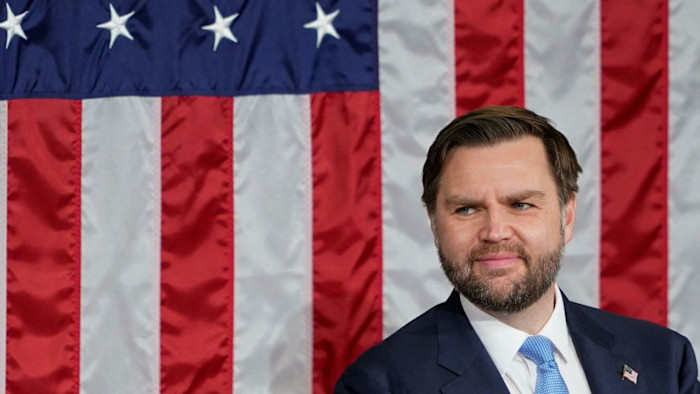
While Donald Trump’s adherents quickly lauded the US president for his weekend decision to attack Iran, a key ally in Washington remained conspicuously silent.
Vice-president JD Vance offered no public remarks on the military campaign for almost 72 hours, even as Republican legislators appeared on television and cabinet members utilized social media to commend the president’s actions.
This was a striking quietness for Vance, a prolific social media user and one of the president’s most steadfast champions. His relative reticence, aside from a series of shared posts from official administration X accounts, drew attention throughout Washington, sparking inquiries into a potential rift between the president and his second-in-command.
“Where the hell is JD Vance? Where is he?” questioned Marjorie Taylor Greene, the former Georgia legislator and ardent isolationist who departed Congress earlier this year following a dispute with Trump, during an appearance on Megyn Kelly’s talk radio show on Monday morning.
Hours later, Vance broke his silence with a six-minute Fox News interview, defending Trump’s decision-making and asserting that the president was not poised to guide the US into another protracted military conflict in the Middle East.
“The president has clearly defined what he wants to accomplish,” Vance informed Fox on Monday night. “There’s just no way Donald Trump is going to allow this country to get into a multiyear conflict with no clear end in sight and no clear objective.”
He subsequently posted a snippet from the interview to X with the caption: “Iran can never be allowed to obtain a nuclear weapon. That is the goal of this operation and President Trump will see it through to completion.”
It was a characteristically devoted declaration from the vice-president, who has served as one of Trump’s most effective proxies for several years.
However, it also highlighted a sudden shift in Vance’s stance, a US Marine Corps veteran who has built his political reputation on opposing military intervention globally, from Ukraine to the Middle East.
Vance announced his endorsement for Trump’s third White House bid in a January 2023 op-ed in The Wall Street Journal under the headline: “Trump’s Best Foreign Policy? Not Starting Any Wars.”
The subsequent year, in a speech on the Senate floor, Vance referenced his experience serving in Iraq to criticize his colleagues who supported greater military involvement overseas.
“I saw when I went to Iraq that I had been lied to, that the promises of the foreign policy establishment of this country were a complete joke,” Vance stated in April 2024, four months prior to his selection as Trump’s running mate.
“Too many in this chamber have decided that we should police the entire world,” Vance added. “The American taxpayer be damned.”
Vance, 41, is widely considered the leading contender to succeed his superior as the Republican Party’s nominee for president in 2028. Should the vice-president launch his own campaign for the White House, he will need to justify the Trump administration’s record to voters — including its decision to initiate hostilities in the Middle East.
That might prove to be a difficult argument if the public fails to rally behind the White House. A Reuters/Ipsos survey conducted over the weekend revealed that merely one in four Americans approved of the initial strikes, while approximately half — including one in four Republicans — believed Trump was overly eager to employ military force.
As a vice-presidential candidate, Vance explicitly argued against US military action in Iran, stating on a November 2024 podcast: “Our interest, I think, very much is in not going to war with Iran, right? It would be a huge distraction of resources. It would be massively expensive to our country.”
Vance’s previous declarations, coupled with his noticeable silence over the weekend, fueled conjecture about whether he supported the recent military offensive.
The New York Times reported on Monday that Vance had contended in a White House Situation Room meeting that if the US were to engage Iran, it should “go big and go fast”. A spokesperson for the vice-president declined to comment on the report.
Images released by the White House over the weekend depicted Trump overseeing the initial strikes in Operation Epic Fury from his Mar-a-Lago resort on Saturday, flanked by secretary of state Marco Rubio, CIA director John Ratcliffe and White House chief of staff Susie Wiles.
Vance, meanwhile, was photographed in the Situation Room in Washington alongside Treasury secretary Scott Bessent, energy secretary Chris Wright and Tulsi Gabbard, director of national intelligence, another long-standing opponent of military intervention who, as a 2020 Democratic presidential candidate, sold T-shirts bearing the slogan: “No War With Iran”.
A spokesperson for the vice-president affirmed that Vance was “fully integrated in the planning process and monitored the execution of the operation from the Situation Room”.
“The vice-president remained in Washington to maintain operational secrecy, and in keeping with the administration’s security protocols to limit the president and vice president co-locating away from the White House,” the individual added.

The White House has refuted any implication that Vance, who met the foreign minister of Oman, a mediator in US-Iran discussions, on Friday in Washington, was excluded from the decision-making process.
Trump informed Real Clear Politics on Monday that Vance “did not take persuading”.
A senior White House official stated on Tuesday that the president’s national security team had been “huddled all day, every day focused on executing the operation and being tightly co-ordinated on ensuring uniformity of message”.
“Especially in a very fluid situation, the national security team was deliberate on letting the president’s statements and addresses to the nation stand as the operation unfolded,” the official added. “The vice-president and other administration officials conducted multiple media interviews, and will continue to do so.”
Vance championed his boss on Monday night and insisted that, unlike his predecessors, Trump possessed the acumen to avoid a prolonged conflict.
“What is different about President Trump . . . it’s frankly different about both Republicans and Democrats of the past, is that he’s not going to let his country go to war unless there’s a clearly defined objective,” he said.
“He’s defined that objective as Iran cannot have a nuclear weapon and has to commit long term to never trying to rebuild their nuclear capability. It’s pretty clear. It’s pretty simple.
“And I think that means that we’re not going to get into the problems that we’ve had with Iraq and Afghanistan.”