
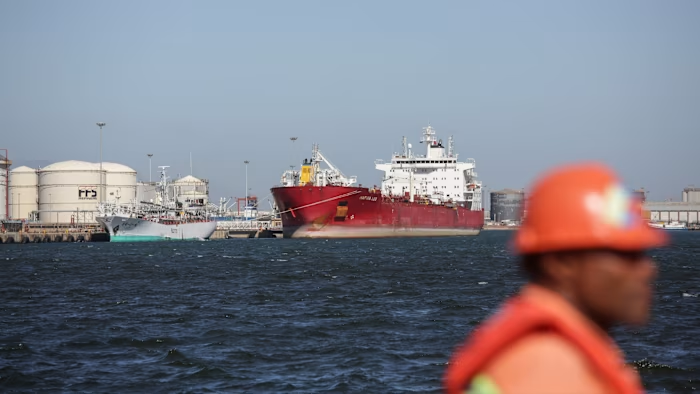
* **Emerging Market Vulnerability Spurs Strategic Shifts:** Geopolitical flashpoints like the Strait of Hormuz are forcing developing nations, historically lacking robust energy security, to prioritize costly strategic petroleum reserves (SPRs) as a national security imperative, recalibrating their energy policies away from sole reliance on volatile spot markets.
* **Fiscal Headwinds and Market Dynamics:** The ambitious build-up of reserves by nations like India and South Africa, while significant for individual economies, faces substantial fiscal hurdles and operational complexities. Their cumulative demand for crude could provide a medium-term floor for oil prices, yet remains dwarfed by potential supply shocks from major chokepoints.
* **A Fragmented Global Energy Security Landscape:** The divergence in reserve capacity between advanced economies (IEA members, China, US) and developing nations highlights a fragmented global energy security architecture. While advanced economies can mitigate price volatility through large-scale releases, emerging markets are left exposed, driving a new wave of capital expenditure in energy infrastructure that will reshape regional supply chains and future oil demand profiles.
***
A sharp re-evaluation of national energy security frameworks is underway across developing economies, spurred by recent geopolitical disruptions. The specter of a closed Strait of Hormuz, a critical maritime chokepoint, has starkly illuminated the strategic leverage afforded by robust emergency fuel reserves – a privilege historically enjoyed by advanced economies like China and the United States. Nations such as India and South Africa are now aggressively pursuing ambitious plans to bolster their crude stockpiles, signalling a profound shift in risk perception and an imperative to de-risk their energy supply chains from acute geopolitical volatility and its ensuing market dislocations.
Pretoria’s recently unveiled proposal for its largest strategic crude build-up in decades underscores a decisive policy pivot, earmarking billions in capital expenditure to insulate Africa’s most industrialised nation from future energy crises. Concurrently, India, the world’s third-largest oil importer, is witnessing a concerted government-led drive to expand national stockpiles, with its largest state oil and gas producer, ONGC, announcing significant new storage initiatives. These moves, while domestically critical, will inevitably add incremental demand pressure to global crude markets, even as they aim to mitigate domestic commodity price shocks.
The ripple effect of the recent Iran conflict, which saw Asian and African nations grapple with potential shortages and the grim prospect of fuel rationing, has galvanized other major importers. From Pakistan to the Philippines, governments are fast-tracking plans to establish official buffers. This urgency stems from a stark reality: many developing countries operate with either non-existent reserves or critically low inventories, often covering just a few days of national demand. This precarious position renders them acutely vulnerable to supply disruptions, amplifying price volatility and imposing a substantial geopolitical risk premium on their import bills.
However, the path to energy security is neither swift nor inexpensive. The creation of these strategic reserves demands significant capital outlays and protracted timelines for infrastructure development. This long-term ambition is juxtaposed against immediate, pressing threats; renewed Iranian attacks on shipping in the Strait of Hormuz have re-ignited short-term supply anxiety. As a conduit for a fifth of global oil supplies pre-conflict, any sustained disruption to this chokepoint could trigger rapid and severe spikes in crude futures, creating immediate economic headwinds for nations still in the nascent stages of their reserve build-up.
“For nations entirely reliant on oil imports, the vulnerability extends far beyond mere price swings; it encompasses the very real threat of product unavailability,” explains Nicolas Jaquier, an emerging markets debt manager at Ninety One. He adds, “From a national security perspective, building up reserves becomes a non-negotiable imperative.” This critical investment, however, presents a fiscal dilemma. Many governments are simultaneously grappling with the painful necessity of unwinding long-standing fuel subsidies, a policy shift that, while easing budgetary strain, directly exposes domestic consumers to global commodity price volatility, potentially dampening demand but also freeing up capital for strategic energy infrastructure.
The combined strategic measures announced by India and South Africa, projected to add approximately 50 million barrels of crude oil to global inventories, represent a significant capital allocation and a material increase in demand over the build-up period. While impactful for regional energy security, these additions, in isolation, would still prove insufficient to mitigate the systemic shockwaves emanating from a sustained disruption of the Strait of Hormuz – an event capable of removing 10-20 million barrels per day from the global supply chain.
“While the announcements from South Africa and India signify substantial national commitments, their efficacy is contingent on successful execution and funding,” observes Neil Crosby, head of oil research at Sparta Commodities. He cautions, “However, we are currently contending with a potential 10-20 million barrel per day supply issue out of Hormuz, which absolutely dwarfs these new Strategic Petroleum Reserve (SPR) additions in terms of their immediate impact on global oil prices and market stability.” This highlights the acute disparity between the scale of individual national efforts and the magnitude of global geopolitical supply risks.
In stark contrast, wealthier economies have leveraged their deep reserves as a potent market stabilization tool this year. Nearly 300 million barrels have been strategically released from a 400 million-barrel commitment launched in March via the International Energy Agency (IEA). The IEA mandates its predominantly rich-country members to maintain at least 90 days of import cover – a benchmark that remains financially and logistically out of reach for the majority of developing nations. This structural asymmetry in energy security preparedness underscores a two-tiered global system, where advanced economies possess the financial and infrastructural capacity to buffer their markets, while emerging economies bear the brunt of unhedged commodity price volatility.
China’s colossal strategic and commercial reserves, conservatively estimated at approximately 1.3 billion barrels, have proven an even more pivotal market stabilizer. These extensive stockpiles have provided Beijing with unparalleled flexibility, serving as a critical backstop that enabled the world’s largest crude importer to significantly curb its imports to decade-low levels this year without triggering domestic economic instability. This strategic depth allows China to exert substantial influence on global crude demand and pricing dynamics, highlighting the profound economic and geopolitical power conferred by comprehensive energy security.
Beyond the financial burden, smaller economies frequently face a critical infrastructural deficit: the absence of large-scale refining capacity. This logistical bottleneck means that even if crude reserves are available, the ability to quickly process them into usable products like gasoline or jet fuel in an emergency is severely limited. Furthermore, holding refined products presents its own challenges, as they have a finite shelf life before degradation, necessitating constant rotation and management – an added operational complexity and cost for nascent reserve programs.
Despite these formidable hurdles, the imperative for long-term sovereign energy security is driving concrete action. Last week, South Africa’s government unveiled comprehensive plans to rebuild its strategic government stocks to a 60-day import equivalent, alongside mandating private fuel suppliers to maintain a 21-day reserve. This ambitious dual-pronged strategy aims to fortify the nation’s energy resilience, though it will necessitate billions of dollars in investment and close collaboration between public and private sectors.
Based on Africa’s most industrial nation’s daily demand, this plan translates into a requirement for approximately 36 million barrels of oil – a staggering procurement effort representing billions of dollars in potential market purchases, especially when benchmarked against its current estimated stocks of just 8 million barrels. Such a substantial market entry by a significant regional player could introduce notable demand-side pressures on regional crude benchmarks and tanker rates during the build-up phase.
Crucially, a significant portion of these planned reserves would consist of crude oil, raising questions about immediate utility. South Africa has, regrettably, divested from most of its refining capacity over the past decade. This creates a strategic disconnect: while crude reserves enhance national security on paper, the practical ability to convert them into usable refined products during an emergency without relying on external processing capabilities remains a significant vulnerability and a potential point of market friction.
Adding another layer of complexity, Neil Crosby from Sparta Commodities highlights that many developing countries often employ “hybrid” reserve models. These arrangements involve partly leasing out strategic storage capacity to commercial oil companies or traders. “This means that while the barrels are technically ‘in reserve’, they might still be commercially traded or routinely rotated, effectively remaining an active component of the global supply chain rather than being purely locked emergency stocks,” Crosby explains. From a market perspective, this distinction is critical, as hybrid barrels offer less absolute protection during a severe supply disruption and may not be immediately callable by the state, thus complicating true emergency response calculations.
In India, ONGC’s recent approval to augment its strategic storage network by 1.75 million metric tonnes (approximately 13 million barrels) marks a tangible step towards its energy security goals, building upon an existing 40 million-barrel capacity. This expansion, while a fraction of global needs, represents a substantial capital investment within India’s public sector and signals sustained demand for crude in the coming years.
Further reflecting the evolving hybrid model and the need for external partnerships, India’s government concurrently inked a deal in May with Abu Dhabi’s national oil company. This landmark agreement explores the potential for storing up to 30 million barrels in Indian reserves, a strategic collaboration that could provide mutual benefits: securing storage for Abu Dhabi and enhancing India’s effective reserve capacity without immediate full capital outlay. Such international energy alliances are becoming increasingly prevalent as nations seek innovative financing and operational models for their reserve programs.
However, the execution risk remains palpable. ONGC has yet to provide a definitive timeline for its latest expansion project. Moreover, India has a historical track record of ambitious strategic oil stockpile plans failing to materialize over the past decade, often due to funding constraints, land acquisition issues, or shifts in political priorities. Investor confidence in the swift realization of these projects will be tempered by this historical context.
Currently, the world’s third-biggest oil importer largely depends on a combination of commercial stocks held by private entities and refinery inventories to meet its domestic consumption exceeding 5 million barrels a day. While these provide a baseline buffer, they lack the dedicated strategic purpose and rapid deployability of government-controlled reserves, leaving India exposed to market volatility and supply shocks that could cascade into significant economic disruption.
Across Asia, the trend is clear: Bangladesh is reportedly targeting an expansion of its standby storage from 60 to 90 days of demand by next year, reflecting a heightened sense of urgency. Meanwhile, Pakistan has initiated the foundational steps by issuing a call for consultants to advise on the establishment of its inaugural strategic petroleum reserve. These national efforts, while individually modest, contribute to a cumulative increase in global crude demand and a subtle shift in market structure as more nations seek to secure their energy lifelines.
In Southeast Asia, lawmakers in the Philippines are actively debating the merits and mechanisms of a similar reserve system, acknowledging the imperative of energy independence. On the African continent, Morocco’s energy minister informed parliament in May of government plans to allocate hundreds of millions of dollars towards significantly increasing fuel storage capacity by the close of the decade. These announcements, while offering long-term market signals, also highlight the significant capital deployment required and the potential for increased sovereign debt burdens in these developing economies.
Even within developed economies, the focus on supply chain resilience is intensifying. Australia, for instance, declared in May its intention to invest over A$10 billion ($7 billion USD) to bolster its crucial fuel and fertilizer stockpiles. This demonstrates a broader, global recognition that geopolitical instability and supply chain fragility are not solely emerging market concerns, but systemic risks requiring proactive investment across the economic spectrum.
Neil Crosby of Sparta Commodities posits that, “In theory, over the next couple of years, the combined Strategic Petroleum Reserve (SPR) refill from IEA member countries, following their recent draws, coupled with the initial fill from these new emerging market announcements, should collectively establish a floor under global oil prices.” This suggests a sustained demand impulse from government procurement, potentially offsetting some bearish pressures from global economic uncertainties.
However, Crosby quickly tempers this outlook, suggesting that such a price floor effect might be “a little overblown when weighed against the myriad of larger unknowns” currently clouding the market. These unknowns include persistent geopolitical risks to Gulf supplies, the unpredictable trajectory of the global economy, and the potential for a significant slowdown in demand growth. These factors introduce a high degree of volatility and uncertainty that could easily negate or overshadow the incremental demand from strategic stockpiling.
**Market Impact:**
The collective drive by emerging markets to build strategic petroleum reserves introduces a significant new dimension to global energy markets. While the immediate demand impulse might be gradual, the long-term commitment to energy security will provide a structural floor for crude oil prices, particularly during periods of market weakness. This sustained demand, coupled with IEA member nations refilling their own reserves, suggests that even if global economic growth falters, government procurement will act as a consistent buyer. However, the fiscal burden of these initiatives on emerging economies is substantial, potentially impacting sovereign credit profiles and diverting capital from other development projects. Investors should anticipate increased capital expenditure in energy infrastructure within these regions, alongside a heightened focus on geopolitical risk premiums in commodity trading. The ultimate market impact will hinge on the pace of implementation, the specific funding mechanisms adopted, and how effectively these new reserves can truly insulate vulnerable economies from the inevitable volatility of a geopolitically charged global oil market.