
Stay informed with free updates
Simply sign up to the War in Ukraine myFT Digest — delivered directly to your inbox.
Key Takeaways:
- Ukraine’s political stability faces renewed scrutiny as President Zelenskyy decisively rejects wartime elections and grapples with high-profile corruption allegations, factors that could significantly influence international financial aid commitments and investor confidence.
- A staggering $27 billion defense funding gap highlights Ukraine’s acute dependence on sustained Western support for military hardware, raising critical questions about long-term fiscal sustainability and the potential for increased sovereign debt amidst escalating infrastructure attacks.
- Persistent geopolitical tensions, marked by intensified reciprocal strikes and Russia’s categorical rejection of Black Sea ceasefire proposals, continue to exert upward pressure on global commodity markets, particularly agricultural exports, and sustain a broader risk premium for emerging economies.
Kyiv Navigates Political Turbulance Amid Fiscal and Geopolitical Pressures
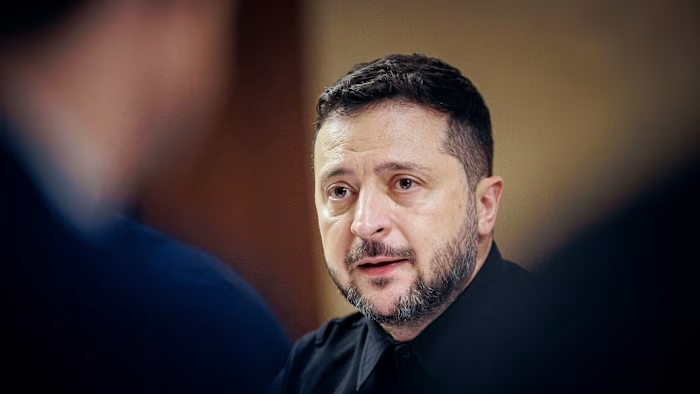
Ukrainian President Volodymyr Zelenskyy has firmly rebuffed calls for wartime elections, a move signaling his intent to prioritize national unity and stability over immediate democratic processes, even as Kyiv grapples with internal political turmoil and formidable economic challenges stemming from Russia’s full-scale invasion. Speaking from his presidential office, Zelenskyy characterized elections during active conflict as a “tsunami for the state” that risked “split[ting] Ukraine apart,” underscoring the deep political and economic ramifications such a divisive process could unleash.
This forceful rejection comes as international financial institutions and donor nations continue to monitor Ukraine’s governance and stability closely, with any perceived political fragmentation having potential implications for the continuity and scale of critical financial and military assistance. Zelenskyy’s stated strategy to “bring the country through to the end of the war, and to preserve an independent and sovereign state” is, in essence, a strategy aimed at maintaining the flow of vital aid, which underpins Ukraine’s macroeconomic stability and sovereign credit outlook.
The President’s remarks were a direct response to a video address by Mykhailo Fedorov, his former defence minister, who had been sacked last month. Fedorov’s blistering denunciation of widespread corruption within the state apparatus, coupled with his call for elections, sent ripples through Kyiv’s political landscape. From a market perspective, allegations of corruption are particularly corrosive; they erode investor confidence, inflate procurement costs, divert funds from essential services, and can jeopardize international aid packages often conditioned on governance reforms and transparency metrics. Such concerns are frequently factored into sovereign credit ratings and the perceived risk premium for Ukrainian assets, influencing borrowing costs and foreign direct investment (FDI) appetite.
Martial law, enacted immediately following Russia’s 2022 invasion, has justifiably suspended all elections. This suspension has garnered broad support among civil society and state officials, who cite the immense practical and logistical challenges of conducting legitimate elections during an active war. The difficulties of facilitating voting for soldiers on the front lines, as well as for the millions of Ukrainians displaced internally or living abroad, pose significant hurdles to electoral integrity. Economically, diverting resources, personnel, and attention to a wartime election could further strain an already stretched national budget and governmental capacity, potentially impacting the efficiency of aid distribution and war efforts, and possibly delaying crucial economic recovery programs.
Fedorov’s dismissal, just six months into his tenure, had already sparked rare wartime protests among segments of civil society and the military, highlighting a simmering discontent that could, if unchecked, lead to political instability. While Fedorov was lauded for his role in turbocharging Ukraine’s domestic drone production and advancing tech-enabled warfare – initiatives that have had tangible economic impacts by enabling long-range strikes on Russian oil facilities and disrupting crucial logistical arteries to Crimea, thereby influencing regional energy and shipping markets – his call for elections alienated even some of his supporters. Dmytro Koziatynskyi, a former combat medic and early Fedorov supporter, publicly stated his “negative” view on wartime elections, reflecting a broader national consensus. A poll in early August by the Kyiv International Institute of Sociology revealed that 57 per cent of Ukrainians believe elections should only occur after a peace agreement and the complete cessation of hostilities, reinforcing the public’s desire for stability over immediate political contests, and by extension, economic predictability.
The appointment of Yevhenii Khmara, former commander of an elite SBU unit, as the new defence minister, succeeding Fedorov, represents an attempt by Kyiv to reassert control and maintain continuity in its defence strategy. However, the shadow of corruption continues to loom large. Fedorov had claimed his dismissal was partly due to resistance to his attempts to clean up corruption within the military — a persistent issue that has long concerned Ukraine’s Western financial backers and contributed to a higher cost of capital for the nation. While Zelenskyy did not directly address Fedorov’s corruption claims, he accused his former minister of overstepping his responsibilities, a subtle acknowledgement of internal friction.
Compounding these political challenges, new corruption investigations have emerged, further unsettling the investment climate. Anti-corruption authorities recently unveiled an alleged scheme involving the laundering of $3.4 million through a state-owned bank to post bail for Herman Halushchenko, Zelenskyy’s former energy minister, who had resigned amid a separate major corruption investigation last year. Zelenskyy’s swift action in firing a top aide implicated in these raids is a crucial signal to international partners about Kyiv’s commitment to combating graft, a key condition for continued financial aid and support for Ukraine’s eventual EU integration. Persistent corruption risks deter foreign direct investment, increase borrowing costs, and can lead to a ‘brain drain’ of skilled labor, all of which impede long-term economic recovery and stifle the growth potential of a post-war Ukraine.
Adding to the nation’s woes, both Russia and Ukraine have intensified strikes on infrastructure far from the frontlines. Russian drone attacks, such as the devastating double-tap strike on a shopping mall in Kryvyi Rih, inflict not only tragic human costs but also significant economic damage, increasing the estimated multi-billion-dollar reconstruction bill and elevating insurance premiums for businesses operating in affected regions. Ukraine’s counter-strikes on Russian infrastructure also contribute to a broader geopolitical risk, impacting global energy markets and supply chains by threatening crucial production and transit facilities.
Financially, Ukraine faces an enormous hurdle: a projected $27 billion deficit for its defence ministry this year. This shortfall, exacerbated by early-year allocations for drone production, highlights the nation’s severe fiscal strain and its overwhelming reliance on external financing. Zelenskyy’s urgent request for 360 interceptor missiles for US-made Patriot anti-air systems – with an ultimate goal of 300 – underscores the high cost of modern warfare and the critical need for sustained Western military aid. A shortage of these sophisticated defense systems has allowed Moscow to inflict greater damage on critical infrastructure, further delaying economic recovery and exacerbating the reconstruction challenge, thereby increasing the ultimate cost to international donors.
The President also revealed attempts to negotiate a ceasefire on long-range strikes in the Black Sea through third parties, aiming to protect vital agricultural export routes. Such a deal would have immediate positive implications for global food security and commodity prices, particularly for grain and oilseeds, potentially alleviating inflationary pressures worldwide. However, Russian President Vladimir Putin’s outright rejection of these “exotic in nature and unacceptable” proposals, coupled with his vow to continue attacks, signals a prolonged period of uncertainty for Black Sea trade and sustained volatility in agricultural markets, directly impacting global food supply chains and consumer prices.
Market Impact:
The confluence of political instability, pervasive corruption concerns, and a significant defense funding gap will likely maintain an elevated risk premium for Ukrainian sovereign debt and the hryvnia, making it more challenging and costly for Kyiv to attract foreign investment. International aid packages, while crucial, may become increasingly conditioned on tangible progress in governance reforms and anti-corruption efforts, impacting the timing and release of critical funds. For global markets, Russia’s rejection of Black Sea ceasefire talks ensures continued volatility in agricultural commodity prices and shipping insurance costs, while intensified infrastructure attacks underscore the persistent geopolitical risk that continues to weigh on energy markets and global supply chains. Investors will closely monitor the flow of Western financial aid, internal political cohesion, and the trajectory of anti-corruption initiatives as key indicators of Ukraine’s economic resilience and future stability, with direct implications for capital allocation in emerging markets and global commodity hedging strategies.