
Royal Navy Engineers Conduct Pioneering Underground Field Hospital Exercise Inspired by Ukrainian War Zones
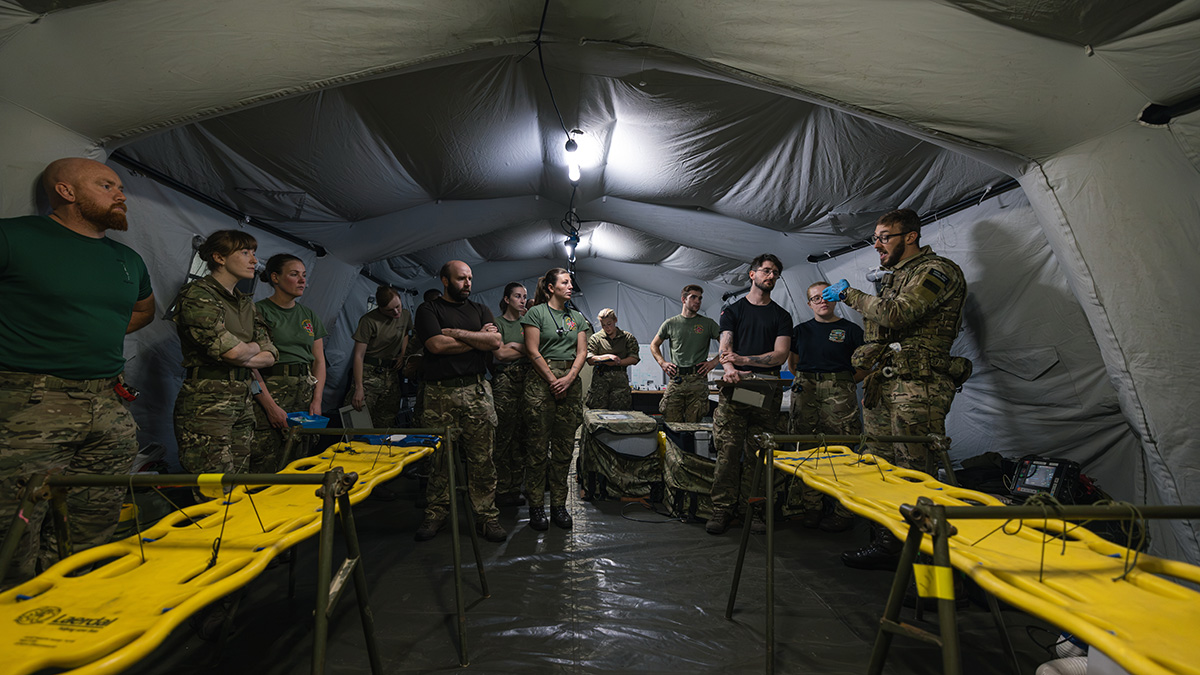
Royal Navy Commando engineers have conducted a significant training exercise near Glasgow, constructing and operating a fully functional subterranean field hospital. This pioneering trial directly applies critical lessons observed from medical teams operating under severe duress in Ukrainian conflict zones, where the necessity of working below ground has become a grim reality. The exercise aims to significantly enhance the survivability and operational effectiveness of medical support for UK forces by developing robust capabilities in environments where traditional above-ground facilities are increasingly vulnerable.
Over six intensive days, soldiers from 24 Commando Royal Engineers meticulously built the underground medical facility at Barnsford Bridge, situated in south-west Scotland, as part of Exercise Strike Warrior. Their efforts involved excavating approximately 243 cubic meters of rock and soil, a volume equivalent to creating a space of twenty square meters – roughly the size of one and a half tennis courts. Once the subterranean structure was complete and secured, medical specialists from the elite Special Operations Surgical Team and the Commando Forward Surgical Group moved in. They then utilized the facility to practice resuscitating and performing simulated surgical procedures on casualties, testing the functionality and limitations of such a unique operational environment.
Chief Petty Officer Ellie Walls of the Commando Forward Surgical Group provided a stark explanation for the necessity of this advanced training.“As an organisation we see the need to develop our ability to build, survive, work and live in these spaces as medics now are not always protected by the Red Cross and can be routinely targeted,”she stated. This observation highlights a troubling shift in modern warfare where international humanitarian law, particularly the protection afforded to medical personnel and facilities by the Red Cross emblem, is frequently disregarded by belligerents. Walls further emphasized the importance of direct experiential learning:“We can look at the lessons learnt from Ukraine and other medical uses of the subterranean space but we have to start experiencing the issues for ourselves to really understand and work through the problem.”She also pointed out the critical, often life-or-death, risk assessment involved:“When looking at using the subterranean space, we have to evaluate if the risks from being below ground outweigh the risks from being above ground.”Furthermore, CPO Walls noted the specific and sensitive demands of patient care in such challenging environments:“However, our demands can be quite specific, we have to take into account the needs of the casualty and ensuring the environment does not negatively impact their outcome.”
From an engineering perspective, Lieutenant Michael Mathers, Access Troop Commander of 54 Commando Squadron, whose troops were responsible for the construction, underscored the invaluable training received.“By designing, constructing, and handing over this facility, our troops gained first-hand experience of the realities of modern peer-on-peer conflict, where survivability, protection, and concealment are critical to success,”Lieutenant Mathers explained. He added that the project provided *“invaluable engineering training across multiple trades, challenging our soldiers to develop new skills and adapt established techniques to a novel environment.”* This included mastering excavation techniques, structural reinforcement, and creating secure access points under simulated combat pressures. Mathers also stressed the continuous learning and adaptation essential for military innovation:“Equally important, it highlighted where we must continue to innovate, ensuring lessons identified are refined, shared, and integrated in future designs and shared across UK Commando Force and the Corps of Royal Engineers.”
Operating a clinical environment within what amounts to a large, excavated trench presented a myriad of unique challenges that traditional tented field hospitals rarely encounter. Significant concerns immediately arose regarding environmental factors such as soil contaminants, bacteria, and pests, all of which could critically compromise patient health and survival rates in a sterile-dependent medical setting. Once the basic facility was handed over, medical teams faced the complex task of establishing full operational capability. This involved devising practical strategies for allocating limited power resources, ensuring the efficient and safe movement of casualties through potentially confined compartments based on the severity of their injuries, and simply navigating the space themselves while attending to patients and managing equipment. Unlike conventional surgical setups, which benefit from consistent light, controlled air circulation, reliable plumbing, electricity, and ample room for movement and resupply, the underground setting severely restricted these fundamental necessities. The exercise also critically examined the psychological and physical effects of working under such confined, demanding, and potentially claustrophobic conditions on the clinicians themselves, understanding that their well-being directly impacts patient care. CPO Walls acknowledged the mixed outcomes of the trial, indicating it was as much a learning experience as a validation:“Whilst it has given us some answers it has generated a lot of questions and thoughts.”Ultimately, the overarching goal remains to enhance patient outcomes under the most extreme conditions:“If we can prepare our equipment and people to work in such areas, we give our patients a better chance of survival.”
The Royal Navy has characterized this subterranean medical facility as a vital prototype. Its development is part of a broader, concerted initiative to research, trial, and ultimately standardize underground medical and support facilities for operational deployment across the entire UK Commando Force and the wider Corps of Royal Engineers. The long-term strategic objective is to evolve this nascent concept through further refinement and testing, ultimately achieving full operational capability and integrating subterranean medical support as a standard practice within frontline and rear-area operations.
This urgent adaptation is a direct response to the profound transformation in the nature of modern warfare. The widespread proliferation of small, sophisticated attack drones and highly destructive loitering munitions has dramatically altered the battlefield landscape. Areas traditionally considered relatively safe, located behind the immediate front lines, are now as vulnerable and dangerous as the front itself. Consequently, in contemporary conflicts globally, both sides have increasingly been compelled to move critical functions – including stabilization points, casualty collection stations, and essential surgical operations – into protected underground locations. These include pre-existing cellars, purpose-built dugouts, and fortified bunkers, all aimed at enhancing survivability for both personnel and patients, and maintaining continuous operational effectiveness in high-threat environments.
Why This Matters
The Royal Navy’s exercise in constructing and operating an underground field hospital represents a critical adaptation to the evolving realities of 21st-century warfare. This initiative holds significant implications for military doctrine, humanitarian aid, and the protection of medical personnel in conflict zones worldwide.
Firstly, it underscores a troubling shift in modern conflicts: the increasing targeting of medical facilities and personnel. As Chief Petty Officer Ellie Walls highlighted, the traditional protections afforded by international humanitarian law, symbolized by the Red Cross, are frequently disregarded. This necessitates a proactive approach by military forces to secure their medical infrastructure, ensuring that life-saving care can continue even under direct attack. The lessons drawn from Ukrainian medics operating underground against persistent aerial threats serve as a stark global precedent, demonstrating that adaptability is paramount for survival and effectiveness.
Secondly, this exercise signifies a broader strategic shift towards survivability and concealment in what military planners refer to as “peer-on-peer conflict.” The proliferation of advanced technologies like small attack drones and loitering munitions has eradicated the traditional safety of rear areas, making all parts of the battlefield potentially lethal. By moving critical medical operations underground, forces can mitigate these threats, protecting both their personnel and the wounded, thereby preserving combat effectiveness and morale. It reflects a future battlefield where basic infrastructure must be capable of enduring sustained, high-intensity attacks.
Thirdly, the challenges identified during the exercise – from managing environmental contaminants to ensuring adequate power and space in confined settings – will drive innovation in military engineering and medical logistics. This hands-on experience provides invaluable data for developing new equipment, refining operational procedures, and training personnel for highly demanding environments. The insights gained are not merely for the UK Commando Force but could inform best practices and technological advancements for allied nations facing similar threats, potentially standardizing subterranean medical capabilities across NATO and other international partnerships.
Finally, beyond military application, this development touches upon the ethical imperative of providing care in warzones. By enhancing the ability to save lives under extreme conditions, such initiatives contribute to the broader humanitarian effort to alleviate suffering in conflict. It sends a message that despite the brutality of modern warfare, efforts to protect the wounded and those who heal them remain a priority, adapting to ensure that medical care can reach those who need it most, even when it means literally going underground.