
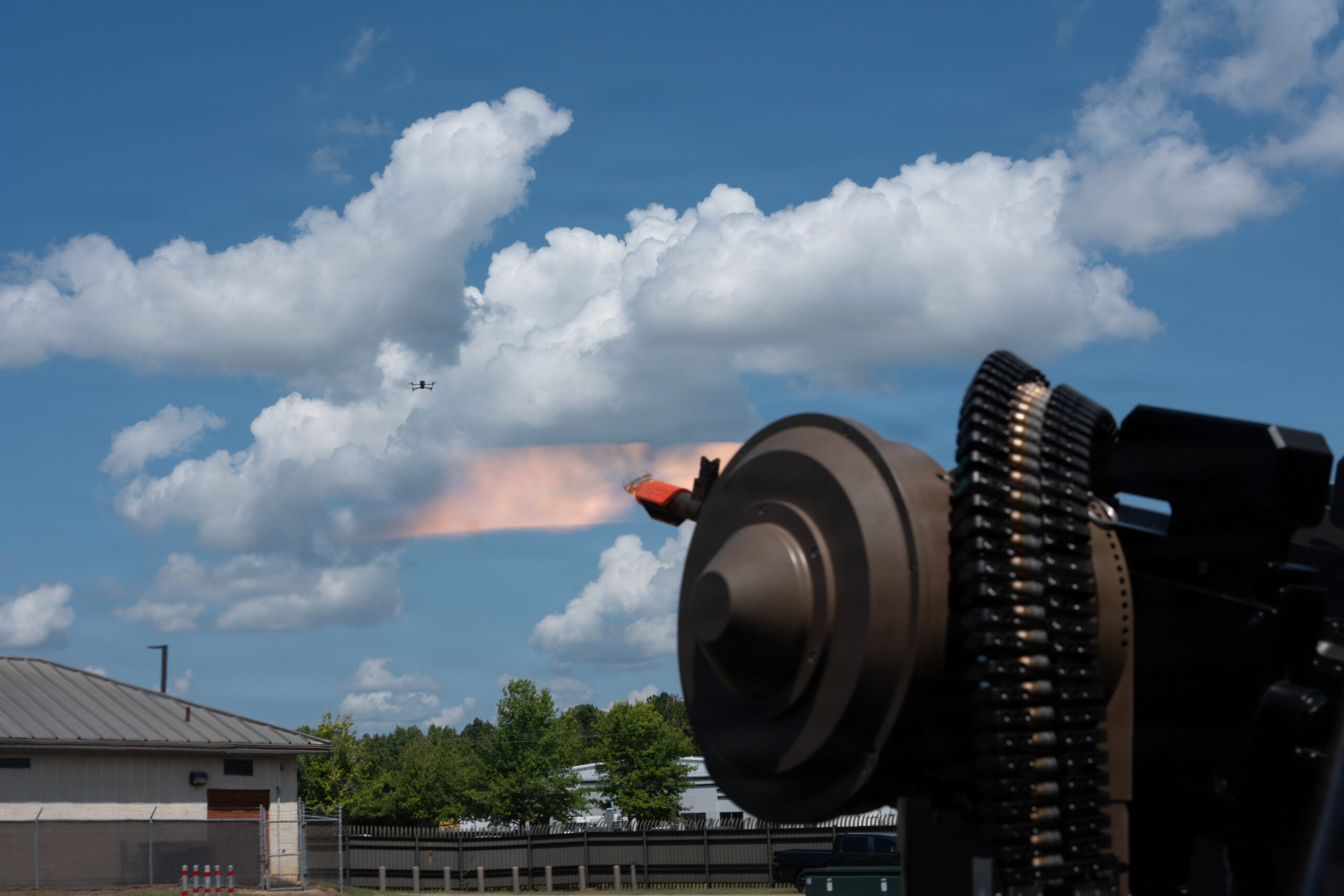
Air Combat Command (ACC) is seeking proposals from private defense firms to provide a comprehensive counter-drone service, including the necessary personnel, to defend U.S. Air Force installations. This initiative represents a strategic pivot towards leveraging commercial capabilities for critical base defense operations across the service.
ACC, which oversees the Air Force’s specialized Point Defense Task Force, has initiated a market survey to identify companies capable of delivering “Counter-Small Unmanned Aerial Systems (C-sUAS) as a Service.” This was outlined in an Oct. 13 solicitation, inviting industry partners to demonstrate their expertise in combating the growing threat posed by various types of drones.
According to the official solicitation document, the core objectives of implementing this service model are multifaceted:
- To establish organic, resilient, sustainable, and agile Point Defense capabilities across all Department of the Air Force installations. This aims to ensure a robust and independently operable defense posture.
- To deploy a flexible, scalable architecture that enables installations to dynamically adjust their operational capacity, either increasing or decreasing it, in response to evolving and fluid threat levels.
- To prioritize the integration of mature, commercially available, or readily adaptable systems. This approach seeks to bypass the often lengthy and high-risk developmental programs typically associated with military procurement, favoring rapid deployment of proven technology.
This market survey underscores the U.S. Air Force’s accelerated efforts to develop and deploy a robust arsenal of capabilities specifically designed to defend its crucial installations against the escalating threat of drone attacks. The global proliferation of unmanned aerial systems, from inexpensive commercial quadcopters to more sophisticated military-grade drones, has necessitated a rapid adaptation in defense strategies.
“The Government envisions an initial prototype deployment at two designated Continental United States Air Force installations, with option mechanisms to scale across additional ACC installations upon proven performance,” the document explicitly states. This phased approach allows for rigorous testing and validation of the commercial service model before wider implementation, ensuring effectiveness and integration into existing defense protocols.
Defense firms interested in participating had until Oct. 31 to respond to the solicitation. ACC’s requirements are extensive, targeting companies that can provide advanced technology for detecting, tracking, and accurately identifying a wide spectrum of drones. This ranges from compact quadcopters, often used for reconnaissance or delivering small payloads, to larger Group 3 systems. An example cited is the Iranian Shahed one-way attack drones, which can weigh up to 1,320 pounds and pose a significant threat due to their range and destructive potential. The desired detection range for these systems is up to five miles from a base perimeter, providing ample warning and response time.
Beyond detection, firms are also expected to demonstrate their capability to incorporate “government-approved kinetic and/or nonkinetic” effectors. Kinetic effectors involve physical interception or destruction, such as interceptor drones or specialized projectiles. Non-kinetic effectors, conversely, include sophisticated electronic warfare measures like radio frequency (RF) jamming to disrupt drone control signals, or directed-energy systems such as high-powered lasers and microwave systems capable of disabling or destroying incoming threats without physical contact. The solicitation emphasizes the importance of continuous software and hardware refresh within a multi-year service contract, aiming to avoid frequent contract modifications and ensure the systems remain at the technological forefront.
Furthermore, ACC requires that any commercial capability proposed must include built-in logistical support, enabling it to be entirely self-sufficient for up to 96 hours. This critical requirement ensures that base defenses can remain operational even during periods when external resupply or support might be temporarily unavailable, enhancing resilience in contested environments.
The overarching concept mandates that the chosen contractor “provide a complete, integrated, turn-key service solution covering materiel, personnel, training, sustainment, and ongoing modernization,” as detailed in the solicitation. This “as a Service” model offloads significant responsibilities from the military, placing the onus on the private sector to deliver a fully operational and continuously updated defense capability.
An intriguing aspect of this commercial outsourcing initiative is its alignment, or potential lack thereof, with the Air Force’s broader strategy to establish a new point defense career field for enlisted Airmen. This new specialty aims to train and equip uniformed personnel specifically to defend air bases from both drone and missile attacks. The Air Force is currently scheduled to begin designating Airmen with this new specialty within the next two years. In the interim, the service has established “point defense flights,” which are specialized units, each comprising approximately 20 Airmen, rigorously trained for rapid deployment to potential hotspots and for defending air bases against drone incursions. The interaction between these military units and commercially operated defense systems remains a key area for clarification as the program progresses.
Currently, the Air Force is equipping its installations with the Small Unmanned Air Defense Systems (SUADS) for countering drones. This system is designed to identify and track enemy missiles or drones of various sizes and can neutralize incoming drones using an electronic warfare weapon. For missile threats, SUADS employs both electronic warfare and kinetic effectors. Its modular design allows it to interface seamlessly with existing commercial counter-drone systems and other air defense networks, providing commanders with flexible defensive options tailored to specific needs.
The service is also actively acquiring additional counter-drone systems through the Pentagon’s Joint Interagency Task Force 401, a broader collaborative effort to enhance defensive capabilities. In the future, all counter-drone technology will be managed under a unified “point defense weapon system” classification. This comprehensive framework will integrate various components, including advanced sensors, radars, sophisticated command and control architecture, and a range of kinetic and non-kinetic effectors, all designed to disable or destroy incoming drones effectively.
Why This Matters
The U.S. Air Force’s pursuit of “C-sUAS as a Service” marks a significant evolution in military doctrine and procurement, reflecting a critical adaptation to the rapidly changing global security landscape. The proliferation of unmanned aerial systems has transformed warfare, making even critical military infrastructure vulnerable to inexpensive, easily acquired, and often difficult-to-detect threats. From commercial quadcopters used for reconnaissance to sophisticated weaponized drones employed by state and non-state actors alike, the spectrum of drone threats is vast and ever-expanding, as demonstrated in conflicts from Ukraine to the Middle East.
This initiative directly addresses the imperative to protect air bases, which serve as vital hubs for projecting airpower, sustaining global operations, and safeguarding personnel and high-value assets. A successful drone attack on an air base could severely disrupt operations, inflict casualties, and damage critical equipment, underscoring the urgency of robust and adaptive defenses. By outsourcing key aspects of counter-drone defense to private firms, the Air Force seeks to leverage the rapid innovation cycles and specialized expertise of the commercial sector. This “as a service” model could enable faster deployment of cutting-edge technology, sidestepping lengthy military acquisition processes and ensuring defenses remain current against quickly evolving threats.
Economically, this approach could offer cost efficiencies by shifting the burden of research, development, maintenance, and continuous modernization to contractors, potentially freeing up military resources and personnel for core combat missions. However, it also raises important questions about the integration of private contractors with uniformed personnel, particularly concerning the Air Force’s concurrent efforts to establish a new enlisted career field for point defense. The success of this dual-track strategy will depend on clear delineation of roles, seamless operational integration, and effective command and control structures.
Strategically, this move signals a broader recognition that modern air defense must extend beyond countering traditional aircraft and missile threats to encompass a layered, resilient defense against asymmetric drone attacks. It highlights a critical shift towards a future where persistent, low-cost aerial threats necessitate flexible, scalable, and technologically agile defensive solutions. For the defense industry, this opens a substantial market opportunity, driving innovation in counter-drone technologies and services. Ultimately, the success of this program will have far-reaching implications for how military installations are protected globally, shaping future defense strategies against one of the most pervasive threats in modern warfare.