
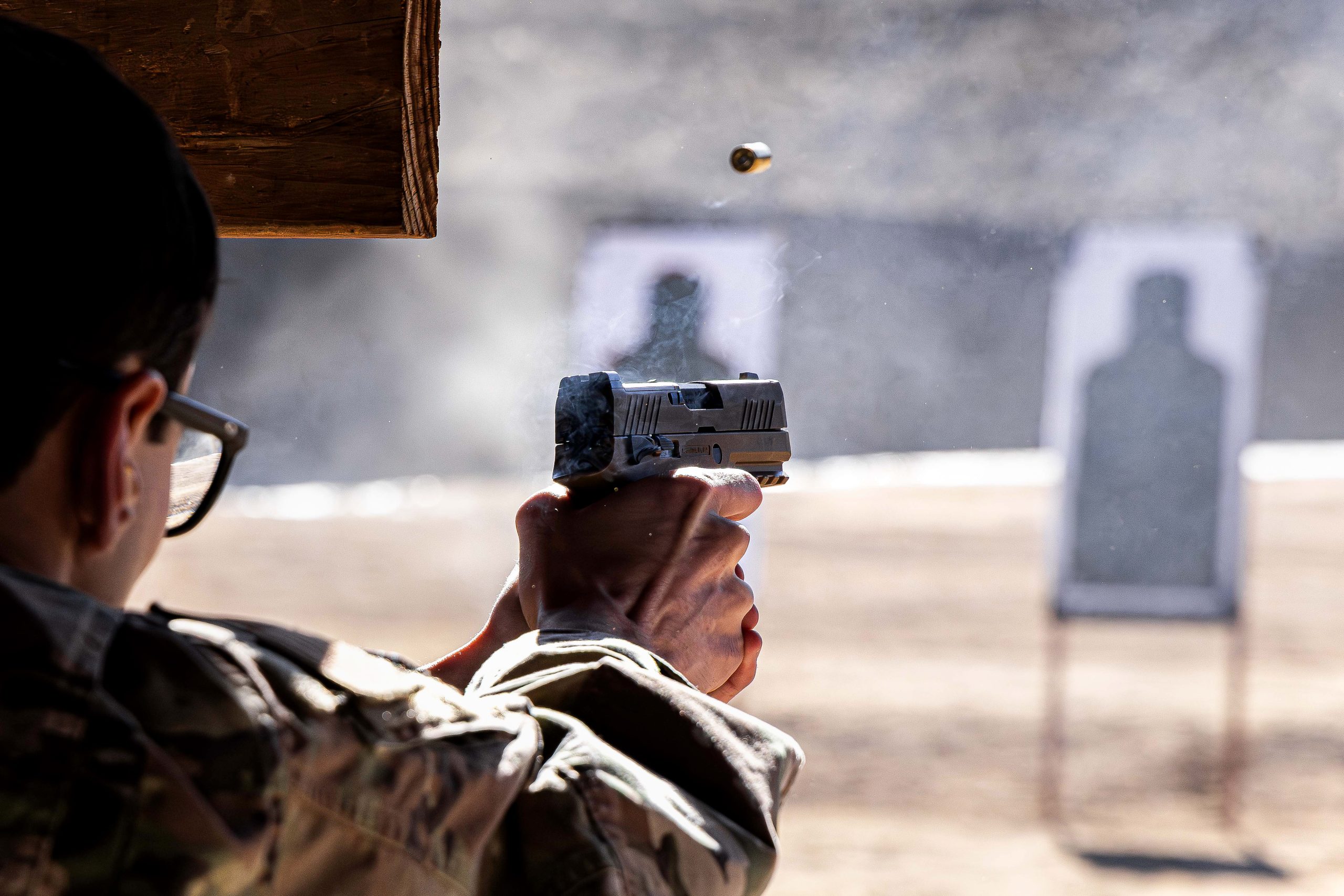
The U.S. Air Force has officially declared its M18 service pistol “safe and reliable” following a comprehensive, force-wide inspection of more than 100,000 of the 9mm firearms. The findings, announced on September 2, affirm the weapon’s integrity after an incident on July 20, 2025, where an M18 discharge resulted in the death of an on-duty security forces Airman at F.E. Warren Air Force Base in Wyoming, initially raising significant safety concerns.
The tragic death of 21-year-old Airman Brayden Lovan was initially investigated as a potential accidental discharge, prompting an immediate reevaluation of the M18’s safety. The M18 is a military variant of the Sig Sauer P320, a striker-fired pistol that has been the subject of multiple lawsuits, primarily from law enforcement officers, alleging that the P320 series firearms can discharge unintentionally without the trigger being pulled.
In response to these concerns and Lovan’s death, Air Force Global Strike Command initiated its own investigation and temporarily prohibited its personnel from using the M18. Shortly thereafter, the Air Force expanded this inquiry into a service-wide inspection of all “in-use” M18 pistols. Global Strike Command reinstated the pistol for use in late August 2025, following its initial inspection results.
More than a year after the initial incident, the Air Force released the comprehensive results of its inspections, though the official report itself is dated January 23. As of that date, the service had inspected 113,479 of its 117,864 M18 pistols designated as “in-use.” The Air Force’s total inventory includes 125,917 M18s, with an additional 8,053 units remaining in storage at a depot in Alabama, not currently in active service.
The inspection yielded overwhelmingly positive results regarding the pistols’ condition. Out of the 113,479 M18s examined, 111,893—approximately 98.6 percent—were deemed “satisfactory.” The remaining 1,586 pistols, representing about 1.4 percent of the inspected inventory, were categorized as “other than satisfactory” due to minor issues such as “lightly pitted” parts or conditions requiring adjustment. These findings were attributed to normal operational wear and tear.
The report clarified that “some weapons displayed normal wear and tear commensurate with their usage schedule and high rates of manual functioning for skill building during classroom training and daily arming.” The Air Force has committed to or has already returned these 1,586 pistols to “serviceable” condition through standard maintenance procedures, emphasizing that these issues were routine and not indicative of a fundamental design flaw.
The inspection process also accounted for 4,385 “in-use” M18s that had not yet been inspected because they were in extended, “sealed” storage. The report mandates that commands responsible for these pistols complete their inspections. “Subject matter experts have a high degree of confidence that these final inspections will yield similar findings as the rest of the inventory,” the report stated, anticipating consistent results across the remaining units.
Crucially, the report concluded that “100 percent of the inspected weapons exhibited no signs of any condition that could have allowed the weapons to experience an ‘uncommanded discharge.’” This finding directly addresses the core safety concern that prompted the extensive review.
Further investigations into Airman Lovan’s July 20, 2025, shooting revealed that his death was not due to an accidental discharge caused by a weapon malfunction. Criminal investigators determined that Airman 1st Class Marcus White-Allen, along with two other Airmen, had fabricated a story to conceal the true circumstances of Lovan’s death. Laboratory tests conducted on White-Allen’s duty-issued M18 pistol “determined there were no defects in White-Allen’s duty-issued weapon,” according to the Air Force statement. Evidence gathered during the investigation indicated that “White-Allen had his finger on the trigger as he placed the firearm on Lovan’s chest,” suggesting human action rather than a mechanical failure as the cause of discharge.
Authorities arrested White-Allen in early August and charged him with involuntary manslaughter, obstruction of justice, and making a false official statement. On October 8, White-Allen was tragically found dead in his dormitory, with details surrounding his death remaining unclear and undisclosed by the Air Force.
The other two Airmen involved in the cover-up, Airman 1st Class Sarbjot Badesha and Airman 1st Class Matthew Rodriguez, faced legal consequences for their roles. On October 30-31, during summary courts martial proceedings, both pleaded guilty to making false statements about the shooting. The Air Force announced on October 31 that Badesha was sentenced to 30 days of confinement, a reduction in rank to E-1, and a fine of $1,545. Rodriguez received a sentence of 10 days of confinement, 15 days of restriction to base, a reduction in rank to E-2, and a $500 fine.
Why This Matters
The Air Force’s extensive investigation and subsequent declaration of the M18 pistol as “safe and reliable” holds significant implications across several domains. For the thousands of Airmen and Guardians who carry this weapon, the official pronouncement aims to restore confidence in their standard-issue sidearm, which is critical for morale, training, and operational readiness. The detailed inspection process, covering nearly 114,000 pistols, demonstrates a commitment to military personnel safety and addresses concerns that could have otherwise undermined trust in their equipment.
Furthermore, this report directly impacts the reputation and commercial standing of Sig Sauer, the manufacturer of the P320 series on which the M18 is based. With multiple civilian lawsuits alleging unintentional discharges of the P320, a finding of a systemic defect in the military variant could have triggered widespread recalls, substantial financial penalties, and significant damage to the company’s credibility. The Air Force’s findings, which attribute the specific fatal incident to human error rather than a weapon malfunction, offer a degree of vindication for the manufacturer in this military context.
Beyond the weapon itself, the full account of Airman Lovan’s death underscores the paramount importance of strict adherence to safety protocols and proper weapon handling in all military environments. The shift in focus from potential equipment failure to individual misconduct highlights that even with reliable firearms, human factors, including negligence and the deliberate subversion of safety procedures, remain critical risks. This revelation reinforces the ongoing need for rigorous training, supervision, and a culture of accountability within military ranks.
Finally, the comprehensive nature of the Air Force’s response—from launching a service-wide inspection to conducting a criminal investigation and pursuing military justice against those involved in a cover-up—demonstrates the military’s robust system for addressing serious incidents. This transparency and commitment to accountability are vital for maintaining public trust in military institutions and ensuring justice for victims and their families, even when the underlying causes are complex and involve multiple human elements.