
Audio of this article is brought to you by the Air & Space Forces Association, honoring and supporting our Airmen, Guardians, and their families. Find out more at afa.org
The U.S. Air Force has officially launched “Dragon Cart,” a new program designed to transform its fleet of cargo planes, such as the C-17 Globemaster III and C-130 Hercules, into airborne strike platforms. This initiative, years in the making, aims to equip mobility aircraft with palletized munitions, with the first operational fielding anticipated in 2027.
The Air Force Life Cycle Management Center (AFLCMC) recently announced the establishment of Dragon Cart as a program of record. This marks a significant step from conceptual development to an acquisition program focused on operationalizing the innovative weapon delivery method.
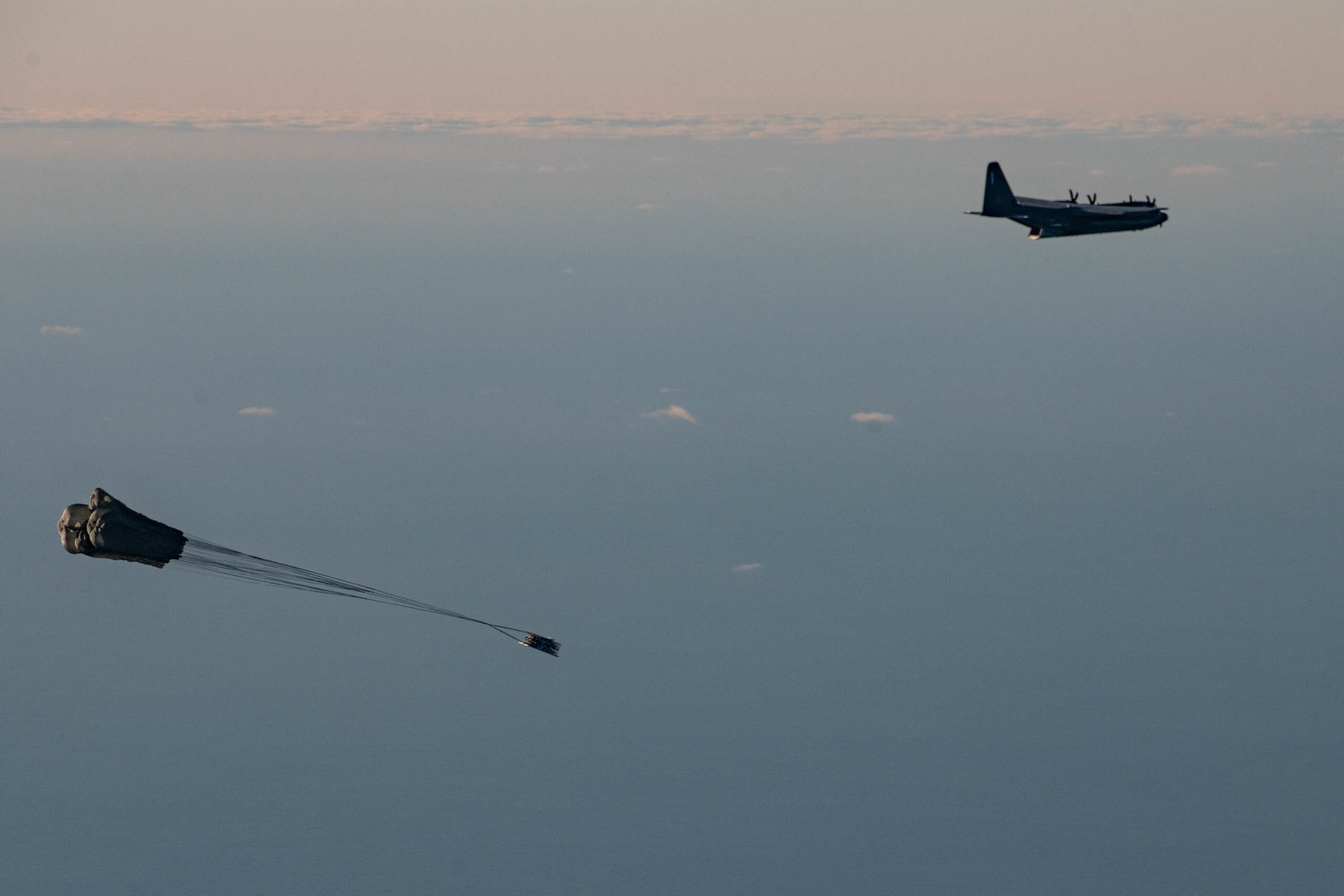
The core concept behind palletized munitions involves integrating a specialized container, loaded with multiple cruise missiles, onto a standard airdrop platform. Once released from the cargo aircraft, the container deploys its parachute, stabilizing its descent. Subsequently, the weapons inside are launched, ignite their engines, pull up from their freefall trajectory, and proceed towards their pre-programmed targets. This method leverages existing airlift capabilities for offensive strike missions, offering a novel approach to force projection.
The foundation for Dragon Cart was laid by the Air Force Research Laboratory (AFRL) through its “Rapid Dragon” program. Rapid Dragon explored the technical feasibility of this concept, and now Dragon Cart is tasked with maturing and operationalizing it for widespread use within the Air Force.
JiaJia Lee, the newly appointed Dragon Cart program manager, emphasized the strategic advantages of this new capability in an AFLCMC release. “This program provides the operational ambiguity, adversary deterrence, and additional command options to maximize operational effects,” Lee stated. “It gives us the option to transform mobility aircraft into powerful strike platforms, unlocking capabilities we wouldn’t normally have in how we employ our airlift fleet.”
Air Force officials highlight several key benefits of employing palletized munitions. These include the ability to saturate enemy airspace with a high volume of weapons, thereby complicating adversary targeting solutions and potentially overwhelming air defense systems. The system is also expected to provide open access to targets that might otherwise be difficult to reach, and to deplete an opponent’s finite air defense missile stockpiles by forcing them to engage numerous incoming threats.
The program is progressing rapidly, with officials expecting to award initial prototype contracts for Dragon Cart in late May. The ultimate goal remains to achieve initial operational capability by 2027, integrating this new strike capability into the Air Force’s strategic arsenal.
A notable aspect of the Dragon Cart program is its emphasis on government control over technical requirements and data rights. This approach is intended to provide inherent flexibility as the Air Force continues to develop and refine the technology. Kent Mueller, the systems engineering program manager and program architect, described Dragon Cart as a “born digital” system, developed entirely within Model-Based Systems Engineering (MBSE) models.
“Because we own the engineering, if a new payload needs a launch module that is slightly longer, we just model it, do the load path analysis, and send that model to our production vendors,” Mueller explained. This “born digital” methodology promises faster adaptation, reduced development costs, and greater agility in incorporating future weapon technologies.
A Cheaper Way to Project Power
Dragon Cart is part of a broader strategic effort by the Air Force to find more cost-effective ways to expand its munitions inventory and enhance its strike capabilities. This drive for “affordable mass” is a key component of the service’s modernization plans, particularly in an era of renewed focus on peer competition.
In recent years, the Air Force unveiled its “Family of Affordable Mass Munitions” (FAMM) program, which encompasses a wide array of missiles and bombs. Cruise missiles, which Dragon Cart will utilize, represent one critical category within this program. Budget documents indicate the Air Force’s intention to invest approximately $12 billion to procure nearly 28,000 inexpensive cruise missiles over the next five years. These acquisitions will include both “lugged” missiles, which are carried directly by fighter or bomber aircraft, and “palletized” munitions designed for release from mobility aircraft like those involved in Dragon Cart.
The precursor “Rapid Dragon” program conducted several successful tests on both C-130 and C-17 aircraft, including a significant live-fire test at Eglin Air Force Base, Florida, in December 2021. The program’s name itself draws inspiration from history: an ancient Chinese military crossbow catapult known as “Ji Long Che” or “Rapid Dragon Carts,” which could launch multiple bolts simultaneously over great distances.
Past experiments with the Rapid Dragon concept demonstrated varying weapon configurations, including a six-missile setup on the C-130 and a nine-missile configuration on the larger C-17. One specific test involved an Air Force Special Operations Command MC-130J Commando II aircraft dropping a four-cell pallet containing a single live cruise missile and three simulated weapons, further validating the operational feasibility of the system.
Initiated in 2019, the Rapid Dragon program eventually transitioned from AFRL to the Defense Innovation Unit (DIU). There, it became part of a larger initiative called “Franklin,” which aimed to develop long-range fires at an ambitious cost target of $100,000 per round.
Looking ahead, the Air Force continues to explore advanced capabilities. A late-April AFLCMC notice to industry sought information on an affordable cruise missile capable of flying more than 1,200 miles. This future munition, dubbed FAMM-Beyond Adversary Reach (FAMM-BAR), must have the option to be either lugged or palletized, signifying the Air Force’s commitment to flexible weapon delivery methods. Current FAMM efforts are focused on missiles with ranges between 250 and 500 miles, making FAMM-BAR a significant leap in potential operational reach.
Why This Matters
The establishment of the Dragon Cart program represents a pivotal shift in military aviation strategy, with profound implications for global power projection, deterrence, and the future of warfare. This initiative transforms traditionally non-combat cargo aircraft into versatile strike platforms, fundamentally altering their role from logistics support to direct offensive capability. This flexibility means that large, relatively ubiquitous transport aircraft can now contribute to strike missions, significantly expanding the number of potential launch platforms and making it harder for adversaries to predict and counter U.S. airpower.
From a strategic deterrence perspective, Dragon Cart introduces considerable operational ambiguity for potential adversaries. By enabling cargo planes to launch cruise missiles, the program complicates enemy intelligence gathering and targeting solutions. Instead of only tracking bomber or fighter bases, an adversary must now consider a much wider array of potential launch points, including airfields typically used for transport operations or even remote locations. This increased unpredictability enhances deterrence by presenting a more complex and resilient threat.
The program is also central to the Air Force’s broader strategy of acquiring “affordable mass munitions.” In an era of renewed great power competition, the ability to produce and deploy a high volume of relatively inexpensive missiles is crucial. It allows for saturation attacks designed to overwhelm sophisticated enemy air defense systems, thereby creating windows of opportunity for more advanced, high-value aircraft and munitions. This approach reduces the reliance on extremely expensive, low-inventory specialized strike assets for every mission, making U.S. airpower more sustainable and adaptable in a protracted conflict.
Furthermore, Dragon Cart exemplifies a move towards “distributed lethality” in air warfare. By diversifying missile launch platforms, the Air Force reduces its vulnerability to a single point of failure. If traditional airbases or bomber fleets are targeted, the ability to launch strikes from numerous cargo planes ensures that offensive capabilities remain intact. This distribution of power makes the U.S. military more resilient and its strike capacity more robust against sophisticated anti-access/area denial (A2/AD) strategies.
Technologically, Dragon Cart’s “born digital” development approach and emphasis on government control of engineering data are groundbreaking. This model promises greater agility in design, faster iteration of capabilities, and reduced dependence on external contractors for future modifications. It sets a precedent for how the Department of Defense can rapidly develop and adapt complex weapons systems, potentially accelerating innovation across other programs.
In essence, Dragon Cart is more than just a new weapons system; it is a strategic enabler that redefines the utility of existing assets, enhances deterrence through unpredictability, and aligns with a future vision of agile, distributed, and cost-effective airpower. Its successful implementation could significantly bolster the U.S. military’s ability to project power, deter aggression, and operate effectively in contested environments globally.
Audio of this article is brought to you by the Air & Space Forces Association, honoring and supporting our Airmen, Guardians, and their families. Find out more at afa.org