
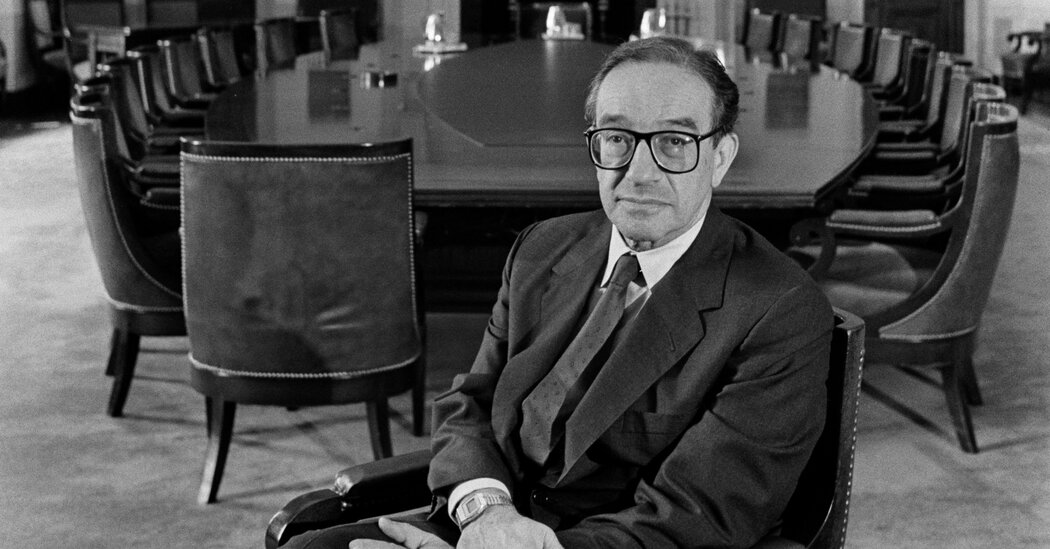
Alan Greenspan, a towering figure in global economic policy who served for nearly two decades as Chairman of the Federal Reserve, died on Monday at his home in Washington. He was 100 years old. His wife, Andrea Mitchell, the chief Washington correspondent and chief foreign affairs correspondent for NBC News, confirmed in a statement that the cause of death was complications from Parkinson’s disease.
Greenspan’s tenure as the head of the United States’ central bank, from 1987 to 2006, spanned a remarkable period of economic expansion and several significant financial crises. He served under four U.S. presidents—Ronald Reagan, George H.W. Bush, Bill Clinton, and George W. Bush—garnering reappointments from both Republican and Democratic administrations, a testament to his perceived influence and indispensability at the time.
During much of his chairmanship, Greenspan was widely regarded as the pre-eminent economic policymaker of his era, synonymous with a period of American prosperity following the end of the Cold War. His economic philosophy, deeply rooted in free-market principles and a belief in the power of technological innovation, advocated for minimal regulation and trusted markets to efficiently allocate resources and improve living standards.
However, the very ideological foundations that defined his leadership later became subjects of intense scrutiny and criticism. His era saw significant deregulation of the banking sector and Wall Street, alongside the increasing complexity of financial instruments. Critics argued that these policies, coupled with his reluctance to intervene in what he recognized as burgeoning asset bubbles in the stock and housing markets, laid the groundwork for future economic instability.
While Greenspan was lauded for his adept management of interest rates, which helped maintain consistent economic growth and low inflation—a period often referred to as “The Great Moderation”—he also expressed reservations about the potential for speculative excesses fueled by this easy-money environment. Despite these concerns, he largely refrained from imposing direct regulatory measures on financial institutions, even as they adopted increasingly complex and ultimately risky trading techniques.
A key achievement credited to Greenspan was his ability to navigate the U.S. economy through several severe shocks. Just weeks into his tenure in October 1987, he faced a sudden stock market crash, responding decisively by assuring liquidity to the financial system, a move widely credited with preventing a deeper crisis. A decade later, he helped steer the economy through the near-meltdown of Asian financial markets in 1997-1998 and later managed the economic fallout from the September 11, 2001 terrorist attacks, again by acting swiftly to provide stability.
The most profound challenges to his legacy emerged only after his retirement in early 2006, particularly following the 2008 global financial crisis, the collapse of the mortgage market, and the ensuing deep recession. In the wake of these events, his philosophy and policy choices became the subject of extensive and often scathing re-evaluation.
A significant portion of criticism focused on his failure to proactively address the escalating housing bubble by raising interest rates more aggressively, or by using regulatory tools to cool an overheating market. Other critics argued that his unwavering commitment to free-market fundamentalism fostered an environment where the financial system operated with insufficient checks and balances, leading to the adoption of excessively risky practices that ultimately destabilized the global economy. Consequently, a figure once celebrated for immense wealth creation became, for many, a central figure accountable for the 2008 crisis and its widespread economic and political repercussions.
Sebastian Mallaby, Greenspan’s biographer, summarized a key critique, concluding that his “most consequential error, one that he did not have to make,” was his failure to prioritize financial stability once inflation was under control. Despite the intense debate surrounding his record, there is consensus that Alan Greenspan was a pivotal figure during a transformative period in economic history, marked by both immense growth and significant ideological struggles over economic management.
At the height of his influence in the late 1990s, during the dot-com boom, Greenspan’s public pronouncements were keenly dissected by global markets, often leading to immediate and significant shifts in stock prices. His distinctive public speaking style, characterized by dense, often elliptical economic jargon, was famously dubbed “Greenspanese” and was frequently a source of amusement and frustration, even for fellow economists.
Behind the scenes in Washington, Greenspan was a highly effective political operator. Drawing lessons from his experiences as a policy adviser during Richard M. Nixon’s 1968 presidential campaign and later as President Gerald R. Ford’s chief economic adviser, he developed a shrewd ability to protect the Federal Reserve’s crucial independence while influencing the economic agendas of successive administrations and guiding legislation through Capitol Hill.
Greenspan inherited a Federal Reserve with considerable credibility, largely thanks to his predecessor, Paul A. Volcker, who had demonstrated the central bank’s resolve to combat inflation, even in the face of political pressure, through a tight-money policy in the late 1970s and early 1980s. This strong foundation provided Greenspan with significant latitude to shape monetary policy and wield broader influence.
A lifelong Republican with strong libertarian leanings—he was an early acolyte of Objectivist philosopher Ayn Rand—Greenspan was appointed to the Fed by President Ronald Reagan. Despite his party affiliation, he often found himself at odds with members of both parties. His willingness to weigh in on issues beyond the Fed’s immediate mandate, such as tax policy, the budget deficit, and trade, underscored his pervasive influence.
For instance, allies of President George H.W. Bush partly attributed Bush’s 1992 re-election loss to Greenspan’s perceived reluctance to lower interest rates more aggressively as the economy emerged from recession. Conversely, Greenspan cultivated close ties with President Bill Clinton and his team, influencing the Democratic administration towards a market-friendly approach to financial regulation and advocating for deficit reduction early in Clinton’s term, sometimes over objections from liberal Democrats.
However, his support for President George W. Bush’s significant income tax cut package in 2001 drew sharp criticism from Democrats, who accused him of abandoning his previous commitment to fiscal prudence to align with the new Republican administration.
The Washington Life
Beyond his professional duties, Alan Greenspan was a ubiquitous and influential figure in Washington’s social circles. He was known for his genial yet reserved demeanor, frequently mingling with Supreme Court justices, cabinet secretaries, and journalists at various functions, always identifiable by his characteristic amused smile and soft handshake.
His personal life occasionally intersected with public interest. He dated veteran journalist Barbara Walters in the late 1970s, an experience he later referenced in his autobiography, stating, “I’m not threatened by a powerful woman.” In 1997, he married Andrea Mitchell, NBC News’ chief Washington correspondent, who famously quipped that he never fully earned her forgiveness for discussing antitrust policy on their first date many years prior.
Why This Matters
Alan Greenspan’s death marks the passing of an economist whose profound influence shaped the global financial landscape for decades, and whose legacy continues to be debated and analyzed. His nearly two-decade tenure at the helm of the Federal Reserve coincided with a period of unprecedented economic transformation, from the rise of technology-driven productivity to the increasing globalization of financial markets.
His story is critical because it highlights the immense power and responsibility vested in the chairman of a central bank, particularly in the world’s largest economy. Greenspan’s decisions on interest rates, his approach to financial regulation, and his broader economic philosophy directly impacted the prosperity of millions, the stability of markets, and the trajectory of U.S. economic policy. The “Greenspan era” serves as a crucial case study in the ongoing debate between market-led growth and the necessity of robust regulatory oversight.
The criticisms leveled against him, especially in the aftermath of the 2008 financial crisis, underscore vital lessons about the potential dangers of unchecked financial innovation and the formation of asset bubbles. His reluctance to use the Fed’s regulatory powers to cool speculative markets is a central point of contention that continues to inform current economic policy discussions and regulatory frameworks worldwide. It emphasizes the complex trade-offs central bankers face between fostering growth and maintaining financial stability.
Furthermore, Greenspan’s adept political maneuvering and his ability to maintain the Federal Reserve’s independence while influencing multiple presidential administrations provide a valuable lesson in the practicalities of governance and the delicate balance between technocratic expertise and political realities. His life and career remain a touchstone for understanding the evolution of modern capitalism, the role of central banking, and the perpetual challenge of balancing economic freedom with stability.
Alan Greenspan, who served as Chairman of the United States Federal Reserve for 18 years, from 1987 to 2006, played a central role in global economic policy during a transformative period. His extensive tenure spanned four presidential administrations and witnessed significant economic shifts, including periods of sustained growth and emerging financial vulnerabilities.
Mr. Greenspan was married to journalist Andrea Mitchell, with their wedding notably presided over by Justice Ruth Bader Ginsburg. Ms. Mitchell is his only immediate survivor. Beyond his professional life, he was known as an avid tennis player, developing a passion for the sport on the White House court during his service in the Ford administration and continuing competitive play into his 80s against various senior officials and Treasury secretaries from both political parties.
Mr. Greenspan’s approach to central banking was characterized by a departure from rigid formulas and rules often employed by his peers. Instead, he favored an intuitive methodology, predicated on deep and continuous analysis of vast data concerning decisions made by businesses, consumers, and investors. He once noted that some of his most effective thinking occurred during quiet reflection, such as while soaking in a hot bath, highlighting his unconventional analytical style.
During his time at the Fed, he identified a confluence of powerful economic forces, notably rapid technological advancements and intensified global competition. He posited that these forces were fundamentally altering the inflation outlook and, consequently, the economy’s capacity to grow and generate employment without creating undue upward pressure on prices. By the mid-1990s, Mr. Greenspan concluded that technology was enabling various industries to significantly increase output while simultaneously reducing costs, leading to substantial gains in productivity.
Guided by this understanding, Mr. Greenspan often maintained interest rates at lower levels than traditional economic models might have indicated. This policy stance allowed for sustained rapid economic expansion, even as unemployment rates fell to levels that previous generations of central bankers would have typically viewed as harbingers of inflation, prompting rate hikes.
For a considerable portion of his chairmanship, particularly in the latter half of the 1990s, this approach appeared to be validated by economic outcomes. His policies were credited with fostering conditions conducive to negligible price increases, the creation of millions of new jobs, attractive borrowing rates for businesses, and a booming stock market, solidifying his reputation as a master of monetary policy.
However, the robust productivity gains began to diminish after the turn of the century. Despite the perceived triumph of his monetary policy over the traditional business cycle, Mr. Greenspan and the Federal Reserve soon encountered complex and ultimately disruptive forces that proved challenging to fully comprehend or manage effectively.
Emerging Risks and Global Dynamics
The environment of readily available and inexpensive money in the United States coincided with two other significant global developments. The first was a growing perception among investors that the Greenspan-led Federal Reserve would consistently intervene to mitigate the fallout from financial crises, thereby limiting investment risk and potentially fostering a sense of complacency, often referred to as the “Greenspan Put.”
Concurrently, a vast pool of global savings emerged, largely fueled by rapid economic growth in China and other developing nations. This capital flowed across international borders in pursuit of lucrative investment opportunities, frequently depressing long-term interest rates, including those on mortgages. However, this capital was also characterized by its volatility, capable of rapidly withdrawing when economic troubles arose or more attractive opportunities emerged elsewhere.
As this global savings pool contributed to inflating first the stock market and subsequently the housing market in the United States, many households experienced a significant, albeit often paper-based, increase in wealth. It also contributed to pushing asset prices to unsustainable levels in the United States and globally, thereby contributing to boom-and-bust cycles.
Mr. Greenspan had a long-standing interest in the complex relationship between the broader economy and asset prices, encompassing stocks, bonds, and real estate. In 1996, he famously provoked financial tremors by publicly questioning whether “irrational exuberance” was leading to market bubbles.
Despite these concerns, he largely demonstrated a reluctance to actively intervene to prevent or deflate bubbles during his tenure, even as he privately expressed apprehension about the issue. Mr. Greenspan frequently articulated in public that it was exceedingly difficult, if not impossible, to avert or deflate bubbles without causing significant damage to the broader economy. He reasoned that identifying a bubble definitively often only became clear in hindsight, after it had already burst.
In a notable statement in 2004, Mr. Greenspan articulated his perspective: “It is far from obvious that bubbles, even if identified early, can be pre-empted at lower cost than a substantial economic contraction and possible financial destabilization — the very outcomes we would be seeking to avoid.”
The risks associated with these asset bubbles were further magnified by the rapid proliferation of new and complex financial instruments. While Mr. Greenspan harbored particular concerns about the housing market — having lobbied unsuccessfully for years against bipartisan congressional opposition to rein in Fannie Mae and Freddie Mac, the government-chartered enterprises instrumental in mortgage securitization — he generally championed the principle of financial markets largely policing themselves.
His philosophical position was rooted in the belief that market mechanisms were more efficient at exposing and penalizing risky behavior than regulations enforced by government officials. These views proved highly influential, notably impacting key Clinton administration officials, who often sided with his arguments during debates concerning financial regulation.
Mr. Greenspan’s overarching philosophy, and his significant influence, persisted even after the bursting of the technology-stock bubble in 2000, an event that foreshadowed the conclusion of what was, at the time, the longest economic expansion on record (1991 to 2001).
The U.S. economy demonstrated resilience, recovering within a year despite the dual financial and psychological shocks of the September 11, 2001 attacks. During the early 2000s, Mr. Greenspan largely dismissed warnings regarding the potential formation of a real estate bubble, maintaining relatively low interest rates.
By the time the mortgage market began to collapse in 2007, precipitating a broader financial crisis that led to the most severe recession since the 1930s, Mr. Greenspan had already concluded his term in office. Following these events, he faced intense scrutiny and criticism, with detractors arguing that he had failed in his capacity as a financial regulator and that his accommodating monetary policies had inadvertently contributed to the destruction of much of the wealth they had initially helped to create.
Among the most pointed criticisms came from John B. Taylor, a prominent monetary economist at Stanford University and the developer of the influential “Taylor Rule” for setting interest rates. In an article published in The Wall Street Journal in early 2009, Professor Taylor attributed significant blame for the housing bubble, if not its sole cause, to the Greenspan-led Federal Reserve, contending that interest rates had been kept excessively low for an extended period.
Critics widely debated whether Mr. Greenspan’s belief in the self-correcting nature of markets, coupled with his reluctance to tighten monetary policy in response to asset price inflation, ultimately contributed to the conditions that led to the 2008 financial crisis. His legacy remains a subject of ongoing discussion among economists, policymakers, and historians.
Why This Matters
Alan Greenspan’s long tenure as Federal Reserve Chairman left an indelible mark on global economic policy and the practice of central banking. His policies and philosophical stances continue to influence debates on monetary policy, financial regulation, and the role of central banks in managing asset bubbles.
Firstly, his “intuitive” approach, which prioritized deep data analysis over rigid models, showcased a period where a central banker’s judgment and interpretation of evolving economic dynamics were paramount. This legacy informs discussions today about the balance between rule-based and discretionary monetary policy, especially in an era of rapid technological change and unprecedented global interconnectedness.
Secondly, the challenges encountered during his later years, particularly concerning the global savings glut and the emergence of asset bubbles, underscored the complexities of monetary policy in an increasingly globalized financial system. His reluctance to intervene directly to prick bubbles sparked a lasting debate about whether central banks possess the tools, or even the mandate, to address speculative excesses in asset markets without causing undue economic harm. This question remains central to modern central banking, particularly in managing financial stability alongside price stability and full employment.
Finally, his advocacy for financial market self-regulation, while reflecting a prevailing economic philosophy of the era, has been critically re-evaluated in the wake of the 2008 financial crisis. The crisis highlighted the potential systemic risks of insufficiently regulated financial innovation and sparked a global shift towards more robust regulatory frameworks. Understanding Greenspan’s era is crucial for grasping the origins of many current financial regulations and the ongoing tension between market freedom and systemic stability. His influence thus extends far beyond his time in office, shaping the strategic decisions of central bankers and policymakers worldwide to this day.
Alan Greenspan, who served as Chairman of the Federal Reserve from 1987 to 2006, oversaw an era of significant economic growth and technological innovation, earning him monikers such as “maestro” and “oracle” at the height of his influence. However, his legacy became the subject of intense scrutiny following the devastating financial crisis of 2008, prompting him to dedicate considerable effort to defending his record after leaving office. The crisis, which he confessed left him in a “state of shocked disbelief” at the failure of market forces, challenged his deeply held belief in the rationality of market actors and the efficacy of self-regulation.
Central to the criticism leveled against Greenspan were two primary areas: his conduct of interest rate policy and his broader laissez-faire approach to the regulation of increasingly complex and interconnected financial markets. Critics argued that his decisions contributed significantly to the conditions that led to the economic boom and subsequent bust.
Monetary Policy and the Boom-Bust Cycle
A significant point of contention regarding Greenspan’s tenure centered on the Federal Reserve’s interest rate policy. Economist Professor John B. Taylor, among others, posited that the Fed kept interest rates artificially low for too long, particularly in the early 2000s. Taylor argued that “good policy should be based on historical experience” and that maintaining interest rates on a trajectory consistent with past successful periods, rather than sustained low rates, “would have prevented the boom and bust.” This perspective suggests that the extended period of low interest rates encouraged excessive borrowing, fueled asset bubbles, and ultimately set the stage for the dramatic market correction that unfolded.
Greenspan, while acknowledging the profound impact of the crisis, often defended his monetary policy decisions, asserting that they were appropriate given the economic circumstances of the time, including the aftermath of the dot-com bubble burst and the September 11th terrorist attacks. He maintained that the Fed acted decisively to support the economy and prevent a deeper recession, even if, in hindsight, some consequences proved unforeseen.
Derivatives and Financial Market Regulation
Even more than his interest rate policy, Greenspan’s philosophical opposition to extensive government intervention in financial markets, particularly concerning derivatives, drew substantial criticism. Derivatives are financial instruments whose value is derived from an underlying asset, rate, or index. While designed to allow companies and investors to manage and spread risk, they were later implicated in amplifying and accelerating the financial shocks that destabilized the global economy in 2007 and 2008.
Throughout the late 1990s, Mr. Greenspan played a pivotal role in resisting efforts to impose stricter regulations on derivatives. He formed close alliances with key members of the Clinton economic team, including Treasury Secretary Robert E. Rubin and his deputy and successor, Lawrence H. Summers. This triumvirate, famously dubbed “The Committee to Save the World” by Time magazine in 1999 for their coordination in addressing a series of international financial crises, was instrumental in blocking a proposal put forth by Brooksley Born, then head of the Commodity Futures Trading Commission (CFTC), in 1998.
Born’s proposal advocated for greater transparency in derivatives trading and the implementation of more robust safeguards against potential losses. However, Greenspan and his allies countered that such regulations could inadvertently destabilize the markets. Their core argument was rooted in the belief that financial markets and the investment firms operating within them were inherently more capable of policing excess risk than government agencies could ever be. This perspective reflected a deep trust in the efficiency and self-correcting mechanisms of unregulated markets.
Notably, the inherent risks associated with financial instruments like derivatives were not unknown at the time. The Federal Reserve itself was heavily involved in orchestrating a bailout of Long-Term Capital Management (LTCM) in the summer of 1998. This prominent hedge fund’s extensive use of derivatives and other sophisticated financial instruments led it to the brink of collapse, threatening to trigger a broader meltdown across Wall Street. Despite this palpable demonstration of systemic risk, Greenspan’s fundamental view on market self-regulation remained largely unchanged.
Even after the profound damage inflicted by the 2008 financial collapse on economies worldwide, Greenspan expressed a continued conviction in the superiority of markets over governments in regulating risk. In a postscript to an updated edition of his autobiography in 2008, he wrote, “It seems superfluous to constrain trading in some of the newer derivatives and other innovative financial products of the past decade. The worst have failed; investors no longer fund them and are not likely to in the future.” This statement underscored his enduring belief that market mechanisms, through failure and correction, would ultimately deter unsustainable practices without the need for government intervention.
From Juilliard to Ayn Rand: Shaping an Economic Philosopher
Born on March 6, 1926, in New York City, Alan Greenspan was the only child of Herbert and Rose (Goldsmith) Greenspan. Following his parents’ divorce when he was five, he was raised by his mother in Manhattan’s Washington Heights. Encouraged by his musically inclined mother, Greenspan became an accomplished musician during his teenage years, eventually attending the Juilliard School and spending several years performing as a saxophonist in a swing band.
During breaks from band gigs, Greenspan cultivated an intellectual curiosity, often reading books borrowed from the library. He recounted in a 1989 interview with The New York Times Magazine, “And one day I got a book out on business, finance or something on the stock market, and I found it really fascinating.” This discovery prompted a significant career shift. Recognizing the potential of economics, he left Juilliard to pursue studies at New York University, where he earned a bachelor’s degree in 1948 and a master’s in 1950, both in economics. He continued his doctoral studies at Columbia University under Arthur F. Burns, who would later become a Federal Reserve chairman, ultimately receiving his Ph.D. from NYU in 1977. His first marriage, in 1952, to painter and writer Joan Mitchell, ended after a year.
Greenspan’s professional reputation was built on his expertise in economic forecasting, which relied on the meticulous analysis of arcane statistics rather than broad theoretical frameworks. Concurrently, throughout the 1950s, he developed a fervent free-market philosophy, profoundly shaped by the author Ayn Rand. Rand’s novels championed laissez-faire capitalism, advocating for a concept she termed “rational selfishness,” which posits that society functions optimally when individuals pursue their self-interest unimpeded.
Through his first wife, Greenspan met Rand in 1952 and soon became a close confidant within her intellectual circle. He spent countless hours engaged in rigorous debates on the intricate relationships among individuals, governments, and markets. Having matured during the ascendancy of Keynesian economic theory—which provided intellectual justification for an active government role in the economy, including using public spending to stimulate growth and redistribute wealth—Greenspan found his prevailing assumptions subjected to sustained intellectual challenge by Rand. He later credited Rand with teaching him that capitalism was not merely efficient and practical, but fundamentally moral.
In the 1989 Times Magazine interview, Greenspan reflected on Rand’s influence: “What she did for me, which was an extraordinary experience, was to demonstrate — that is, aggressively backing me into a corner — that the positions I was holding were wrong, fundamentally contradictory. I was really fascinated and, over the years, as I got to know her better and read her materials and had conversations with her, she had a sort of effect similar to that of a favorite college professor.”
Entry into Public Service
Greenspan’s foray into politics began in 1967 when he joined Richard Nixon’s presidential campaign as an economic adviser. This experience exposed him to the practical complexities and trade-offs inherent in balancing ideological principles with the realities of political campaigning and governance. In 1974, shortly before Nixon’s resignation due to the Watergate scandal, Greenspan was appointed chairman of the White House Council of Economic Advisers, a position he formally assumed just after Gerald Ford became president, at a time when the nation was grappling with significant economic challenges.
Why This Matters
Alan Greenspan’s nearly two-decade tenure as Federal Reserve Chairman coincided with, and significantly shaped, a pivotal era in global finance. His legacy is not merely a historical footnote but remains central to ongoing debates about economic policy, financial regulation, and the role of central banks. Understanding his decisions and underlying philosophies is crucial for several reasons:
- The Future of Financial Regulation:The 2008 financial crisis spurred a worldwide reevaluation of how financial markets are overseen. Greenspan’s staunch belief in market self-regulation, particularly his resistance to tighter controls on derivatives, represents a foundational viewpoint in the ongoing tension between proponents of free markets and advocates for greater government oversight. The effectiveness and necessity of regulations like Dodd-Frank in the U.S. continue to be debated through the lens of the Greenspan era.
- Monetary Policy Debates:The criticism regarding Greenspan’s interest rate policies directly informs current discussions on monetary policy. Central banks globally constantly grapple with how to stimulate economic growth without inadvertently fueling asset bubbles or creating conditions for future financial instability. The “boom and bust” narrative associated with his tenure serves as a cautionary tale and a key reference point for policymakers today.
- Influence of Economic Philosophy:Greenspan’s deep-seated free-market ideology, profoundly influenced by Ayn Rand, illustrates how personal philosophical convictions can profoundly impact public policy and economic outcomes for an entire nation and, given the Fed’s global role, the world. This highlights the importance of understanding the intellectual underpinnings and biases of economic leaders.
- Understanding Systemic Risk:The events of 1998 with Long-Term Capital Management and, more catastrophically, 2008 demonstrated the interconnectedness of modern financial markets and the potential for seemingly isolated failures to trigger systemic collapse. Greenspan’s decisions, or lack thereof, regarding these risks continue to be analyzed for lessons on how to identify, mitigate, and respond to threats to global financial stability.
- Lessons for Future Crises:Analyzing the causes and responses to the 2008 crisis, including Greenspan’s role and rationale, provides critical lessons for current and future policymakers. It helps in developing more resilient financial systems, designing effective crisis management tools, and fostering a global economic environment less susceptible to severe downturns. The long shadow of his legacy ensures that the debate over the proper balance between innovation, freedom, and regulation will persist for generations to come.
Alan Greenspan, a prominent American economist and public servant, served as the 13th Chair of the Federal Reserve from 1987 to 2006. His nearly two-decade tenure, spanning four presidential administrations, positioned him as a central figure in shaping U.S. and global economic policy. Known for his intellectual prowess and often enigmatic public statements, Greenspan navigated periods of significant economic growth, financial crises, and fundamental shifts in monetary policy, earning him the moniker “the Maestro.”
Early Career and Influences
Born in New York City in 1926, Alan Greenspan initially pursued studies in music before earning degrees in economics from New York University. His early career was significantly influenced by his association with Ayn Rand, the Russian-American novelist and philosopher, and her Objectivist movement. Greenspan became a devout follower of Rand’s philosophy, which advocated for rational self-interest and minimal government intervention in the economy. This philosophical foundation would inform his economic views throughout his career, emphasizing free markets and limited regulation, though his practical policy decisions often demonstrated a pragmatic flexibility. Before his prominent public service roles, Greenspan founded and led Townsend-Greenspan & Co., an economic consulting firm, from 1954 until 1974, providing insights to corporate clients.
Entry into Public Service and the Ford Administration
Greenspan’s transition into public service began with an appointment to President Richard Nixon’s Council of Economic Advisers (CEA) in 1970. He later ascended to the chairmanship of the CEA under President Gerald Ford in 1974. His tenure at the CEA coincided with a challenging economic period for the United States, marked by the aftermath of the Watergate political scandal, the severe economic shock of surging oil prices, and rampant inflation. Greenspan advised President Ford on strategies to combat these dual threats of political instability and economic turmoil, advocating for measures to restore economic stability amidst what was then known as “stagflation” – a combination of stagnant economic growth and high inflation.
Interim Years and Rising Influence (1976-1987)
Following President Ford’s defeat to Jimmy Carter in the 1976 election, Greenspan remained actively involved in Republican politics. At the 1980 Republican National Convention, he played a crucial role in negotiations for a potential, though ultimately unexecuted, power-sharing deal that would have seen Ford as Vice President on a ticket with Ronald Reagan. His political capital grew significantly when President Reagan appointed him in 1983 to chair a commission tasked with addressing the looming solvency crisis of the Social Security system. The commission’s recommendations, which included a combination of benefit reductions and tax increases, were largely adopted by Congress. This successful resolution of a critical national issue substantially enhanced Greenspan’s reputation and influence in Washington, positioning him as a trusted economic advisor. Over the subsequent years, he maintained a regular presence in the capital, providing counsel to the Reagan administration, testifying before Congress, and serving on various advisory bodies.
Appointment as Federal Reserve Chairman
By 1986, speculation mounted in Washington and on Wall Street that Greenspan was a leading candidate to succeed Paul Volcker as Chairman of the Federal Reserve. Volcker, whose rigorous anti-inflation policies had led to two recessions but successfully curbed spiraling prices, chose not to seek a third four-year term in 1987. The Reagan administration viewed Greenspan as the natural successor due to his extensive economic expertise and political connections. On August 3, 1987, the Senate confirmed Greenspan’s nomination with an overwhelming 91-2 vote, and he was sworn in as the 13th Federal Reserve Chairman eight days later.
The Crash of ’87: First Major Test
Greenspan assumed office under the significant shadow of his predecessor, with many observers questioning his readiness for the immense responsibilities of the Fed Chair. His leadership was immediately tested just over two months into his tenure by the dramatic stock market crash on “Black Monday,” October 19, 1987. The Dow Jones Industrial Average plunged 508 points, a staggering 22.6 percent, exceeding the single-day percentage drop of the 1929 crash. Prior to this event, the primary concern had been whether Greenspan would demonstrate the same inflation-fighting resolve as Volcker, particularly under pressure from a Republican White House eager to sustain economic growth ahead of the 1988 election. The crisis compelled Greenspan to swiftly pivot from a tightening monetary policy to an aggressive easing. He flooded the financial system with liquidity, effectively lubricating the markets and preventing widespread brokerage and bank failures. The economy ultimately weathered the storm without suffering lasting damage. His decisive action during this critical period earned him widespread respect and solidified his authority within the Federal Reserve system. Over the following years, he cultivated a level of influence comparable to Volcker’s peak, with other Fed governors and regional bank presidents rarely challenging his decisions.
Era of Price Stability and the “Maestro” Years
By the late 1990s, Alan Greenspan was widely credited with achieving what many economists considered price stability in the U.S. economy. Consumer Price Index increases consistently remained below 2 percent, fostering a significant psychological shift among businesses and consumers. Inflationary expectations, which had been deeply ingrained in economic planning for decades, began to recede, leading to a subsequent decline in long-term interest rates. While this achievement was partly facilitated by several favorable external factors—including a strong dollar suppressing import costs, managed care containing healthcare expenses, global economic weakness dampening commodity prices (especially oil), and substantial technology investments boosting productivity growth—Greenspan’s proactive monetary policy played a crucial role. Beginning in 1994, he orchestrated a series of interest rate increases designed to preemptively quell inflationary pressures before they could fully materialize, often acting before inflation was unequivocally perceived as an imminent threat. This “pre-emption strategy” drew criticism from some liberals who argued it prioritized inflation fighting over job and wage growth. However, by clearly signaling his intolerance for inflation, Greenspan convinced key economic actors—from Wall Street investors to labor unions, producers, and retailers—that they no longer needed to embed inflationary assumptions into their wage and pricing decisions. This shift reduced cost-of-living adjustments in union contracts, curbed price increases by producers, and diminished the “inflation premium” demanded by investors. Crucially, Greenspan concluded that this break in inflationary psychology granted him greater flexibility to maintain lower official interest rates even as the economy boomed in the latter half of the 1990s.
Navigating Global Challenges and Asset Bubble Concerns
As inflation became largely contained, Greenspan’s tenure from the mid-1990s onward increasingly involved confronting challenges posed by an ever-more interconnected and complex global financial system. Overseas, the U.S. economy faced repercussions from financial crises in Mexico, emerging Asian economies, and Russia, which at various times threatened not only investors and financial institutions but also American jobs and savings. Domestically, discussions within the Fed turned to the potential dangers of deflation, a persistent decline in prices and wages, a phenomenon that had notably affected Japan. Despite a booming domestic economy, Greenspan opted to largely sidestep direct interventions against the risks inherent in an increasingly complex financial landscape and the growing concerns that asset bubbles, particularly in the stock market and later housing, could collapse and destabilize the economy. In 2003, as worries about a housing bubble intensified, Greenspan publicly dismissed such an outcome as “most unlikely.”
Departure and Evolving Legacy
On January 31, 2006, at the age of 79, Alan Greenspan concluded his nearly 19-year tenure as Federal Reserve Chairman. His final official act was to oversee a modest interest rate hike at a Fed policy meeting. Hours later, the Senate confirmed his successor, Ben S. Bernanke. Greenspan departed with a symbolic souvenir—his chair from the central bank’s boardroom—and what at the time appeared to be the promise of a largely secure and celebrated legacy. However, the subsequent global financial crisis, beginning in 2007, and the bursting of the housing bubble he had once deemed unlikely, would later lead to significant re-evaluations and critical scrutiny of some of his policy decisions and philosophical stances during his extended leadership of the world’s most powerful central bank.
Why This Matters
Alan Greenspan’s nearly two-decade leadership of the Federal Reserve fundamentally reshaped modern monetary policy and left an indelible mark on the global economy. His tenure coincided with an unprecedented period of economic stability and growth, often dubbed the “Great Moderation,” during which inflation was largely tamed, and the U.S. experienced sustained expansion. Greenspan’s legacy is significant for several reasons:
First, he solidified the Federal Reserve’s role as the preeminent authority in U.S. economic management. His command of economic data, his willingness to act decisively (as seen during the 1987 crash), and his public persona as “the Maestro” instilled confidence in markets and policymakers alike. He demonstrated the critical importance of a central bank’s credibility in anchoring inflation expectations, showing how clear communication (or strategic ambiguity, as was often the case with his famously nuanced public statements) could influence economic behavior.
Second, his “pre-emption strategy” against inflation became a hallmark of his approach. By raising interest rates preventively, even when inflation was not yet clearly evident, he aimed to nip inflationary pressures in the bud. This strategy effectively broke the inflationary psychology that had plagued the U.S. economy since the 1970s, leading to lower long-term interest rates and fostering an environment conducive to investment and growth. This approach redefined the central bank’s proactive role in maintaining price stability.
Third, Greenspan’s time at the Fed also highlighted the increasing complexity of global financial markets and the challenges of managing asset bubbles. While praised for navigating multiple international financial crises, his reluctance to use monetary policy to directly address surging stock and housing prices during the late 1990s and early 2000s remains a contentious aspect of his legacy. His belief that asset bubbles were difficult to identify and best addressed after they burst, rather than through preemptive central bank action, has been heavily scrutinized in the wake of the 2008 financial crisis. Critics argue that his policies, particularly the prolonged period of low interest rates, may have inadvertently fueled the housing bubble, contributing to the subsequent financial meltdown.
Finally, Greenspan’s career illustrates the dynamic interplay between economic theory, political pragmatism, and the immense power vested in the head of the central bank. His evolution from an ardent Objectivist to a pragmatic central banker, willing to intervene decisively during crises, reflects the complexities of real-world economic governance. Understanding Greenspan’s era is crucial for comprehending the origins of current debates about financial regulation, the limits of monetary policy, and the Federal Reserve’s responsibility in maintaining not just price stability but also financial stability. His influence continues to shape discussions on how central banks should respond to rapid technological change, globalization, and the formation of asset bubbles in an interconnected world.