
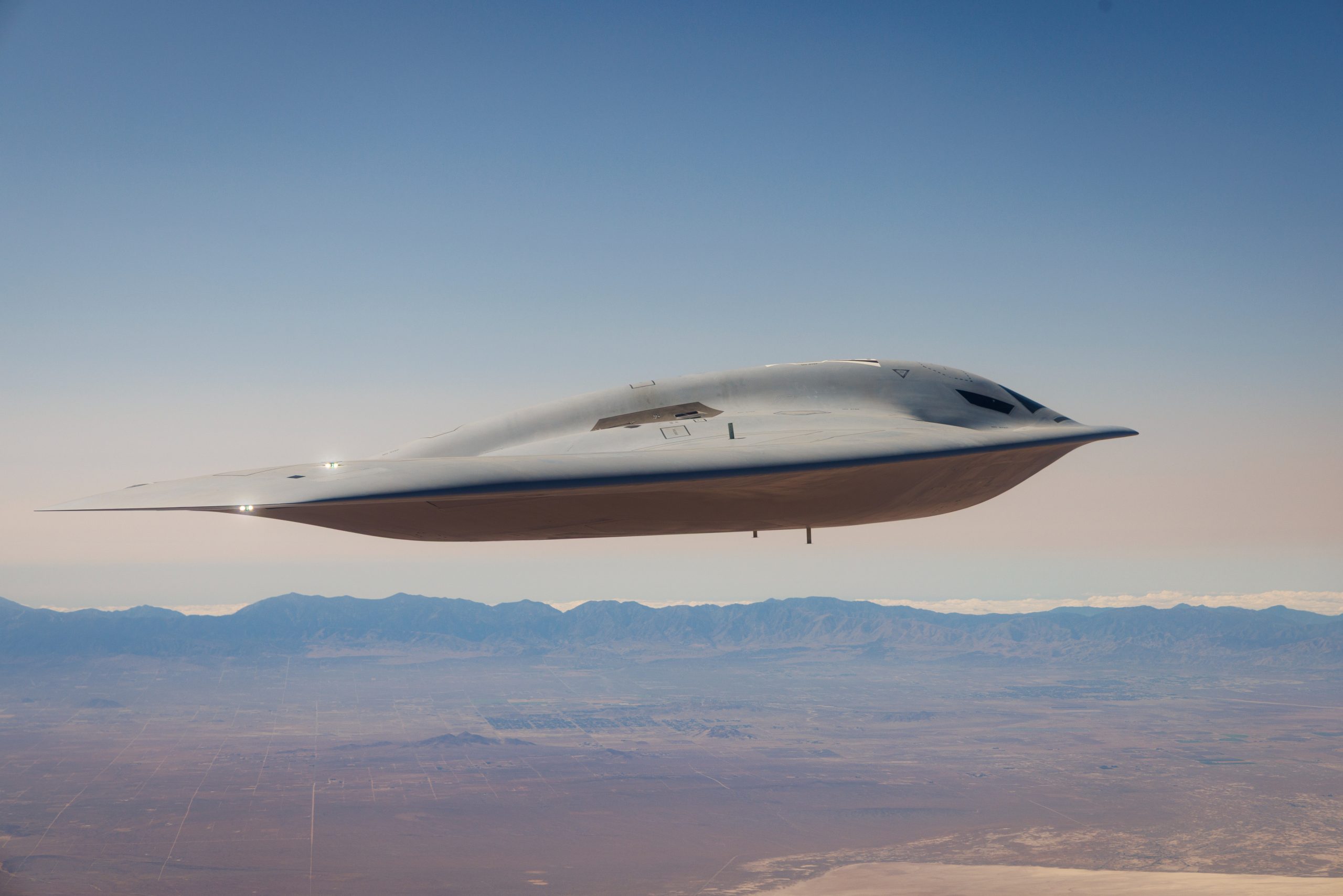
The B-21 Raider, the U.S. Air Force’s newest stealth bomber, successfully conducted its inaugural weapons release test in the first week of November, officials from the Air Force and manufacturer Northrop Grumman announced on November 13.
This test, which involved a B-21 taking off from Edwards Air Force Base in California and releasing a conventional weapon, marks a critical transition for the aircraft. According to the Air Force, it signifies the bomber’s evolution from a flight test platform to a functional weapons system. Northrop Grumman echoed this sentiment, stating the event advances the Raider into its dedicated weapons testing phase.
The B-21 Raider represents the first new bomber introduced by the U.S. Air Force in over three decades. Both the Air Force and Northrop Grumman characterize the aircraft as the world’s first “sixth-generation” platform, citing its advanced stealth capabilities, open systems architecture, sophisticated sensors, and extensive data-sharing functionalities. These attributes are designed to enable the Raider to operate effectively in highly contested environments.
Designed for long-range missions without immediate refueling, the Raider is intended to carry both conventional and nuclear weapons. Its primary operational role is expected to involve conducting penetrating strikes deep into enemy territory, leveraging its stealth characteristics to evade detection by advanced air defense systems.
Following the early November test, the Air Force reported that the conventional weapon release was successful. This success, according to the service, validated the aircraft’s digital models and the maturity of its open systems architecture. It also served as a proof-of-concept for the Raider’s strike capability. Officials further indicated that the test demonstrated the B-21’s ability to rapidly integrate new weapon systems, solidifying its projected role as the future backbone of the U.S. bomber fleet.
Air Force Secretary Troy Meink commented on the test, stating that the B-21 is engineered to deliver enhanced combat capability to military personnel by combining reliability and maintainability with the capacity to quickly integrate new weapons. Meink added that the successful test underscores the Air Force’s ability to adapt rapidly and hold any target at risk if deterrence measures fail.
A significant aspect highlighted by the Air Force is the extensive use of digital engineering throughout the B-21’s development. This test was preceded by thousands of hours of virtual modeling using the B-21’s digital twin. This digital approach is credited by the Combined Test Force with accelerating weapons integration and allowing for precise prediction and refinement of weapon trajectories before any physical flight tests. Northrop Grumman also acknowledged the “sustained rapid test pace and progress” achieved by the B-21 Combined Test Force.
Tom Jones, president of Northrop Grumman Aeronautics Systems, remarked in the company’s statement that the B-21 brings the U.S. closer to achieving “unrivaled deterrence,” adding that Northrop Grumman is transforming advanced technology into operational capability with both performance and speed.
Both the Air Force and Northrop Grumman confirm that the first operational B-21 aircraft remains on schedule for delivery to Ellsworth Air Force Base in South Dakota by 2027. To prepare for this deployment and subsequent deliveries, Northrop Grumman has initiated efforts to accelerate its production and testing capabilities.
As part of these efforts, Northrop Grumman recently inaugurated a new 265,000-square-foot B-21 manufacturing facility in Layton, Utah. The company has also broken ground on a one-million-square-foot assembly line facility at Plant 42 in Palmdale, California. These expansions are described by Northrop Grumman as critical steps in meeting the Air Force’s directive to expedite B-21 production and delivery to the field.
Northrop Grumman emphasizes the B-21’s “exceptional payload flexibility,” which is intended to allow commanders to customize the bomber’s weapon loadout according to specific mission requirements, whether for long-range conventional strikes or operations within heavily contested enemy airspace.
Why This Matters
The successful weapons release test of the B-21 Raider is a significant milestone with broad implications for global security, military strategy, and technological development. This event marks a transition for the aircraft from an experimental platform to a combat-ready asset, signaling a substantial upgrade to the United States’ strategic airpower capabilities.
From a **geopolitical perspective**, the B-21 is designed to reinforce the U.S.’s deterrence posture against potential adversaries, particularly those with advanced air defense systems. In an era characterized by increasing competition among major powers, a new long-range, stealth-capable bomber that can deliver both conventional and nuclear payloads sends a clear signal about the U.S.’s commitment to maintaining its military advantage. This development could influence the strategic calculations of nations like China and Russia, potentially impacting regional stability and the broader balance of power. It may also prompt other nations to accelerate their own military modernization efforts, potentially contributing to an arms race.
In terms of **military strategy and capabilities**, the B-21 is envisioned as a cornerstone of future U.S. air operations. Its claimed “sixth-generation” attributes, including advanced stealth, open systems architecture for rapid upgrades, and sophisticated data integration, are intended to allow it to penetrate and operate within highly defended airspace where older platforms might struggle. This enhances the U.S.’s ability to project power globally and hold distant, well-protected targets at risk. The aircraft’s ability to carry both conventional and nuclear weapons provides decision-makers with flexible response options across the spectrum of conflict, from conventional deterrence to nuclear retaliation. Its rapid weapon integration capability, as demonstrated by this test, suggests a more adaptable and responsive force.
**Technologically**, the B-21 program highlights the growing reliance on digital engineering and virtual modeling in modern defense procurement. The claim that thousands of hours of digital twin modeling accelerated development and testing, allowing for precise weapon trajectory predictions, suggests a paradigm shift in how complex military aircraft are designed, built, and tested. If successful in practice, this approach could significantly reduce development times and costs for future defense programs, setting a precedent for other nations and industries. The “open systems architecture” is also a crucial technological point, promising easier and faster integration of new technologies and weapons throughout the aircraft’s lifespan, preventing obsolescence and extending its utility.
**Economically**, the B-21 program represents a multi-billion-dollar investment, supporting a vast industrial base and creating numerous high-tech jobs across the country, as evidenced by Northrop Grumman’s new manufacturing facilities. The long-term production and maintenance of these aircraft will continue to drive significant economic activity for decades. However, such large-scale defense spending also raises questions about budget priorities and resource allocation, particularly in a complex economic environment.
Ultimately, the B-21 Raider’s journey from concept to a tested weapons platform signifies a major evolution in strategic airpower. It underscores the ongoing commitment to modernizing the U.S. military to meet future threats, with potential ripple effects on international relations, military doctrine, and technological innovation worldwide.