
Extensive Allied Air Activity Observed Across European Skies, Officials Cite Routine Training and Deterrence
On August 18, Allied air forces conducted a substantial series of coordinated flight operations across multiple regions of Europe, which U.S. Air Forces in Europe (USAFE) characterized as routine training alongside allies and partners. While declining to provide specific operational details due to security considerations, military spokespeople emphasized the activities reinforced interoperability, readiness, and deterrence capabilities.
Open-source flight tracking platforms documented a significant concentration of aircraft movement throughout the morning, spanning from the North Sea, across Germany, and into Poland. This observed activity included at least five aerial refueling tankers, essential for extending the operational range and endurance of various aircraft. These tankers were seen operating in conjunction with two NATO E-3A Sentry Airborne Warning and Control System (AWACS) aircraft, which provide airborne command and control, surveillance, and communication capabilities. Additionally, a G550 Conformal Airborne Early Warning (CAEW) aircraft, known for its advanced radar and reconnaissance capabilities, was tracked within the same operational area.
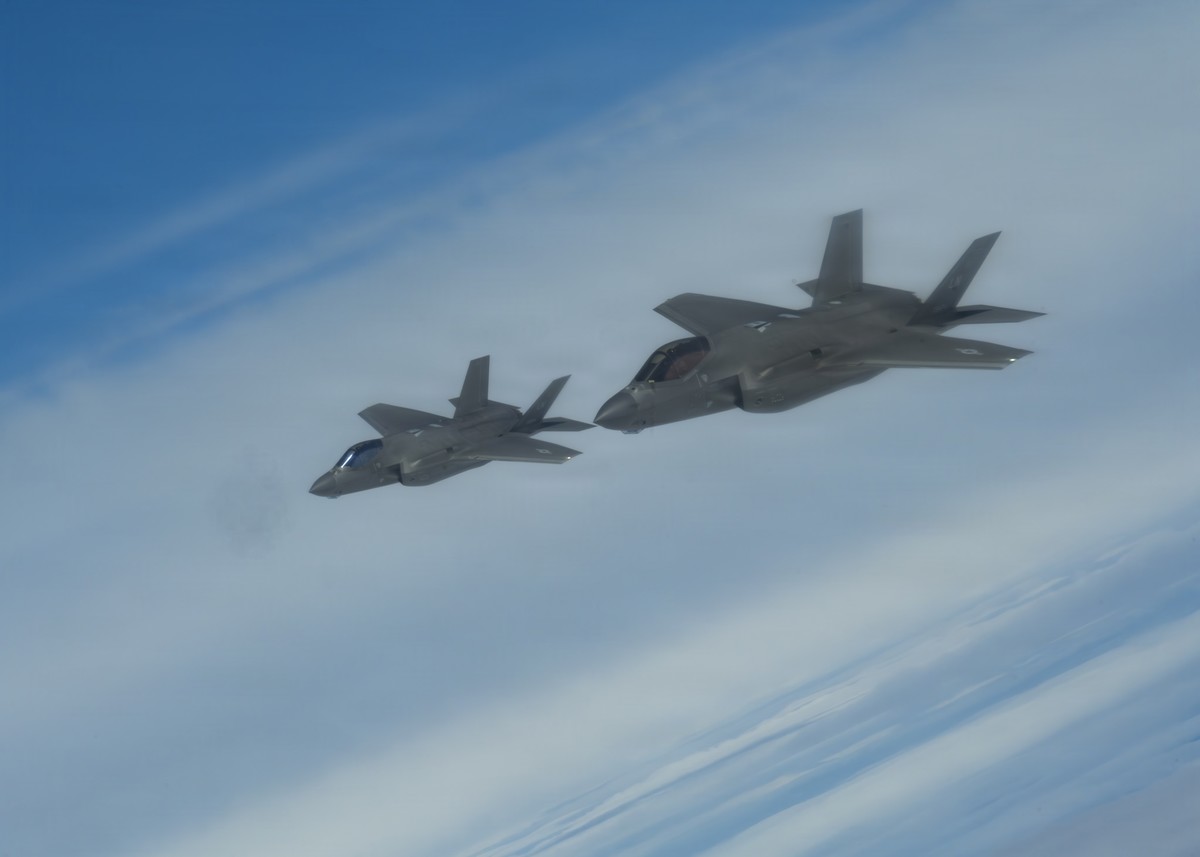
Among the fighter assets observed were six USAF F-35A Lightning II stealth multirole combat aircraft, operating out of RAF Lakenheath in the United Kingdom, tracked over the same period. In the broader operational theatre, a Turkish Air Force E-7 Airborne Early Warning and Control aircraft, another critical asset for airborne surveillance and command, was also tracked at an altitude of 30,000 feet, further indicating the wide scope of the day’s exercises.
When questioned about the nature of the activity—specifically whether it was pre-planned, a response to ongoing geopolitical events, or a deliberate deterrence effort—a spokesperson for U.S. Air Forces in Europe reiterated the standard nature of such operations.
“U.S. Air Forces in Europe routinely conducts training activities alongside Allies and partners, and yesterday’s air integration exemplifies interoperability, readiness, and deterrence,” the spokesperson stated. “By practicing coordination and communication in realistic training scenarios, we strengthen our collective defense and ability to maintain security and stability in the region. Due to operational security considerations, no additional details will be provided at this time.” This statement underscores the dual purpose of such exercises: enhancing practical military capabilities and projecting a message of resolve.
Colonel Martin O’Donnell, a spokesperson for Supreme Headquarters Allied Powers Europe (SHAPE), echoed this sentiment, emphasizing the defensive posture of the Alliance. “NATO is a defensive Alliance and Allies are constantly honing their defensive abilities,” Colonel O’Donnell commented. He specifically referenced activity in the Baltic region on August 18, noting the involvement of U.S. and Norwegian fighter aircraft, Polish ground forces, and a NATO E-3A AWACS, all overseen by the U.S. This broader context suggested a multi-domain exercise, integrating air and ground assets to simulate a comprehensive defensive scenario.
However, despite Colonel O’Donnell’s mention of Norwegian fighter contributions and Polish ground force elements, these components were not independently verifiable through open-source flight tracking, suggesting that some aspects of the exercise might have involved assets or activities not publicly broadcast or easily discernible.
Allied Air Command, responsible for NATO’s air operations, aligned with USAFE’s position, declining to disclose further details on grounds of operational security. They deferred subsequent inquiries to U.S. Air Forces in Europe, indicating that the day’s activities were primarily U.S.-led. Neither command clarified whether these extensive operations fell under “Eastern Sentry,” the enhanced air posture initiated by NATO over its eastern flank following repeated airspace violations in the region, which aims to bolster air policing and defense capabilities.
The air activity was not confined to Central and Eastern Europe. A separate, equally significant concentration of Allied intelligence, surveillance, and reconnaissance (ISR) aircraft was observed operating around northern Norway and the strategic approaches to the Barents Sea during the same morning. This northern theatre of operations included a Royal Air Force (RAF) RC-135W Rivet Joint, a highly capable electronic intelligence gathering aircraft. It was tracked alongside an RAF P-8A Poseidon maritime patrol aircraft and a Norwegian P-8A Poseidon, both designed for anti-submarine warfare, anti-surface warfare, and intelligence gathering over vast maritime areas. A NATO A330 Multi-Role Tanker Transport (MRTT) aircraft was also operating in this northern region, providing essential aerial refueling support to extend the endurance of the ISR platforms.
Why This Matters
The extensive Allied air activity observed across Europe on August 18 carries significant geopolitical weight and underscores several critical aspects of contemporary international security. These exercises are far more than routine flights; they represent a tangible manifestation of NATO’s commitment to collective defense and deterrence in a dynamic security environment.
Firstly, the sheer scale and geographical breadth of the operations—stretching from the North Sea to the Baltic region and extending into the strategically vital High North—highlight NATO’s capacity to operate across its vast area of responsibility. The simultaneous deployment of diverse assets, including advanced fighter jets like the F-35s, critical airborne command and control platforms like AWACS, and specialized intelligence and maritime patrol aircraft, demonstrates a sophisticated, multi-domain approach to security challenges. This integrated approach is crucial for responding effectively to potential threats, which may not be confined to a single domain or region.
Secondly, the emphasis on “interoperability, readiness, and deterrence” by military spokespeople is particularly pertinent given the ongoing conflict in Ukraine and heightened tensions with Russia. Interoperability ensures that the armed forces of various NATO member states can work seamlessly together, sharing intelligence, communicating effectively, and executing complex maneuvers as a cohesive unit. This capability is the bedrock of any successful coalition operation. Readiness, meanwhile, signals that the Alliance is prepared to respond swiftly and effectively to any contingency, projecting an image of strength and resolve to potential adversaries. Deterrence, therefore, is not merely a statement but a demonstration: by openly practicing and showcasing these capabilities, NATO sends a clear message that any aggression against its members would be met with a coordinated and robust response.
Thirdly, the specific regions of activity hold strategic importance. The Baltic Sea region is a critical area due to its proximity to Russia and the vulnerability of NATO’s eastern flank. Exercises here reinforce the defense of frontline states and ensure freedom of navigation. The activity around northern Norway and the Barents Sea approaches is equally vital. This area represents the gateway to the Arctic, a region of increasing geopolitical competition, and is home to significant Russian military assets, particularly its Northern Fleet. Allied presence and ISR operations in this region are essential for monitoring activity, maintaining situational awareness, and projecting influence in a crucial maritime and aerial domain.
Finally, the careful balance between official transparency and operational security is a consistent feature of such military activities. While open-source tracking provides a partial view, military commands selectively release information to both inform the public of their defensive posture and maintain the secrecy of specific tactics and capabilities. This approach is intended to prevent adversaries from gaining exploitable intelligence while still demonstrating the Alliance’s commitment and capability. The unconfirmed nature of certain elements, such as specific Norwegian and Polish contributions in open-source tracking, further illustrates this delicate balance.
In essence, these extensive air operations are a vivid reminder of NATO’s enduring commitment to collective defense, its continuous adaptation to evolving threats, and its strategic messaging through the visible demonstration of military power and cohesion.