
Dolly Parton, the celebrated country music icon, philanthropist, and businesswoman, died on Tuesday in Nashville at the age of 80, a relative confirmed. Her passing prompted immediate and widespread mourning, particularly throughout her home state of Tennessee, where her deep and enduring connections to its people and culture were uniquely profound.
Born in a one-room cabin in rural Sevier County, East Tennessee, Ms. Parton’s life and career were inextricably linked to her origins. Her ascent to global stardom began with music that often reflected her impoverished childhood and the values instilled in her mountain community. Early album covers frequently depicted familiar Tennessee landscapes, while her songwriting chronicled the trials and triumphs of humble beginnings, resonating with audiences far beyond the Appalachian foothills. Her performances at Nashville’s legendary Grand Ole Opry further solidified her status as a quintessential voice of Tennessee country music.
Despite achieving international renown, Ms. Parton consistently reinvested in her home state through various initiatives. She contributed millions of dollars to disaster relief efforts, notably after devastating wildfires swept through East Tennessee, and provided crucial funding for vaccine research at Vanderbilt University. Her commitment to local economic development is perhaps best exemplified by Dollywood, the sprawling amusement park she established in Pigeon Forge, near her hometown of Sevierville, which has become a major tourist attraction and employer in the region. Furthermore, her autobiographical musical received its world premiere in Nashville before its eventual move to New York, underscoring her dedication to the state’s cultural landscape.
This sustained loyalty fostered an exceptional bond between Ms. Parton and the people of Tennessee. Christy Farris, 51, a Nashville resident, articulated this sentiment: “She stayed true to us. I don’t know if anybody could replace her, or even come close.” This widespread admiration often transcended political or social divides, making Ms. Parton a rare unifying figure.
Beverly Keel, the dean of the College of Media and Entertainment at Middle Tennessee State University, observed the depth of this connection. “She aspired Tennesseans to be better, because she was one of us,” Keel stated, anticipating the significant emotional impact her death would have on the state. Ms. Parton, who had been managing health challenges for several months, passed away in Nashville, with the announcement quickly reverberating across Tennessee and beyond.
In Nashville, the influence of Ms. Parton is visibly pervasive. Murals depicting her signature image – a distinctive blonde wig, beauty mark, and wide grin – adorn city walls, while merchandise featuring her likeness is commonly found in shops. Her extensive catalog of songs, from “Jolene” to “9 to 5,” remains a constant presence in local businesses and music venues, serving as a testament to her enduring cultural footprint.
Scout Gillett, 31, a singer visiting Nashville, reflected on the profound sense of loss felt by many. “She just always seemed immortal,” Gillett remarked while observing Ms. Parton’s exhibit at the Country Music Hall of Fame. “It’s just amazing how many people she touched.”
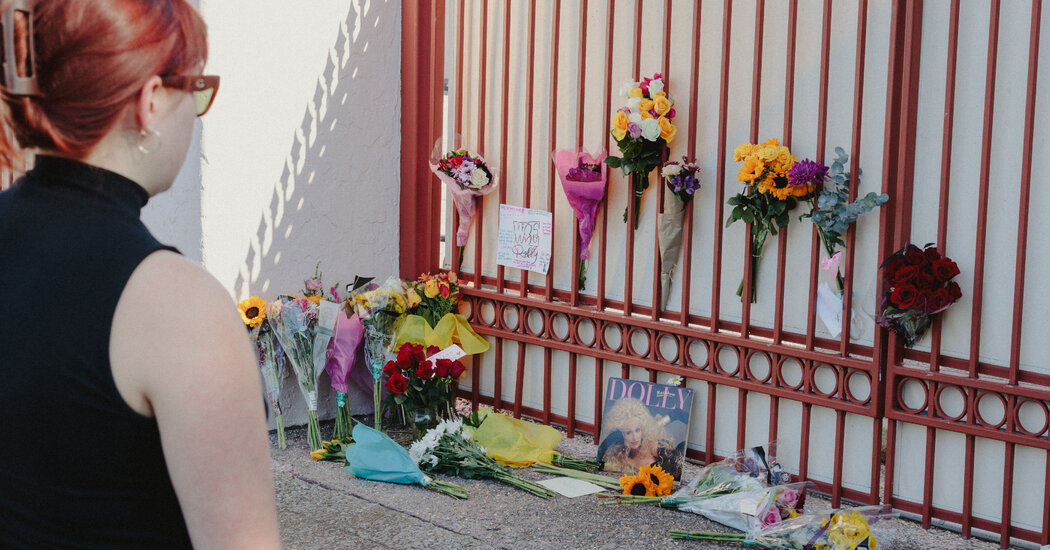
Public mourning rituals commenced swiftly across Nashville. At the Country Music Hall of Fame, a continuous line of visitors formed to sign a condolences book for Ms. Parton’s family. Flags throughout the city were lowered to half-staff, and numerous politicians and artists issued statements of tribute and sympathy. Flowers and other mementos were placed at her star on a prominent walkway near the Hall of Fame. Along the historic lower Broadway, honky-tonk establishments performed her songs in tribute, while vehicles frequently played her hits, including “9 to 5,” as a collective expression of remembrance.
Erin Russell, a visitor from Connecticut whose admiration for Ms. Parton was inherited from her Alabama-born father, highlighted the artist’s consistent public persona. “She stayed so respectable and didn’t really waver from who she truly was from the age of 10 until the age of 80,” Russell stated. She recounted a friend’s observation that being in Nashville on Tuesday felt akin to being in London during the period of mourning for Princess Diana, illustrating the perceived scale of collective grief.
Beyond the urban center of Nashville, the grief was particularly pronounced in East Tennessee, the mountainous region where Ms. Parton spent her formative years and subsequently invested heavily in projects like Dollywood. In Sevierville, her birthplace, the city issued a statement acknowledging the dual loss: “the world has lost an icon, but Sevierville has lost a daughter who never stopped loving her home.”
On Tuesday afternoon, residents and visitors converged at a statue of Ms. Parton situated on the lawn of the old Sevier County Courthouse. They left a growing memorial of flowers, balloons, and other tokens of respect. Hannah Sanderson, 35, brought her children, Evie, 10, and Owen, 8, to the site, placing yellow roses amidst the tributes. “If anybody deserves to have respects paid, it’s Dolly,” Sanderson affirmed, reflecting the deep local reverence.
Beth Braden contributed reporting from Sevierville, Tenn.
Why This Matters
The death of Dolly Parton marks the end of an era for country music and represents a significant cultural loss far beyond her genre. Her impact extended across multiple domains: as a groundbreaking musician and songwriter, a shrewd businesswoman, and a prominent philanthropist.
Musically, Parton crafted a catalog of songs that transcended boundaries, blending traditional country with pop sensibilities and telling stories that resonated with a diverse global audience. Her distinctive voice and songwriting prowess, often rooted in themes of resilience, aspiration, and empathy, solidified her place as one of the most prolific and influential artists of her time. Beyond music, her entrepreneurial spirit led to the creation of Dollywood, which not only became a thriving tourist destination but also a significant economic engine for a historically underserved region of East Tennessee, providing thousands of jobs and fostering local development.
Moreover, Parton established herself as a powerful force in philanthropy. Her Imagination Library program, which mails free books to children worldwide, has distributed over 200 million books, promoting literacy from an early age. Her significant financial contributions to disaster relief and medical research demonstrated a consistent commitment to societal well-being. She served as a rare unifying figure in a divided world, celebrated for her authenticity, wit, and generosity across political, social, and demographic lines. Her legacy is one of artistic brilliance, astute business leadership, and profound human kindness, setting a benchmark for celebrity engagement and lasting positive societal influence.