
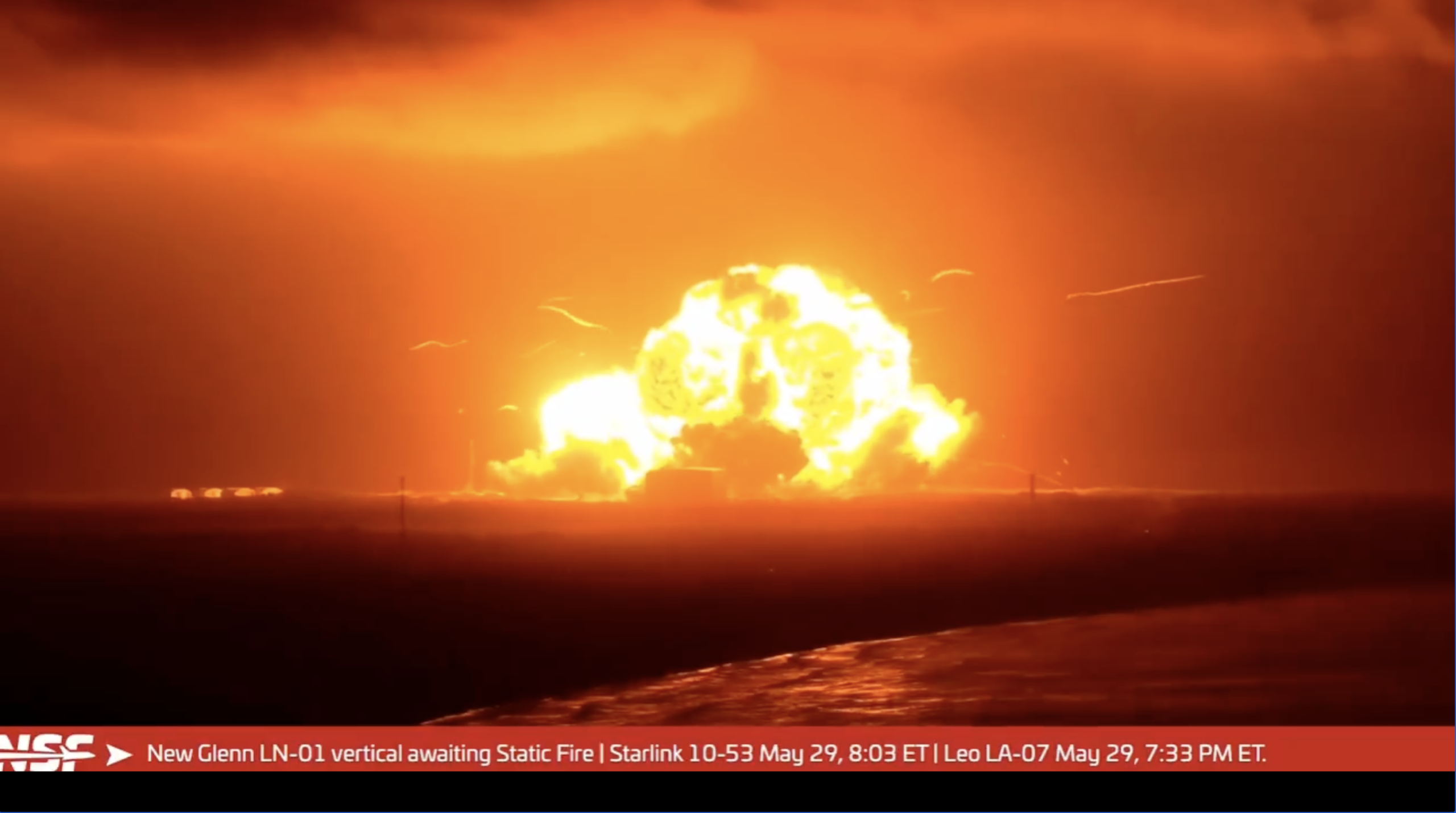
Cape Canaveral, Florida – An explosion involving a Blue Origin rocket on May 28 at Cape Canaveral Space Force Station, Florida, has been identified as the largest incident of its kind in the installation’s operational history. The anomaly occurred during a hotfire test of the company’s New Glenn rocket, a critical preparatory step before its inaugural orbital launch.
Colonel Brian Chatman, commander of Space Launch Delta 45 (SLD 45), the unit responsible for operating the Eastern Range at Cape Canaveral, addressed reporters on June 2, emphasizing that despite the unprecedented scale of the event, the base’s established safety protocols effectively contained its impact. These procedures were credited with safeguarding personnel and preventing broader disruptions across the vast launch complex.
“What that identifies is that we’ve got the right safety procedures really laid in to keep personnel safe and to keep the public safe when we go through launch operations and we have a major anomaly,” Chatman stated. He added, “We know what post-anomaly response looks like, and we tested that in real time with regards to the incident that occurred Thursday night.”
The incident occurred as the New Glenn rocket underwent a hotfire test, a procedure designed to thoroughly check the vehicle’s engines and systems while remaining tethered to the launch pad. The test involves igniting the rocket’s engines at full thrust for a sustained period, simulating flight conditions without leaving the ground. While Blue Origin has yet to disclose the precise root cause of the explosion, the event manifested as a significant fireball that appeared to engulf a substantial portion of Space Launch Complex 36A, Blue Origin’s dedicated launch pad for New Glenn.
However, initial concerns about catastrophic damage to the launch infrastructure were partially alleviated by a June 1 update from Blue Origin CEO Dave Limp. Limp reported that the damage was less severe than initially feared, specifically noting that critical components such as the pad’s water tower, propellant farm, and the liquid oxygen and liquid hydrogen storage tanks remained intact and “in good shape.”
“This is good luck because these are very long lead items,” Limp commented, expressing optimism that the New Glenn rocket could still achieve its maiden flight before the close of the year.
A key factor in mitigating the incident’s broader impact was the geographical placement of Blue Origin’s launch complex. Situated at the southernmost extremity of the Eastern Range, Space Launch Complex 36A allowed SLD 45 to manage the anomaly response without interfering with other scheduled launch operations. Colonel Chatman highlighted this advantage, noting, “In this instance, geography was our friend.” This strategic positioning enabled a SpaceX launch to proceed within 12 hours of the Blue Origin incident, followed by a United Launch Alliance mission that lifted off on the evening of May 29, demonstrating the range’s operational resilience.
While the immediate operational impact was contained, the SLD 45 team is continuing its assessment of the explosion’s collateral damage to facilities surrounding Blue Origin’s complex. Confirmed damage includes a nearby hangar and a weather balloon release area. Despite damage to the latter, equipment was sufficiently functional to support the subsequent ULA launch. Further detailed assessments are pending as an Interim Safety Board team surveys government facilities located outside the primary Blast Danger Area (BDA).
The BDA is a crucial safety perimeter established around a launch pad before any operations commence. Its size, which for the New Glenn hotfire test exceeded 7,000 feet in diameter, is determined by various factors, including the volume of fuel onboard the vehicle and prevailing wind conditions. Access to this zone is strictly prohibited for both personnel and the public, a measure that proved critical in preventing casualties during the May 28 explosion.
This New Glenn anomaly occurs amidst a period of unprecedented expansion and increased activity at the Space Force’s Eastern Range. The installation successfully supported 109 launches in 2023, with projections indicating a potential surge to between 500 and 1,000 launches annually by 2036. To accommodate this burgeoning demand, the Space Force is actively upgrading infrastructure at both Cape Canaveral and its Western Range counterpart at Vandenberg Space Force Base, California, aiming to enhance operational efficiency and safety despite the higher cadence. The expansion also includes making room for an increasing number of new launch providers, with companies like Stoke, Relativity, and Blue Origin introducing new rocket designs and capabilities in the coming years.
Addressing concerns that the inherent risks associated with launching less-seasoned vehicles could impede future operations, Colonel Chatman affirmed that the Space Force’s launch enterprise will integrate lessons learned from the New Glenn incident into its evolving strategy. While acknowledging that the investigation is in its preliminary stages, Chatman indicated that the anomaly has already highlighted the need to reduce the number of personnel required at a launch pad. It also reinforces the imperative for more efficient traffic flow, improved pad access, and streamlined commodity delivery systems.
“Looking through the lens of public safety, looking through the lens of safety of the men and women operating on Cape Canaveral—whether that’s Space Launch Delta 45 personnel or industry partner personnel, launch service providers—and then working on how we can maximize efficiency to hit that launch cadence of 1,000 launches in the 2036 time frame, are all things that we’re laying in now,” Chatman concluded, underscoring the ongoing commitment to safety and efficiency in the rapidly accelerating space launch environment.
Why This Matters
The Blue Origin New Glenn explosion at Cape Canaveral is more than an isolated incident; it serves as a potent reminder of the inherent risks and formidable challenges within the burgeoning commercial space industry. As global demand for satellite deployment, space exploration, and human spaceflight continues to skyrocket, the frequency of rocket launches is projected to increase dramatically. This incident underscores the critical importance of rigorous safety protocols and resilient infrastructure in an environment where even routine tests can lead to significant events.
For the United States, maintaining leadership in space is both an economic and strategic imperative. The ability of facilities like Cape Canaveral to absorb such an anomaly and continue operations within hours demonstrates the robustness of its management and the value of its geographical layout. Lessons learned from this explosion — from improved pad access and traffic flow to enhanced safety perimeters — will directly inform future design and operational standards across the entire space launch enterprise. This incident, while a setback for Blue Origin, will ultimately contribute to making space travel safer and more efficient for all participants, paving the way for the ambitious launch cadences projected for the coming decades and ensuring the continued advancement of human endeavors beyond Earth.