
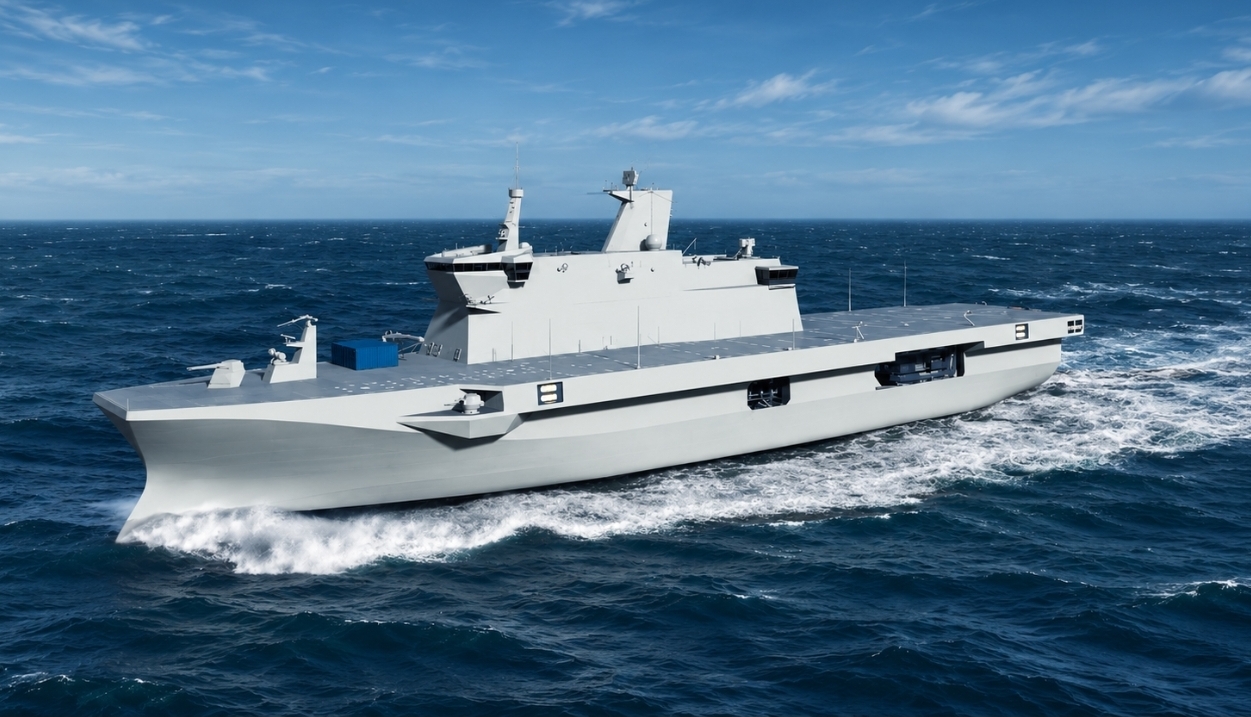
New Anglo-Dutch Amphibious Transport Ship Design Unveiled, Signaling Enhanced Naval Cooperation
The highly anticipated design for the Royal Netherlands Navy’s new Amphibious Transport Ship (ATS) has been publicly revealed at the NEDS 2026 naval exhibition, marking a significant step forward in a joint Anglo-Dutch naval defence program. This unveiling coincides with a formal agreement between Damen Naval, the primary designer and builder, and electrical integrator Alewijnse, to deepen their collaboration on this critical initiative and future defence projects. The program aims to deliver a new generation of amphibious warfare vessels, with the United Kingdom also committing to acquire four of the same class, creating a shared fleet of eight ships.
The NEDS 2026 naval exhibition served as the platform for Damen Naval to showcase the advanced design of the future ATS. These vessels are intended to replace the Royal Netherlands Navy’s existing Landing Platform Docks (LPDs), HNLMS Rotterdam and HNLMS Johan de Witt, which have been key assets in the Dutch fleet’s expeditionary capabilities. Concurrently, Damen Naval and Alewijnse, a long-standing partner in naval electrical systems, formalized their enhanced cooperation. Under this renewed agreement, Alewijnse will assume comprehensive responsibility for the integration and installation of all electrical systems onboard these sophisticated vessels, a critical component for their operational capabilities and technological superiority.
Roland Briene, Managing Director of Damen Naval, underscored the importance of robust industrial partnerships in complex naval shipbuilding. “In our role as designer, builder and integrator of complex naval vessels, we work closely with the Dutch maritime manufacturing industry. Alewijnse is one of the companies with which we have collaborated for many years and on many vessels,” Briene stated. He emphasized that strengthening this cooperation is a vital strategic move, designed to “help ensure the continuity of naval shipbuilding programmes and enables new vessels to become operational as quickly as possible,” highlighting the national security implications of efficient project delivery.
Echoing this sentiment, Gert Bravenboer, CEO of Alewijnse, highlighted the power of collaborative effort. “Our strength lies not only in what we can achieve individually, but especially in what we can accomplish together,” Bravenboer remarked. He expressed pride in Alewijnse’s contribution, affirming their commitment to leverage “expertise, capabilities, and teamwork to the delivery of the best naval vessels, thereby supporting the security and future of the Netherlands.” This partnership extends beyond the current ATS program, laying the groundwork for future joint ventures in the defence sector, fostering innovation and shared expertise.
The broader context for this shipbuilding initiative was set on July 7th, when the United Kingdom and the Netherlands officially solidified their defence alliance concerning these new amphibious ships. The agreement was reportedly signed by then-Prime Minister Mark Rutte of the Netherlands and Prime Minister Keir Starmer of the UK during the NATO summit in Washington D.C., committing both nations to a collaborative procurement and operational strategy. The total estimated value of the UK’s commitment to the program stands at £2.4 billion, reflecting a substantial investment in future naval capabilities and a significant deepening of bilateral defence ties.
Under the terms of the agreement, the vessels will be based on a Dutch design, leveraging Damen Naval’s extensive expertise in naval architecture. However, a significant aspect of the deal is the commitment for the British contingent of four ships to be built in UK shipyards, in close collaboration with Dutch industry. This arrangement is designed to foster industrial cooperation, share technological knowledge, and strengthen the defence manufacturing bases of both countries. Each of these new Amphibious Transport Ships is projected to be approximately 160 metres in length and displace around 15,000 tonnes, offering substantial capacity for expeditionary forces.
These vessels are engineered to transport and deploy a diverse range of assets, including troops, heavy vehicles, essential equipment, and advanced drones. A key feature highlighted in the design is a sophisticated flight deck specifically optimized for the operation of long-range drones and various autonomous systems. This integration of uncrewed capabilities underscores a forward-looking approach to amphibious warfare, enhancing reconnaissance, strike, and logistical support in complex operational environments. The UK Defence Journal had previously reported on Britain’s commitment to these new assault ships as part of this joint effort, emphasizing their critical role in projecting power and delivering humanitarian aid.
For the Royal Navy, these new Amphibious Transport Ships are crucial for addressing a significant capability gap. They are slated to replace the amphibious capability previously provided by the Landing Platform Dock (LPD) class ships, HMS Albion and HMS Bulwark. While HMS Albion remains in service, the future of HMS Bulwark has been subject to considerable speculation, with recent reports indicating it is currently undergoing preparations at Devonport for potential transfer to Brazil. The acquisition of these new ships is therefore vital to ensure the UK maintains its strategic amphibious projection capabilities, which are essential for rapid response operations, humanitarian assistance, and supporting allied forces globally.
Amphibious warfare capabilities are fundamental for modern navies, enabling forces to project power from sea to land. These ships serve as floating bases, capable of deploying marines, vehicles, and aircraft to littoral regions, often without established port infrastructure. This flexibility is invaluable in diverse scenarios, from disaster relief and evacuation missions to complex military operations. The new design, with its emphasis on drone integration and autonomous systems, signifies an evolution in amphibious doctrine, allowing for more distributed, stealthy, and adaptable operations in contested environments, thereby enhancing overall operational effectiveness and force protection.
The construction phase of the British contingent of these ships presents significant opportunities for the UK’s shipbuilding industry. While the design originates from the Netherlands, the commitment to build in UK shipyards has sparked considerable interest among domestic defence contractors. As of now, no specific UK yard has been officially designated for the construction of these vessels, indicating a competitive bidding process is likely. Lord Coaker, Minister of State at the Ministry of Defence, recently affirmed the importance of this program, listing the UK-Netherlands initiative among key future shipbuilding opportunities in a parliamentary answer this week, underscoring the government’s commitment to bolstering the national shipbuilding strategy.
Among the companies expressing interest in securing contracts for the new ships, Balaena Structures has publicly pitched its yards as suitable candidates. The selection of shipyards will not only consider manufacturing capacity and expertise but also geopolitical factors, aiming to distribute economic benefits and strengthen industrial resilience across the UK. This joint procurement model, combining Dutch design with UK construction, exemplifies a trend towards greater European defence industrial cooperation, seeking efficiencies and shared capabilities in an increasingly complex and challenging security landscape.
Why This Matters
The unveiling of the new Amphibious Transport Ship design and the deepening of the Anglo-Dutch naval partnership carries profound significance on multiple fronts – strategic, industrial, and geopolitical – shaping the future defence capabilities and international relations of both nations.
Firstly, from a **strategic and operational perspective**, these ships are critical enablers of modern naval power. For both the Royal Netherlands Navy and the Royal Navy, the new ATS class will replace aging platforms, ensuring the continuity and enhancement of vital amphibious capabilities. Amphibious forces provide a unique ability to project power from the sea onto land, facilitating rapid response operations, humanitarian aid missions, and complex military interventions in regions lacking established port infrastructure. The integration of advanced drone and autonomous systems into the ship’s design represents a forward-thinking adaptation to evolving threats and operational doctrines, allowing for more flexible, distributed, and potentially less risky deployments in contested littoral zones. This ensures both nations maintain a cutting-edge expeditionary capability, crucial for protecting national interests and fulfilling international security commitments, particularly within NATO and other allied frameworks, thereby reinforcing collective defence in an era of global instability.
Secondly, the program’s emphasis on **industrial cooperation and economic impact** is substantial. By leveraging a Dutch design while committing to UK construction for four vessels, the agreement fosters a robust transatlantic defence industrial base. This not only supports thousands of skilled jobs in shipbuilding, engineering, and related sectors in both countries but also promotes the transfer of technology and expertise. For the UK, the commitment to build these ships domestically is a significant boost to its National Shipbuilding Strategy, ensuring sustained investment in strategic industries and maintaining sovereign capabilities critical for national security and economic resilience. For the Netherlands, it solidifies its position as a leading naval design and engineering hub, showcasing its innovative capacity. This collaborative model demonstrates how international partnerships can drive economic growth and enhance resilience within the defence supply chain, creating mutual benefits for national economies and fostering a more integrated European defence industry.
Finally, the joint nature of this program has considerable **geopolitical implications**. It reinforces the strong bilateral defence relationship between the United Kingdom and the Netherlands, two key NATO allies with a shared maritime heritage and a common vision for international security. In an era of increasing global instability, including heightened competition and new security threats, such joint ventures underscore a commitment to collective security, interoperability, and burden-sharing within allied structures. It signals to potential adversaries a united front and significantly strengthens NATO’s overall maritime capabilities. The ability of two nations to seamlessly operate identical, advanced amphibious platforms enhances their combined expeditionary potential, allowing for greater efficiency, economies of scale, and a more potent collective response to emerging security challenges. This Anglo-Dutch initiative serves as a model for future European defence collaboration, promoting deeper integration and efficiency in defence procurement and operations across the continent, contributing to broader regional stability.