
Key Takeaways:
- Persistent Geopolitical Risk & Commodity Volatility:Vladimir Putin’s continued hardline stance and conditional engagement with European leaders underscore persistent geopolitical uncertainty, particularly impacting global energy and agricultural commodity markets. The rejection of a ceasefire and demands for territorial concessions signal protracted conflict, maintaining upward pressure on energy prices and food inflation.
- European Economic Headwinds & Strategic Realignment:Europe’s struggle to forge a unified peace strategy amidst competing US-Russia-China agendas highlights the continent’s economic vulnerability to energy supply disruptions and trade fragmentation. This dynamic is driving increased defense spending and a re-evaluation of supply chain resilience, influencing investment decisions across key European sectors.
- Uncertainty for Global Investment & Defense Sector Tailwind:The looming threat of a “new Yalta” and the Kremlin’s insistence on “realities” over a swift resolution create an environment of elevated risk premium for global investors. While traditional safe havens benefit, the sustained military aid commitments and heightened security concerns provide a significant, long-term tailwind for the defense and cybersecurity sectors.
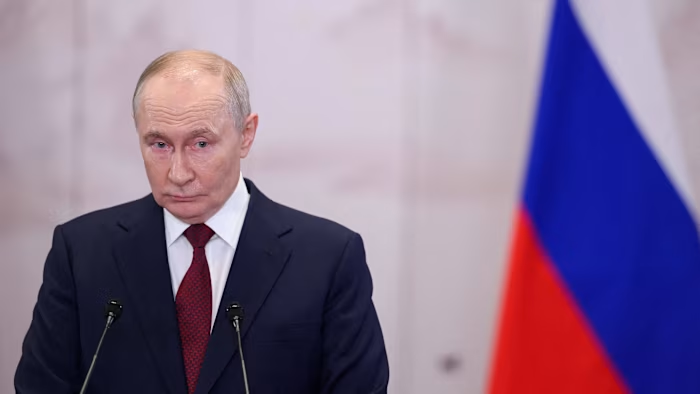
Vladimir Putin’s invitation to European leaders for talks in Moscow on the nearly five-year invasion of Ukraine, while seemingly an olive branch, has sent nuanced signals across global financial markets. His refusal to commit to a formal European role in a US-led peace process that continental capitals fear could bypass them underscores the intricate geopolitical dance currently dictating risk sentiment and investment flows.
The Russian president’s comments, delivered after a groundbreaking summit with US President Donald Trump and China’s Xi Jinping in Shenzhen, indicate a steadfast unwillingness by the Kremlin to soften its hardline demands for ending the conflict. For energy markets, this translates into continued uncertainty regarding gas supply to Europe and persistent volatility in crude oil prices, as geopolitical risk remains a primary driver.
European capitals, grappling with internal divisions on direct engagement with Moscow, have intensified efforts to insert themselves into the US-brokered talks on Ukraine. Their simultaneous resistance to Russian overtures for discussions on a broader European “security architecture” reflects a deep-seated apprehension about ceding influence and potentially impacting future trade agreements or regional economic blocs. The prospect of a continent divided into new spheres of influence, reminiscent of the post-WWII Yalta Agreement, carries significant implications for long-term foreign direct investment and market access in Central and Eastern Europe.
The so-called Coalition of the Willing, comprising 36 countries led by the UK, France, and Germany, met in Berlin to announce further financial and military support for Ukraine. This coordinated effort, timed to coincide with the Shenzhen summit, aimed to counterbalance any perception of a potential US-Russia-China consensus that might override European interests. Increased military aid packages, funded by national budgets, are a clear boon for the defense sector, with companies specializing in armaments, logistics, and surveillance systems poised to see sustained demand. German officials explicitly stated the Berlin summit’s purpose was to push back against a “new Yalta” scenario, highlighting concerns over potential shifts in global trade routes and supply chain dependencies that such an agreement might entail.
Europe’s collective efforts to forge a common position and secure a formal role in the peace talks are critical for the stability of the Eurozone economy. A prolonged conflict, coupled with energy insecurity and higher defense spending, continues to exert inflationary pressure and dampen GDP growth forecasts across the continent. Jared Kushner, Trump’s son-in-law and a key US negotiator, indicated Russia’s willingness to “try” allowing European participation in future negotiations, a development that, if materialized, could offer a semblance of stability and encourage a modest uptick in investor confidence.
Speaking from Shenzhen, Putin’s conditional invitation for Europeans to “come to Moscow to define their position” before deciding on the format for continued dialogue on Ukraine, suggests a deliberate strategy to fragment European unity. His explicit warning against “possible military co-operation” between Ukraine and EU countries, and insistence against foreign troop deployments post-war, signal non-negotiable red lines for the Kremlin. These statements reinforce the perception of a prolonged conflict, which will continue to impact agricultural commodity prices, given Ukraine’s role as a major global grain producer, and prolong the flight to safety in global bond markets.
Putin’s assertion that full normalisation of relations with Europe would only be possible after “the political elite changes in certain countries” is a stark reminder of the deep ideological chasm, effectively pricing in long-term diplomatic and economic estrangement for many European nations. The Kremlin’s refusal to name invited European leaders adds to the ambiguity, further clouding the diplomatic landscape and keeping markets on edge. However, the unified stance adopted by EU leaders, represented by a coalition of France, Germany, Italy, Poland, and the UK, alongside the EU and Nato, projects a powerful, albeit cautious, collective voice. As European Council president António Costa stated, “What concerns Europe needs to be discussed by Europe,” underscoring the continent’s determination to protect its economic and security interests.
Following the Berlin talks, Kushner hailed “very productive” discussions with German Chancellor Friedrich Merz and his national security adviser Günter Sautter, noting on X (formerly Twitter) his commitment to “work in close co-ordination with Germany, Ukraine and our European partners to align our positions and prepare for the next round of negotiations.” Such statements, while offering hope for diplomatic progress, are often met with cautious optimism by markets, which tend to react more strongly to concrete outcomes rather than preparatory dialogues.
In Shenzhen, Putin also unequivocally rejected Kyiv’s calls for a ceasefire ahead of winter, signaling an anticipated major campaign of air strikes targeting Ukrainian energy, logistics, and transport infrastructure. This announcement immediately raises concerns about humanitarian crises, further displacement, and significant reconstruction costs in the long term, which could weigh on future sovereign debt issuance and international aid commitments. His justification, citing the destruction of the Crimean bridge as a reason for not agreeing to a ceasefire, and the promise of a “considerably more painful” response, paints a grim picture for any near-term de-escalation, ensuring that global commodity supply chains remain under severe stress.
Despite a joint statement from the US, Russian, and Chinese leaders indicating Ukraine was not discussed in detail in Shenzhen, Putin’s subsequent remarks made it clear he views a “new Yalta” as a realistic and even desirable outcome. His argument that “Yalta just codified the realities” and that “in today’s conflict one will likewise have to come to terms with the realities” suggests a strategic objective to force recognition of territorial gains, which would have profound implications for international law, trade agreements, and the principle of national sovereignty. Putin’s readiness to accept “compromises” discussed at a summit with Trump in Alaska last year, specifically Ukraine surrendering territory in the Donbas region, further solidifies the Kremlin’s maximalist demands, leaving little room for a negotiated settlement that respects Ukraine’s territorial integrity.
Market Impact:
The prevailing geopolitical uncertainty, exacerbated by Putin’s hardline stance and the complex interplay of great power diplomacy, continues to shape global market dynamics. Energy prices, particularly natural gas and crude oil, are expected to remain volatile, reacting sharply to any escalation or perceived de-escalation of the conflict, directly impacting corporate earnings for energy companies and the cost of living for consumers. Global food prices, especially for wheat and other grains, will likely remain elevated due to disruptions in the Black Sea region, further fueling inflationary pressures worldwide. The defense sector, including aerospace and security technology firms, is positioned for sustained growth as nations bolster their military capabilities and invest in advanced defense systems. Conversely, European equities and the Euro are likely to face continued headwinds from higher energy costs, reduced economic growth forecasts, and increased defense spending diverting resources from other sectors. Investors will likely maintain a preference for safe-haven assets such as the US Dollar, gold, and highly-rated government bonds, while emerging markets, especially those reliant on commodity imports, may experience increased capital outflows and currency depreciation. The long-term investment landscape remains clouded by the prospect of a fragmented global economic order and the need for businesses to re-evaluate supply chain resilience and geopolitical risk exposure.