
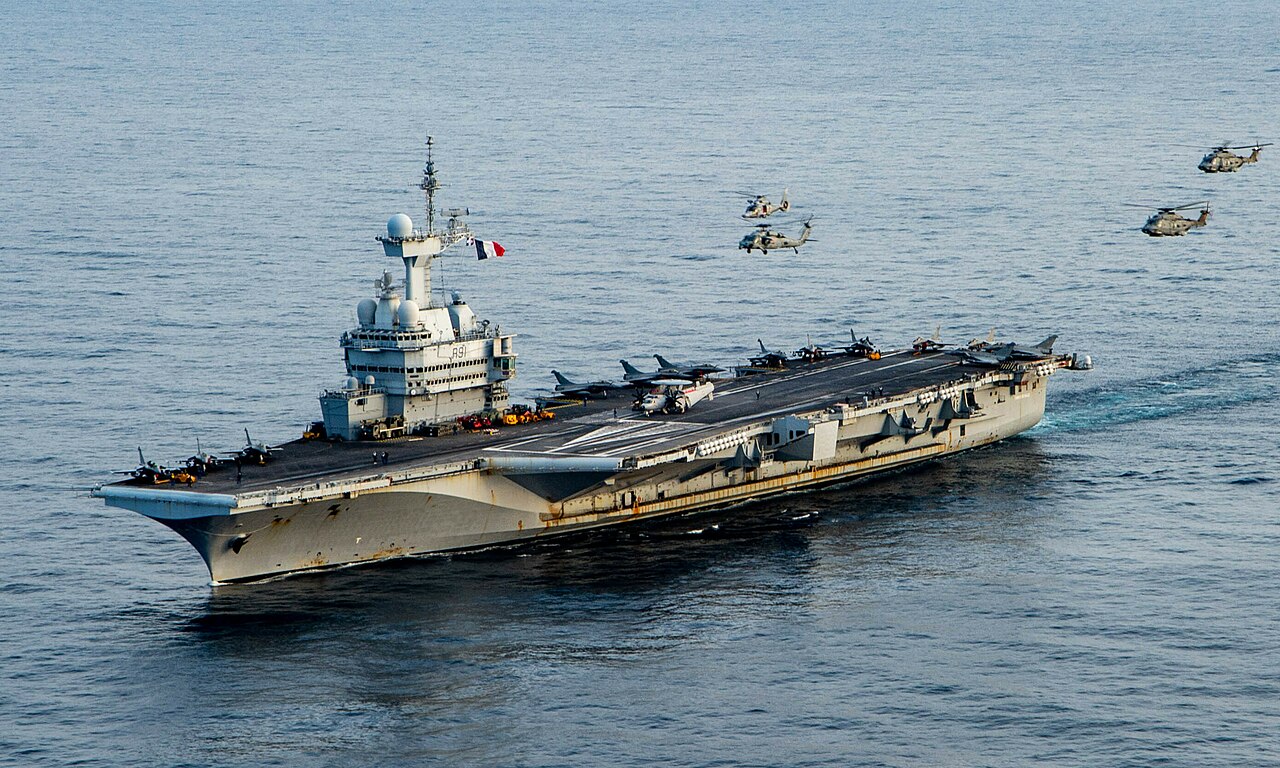
The French atomic-propelled aircraft carrier, Charles de Gaulle, was dispatched to the eastern Mediterranean Sea, forming part of a broader French naval reaction to escalating tensions tied to the conflict involving Iran.
The aircraft carrier, along with its escorting battle group, proceeded southward following the intensification of circumstances in the Middle East, as Paris endeavors to bolster European safety and aid in securing sea lanes in the area. This positioning is integral to a more extensive French naval footprint, encompassing further frigates and auxiliary ships active throughout the Mediterranean and Red Sea regions. Furthermore, France has conveyed that its maritime forces could back initiatives to secure commercial transit paths should circumstances worsen considerably.
Emmanuel Macron, the French head of state, stated that these maritime dispositions aim to uphold nautical safety and equilibrium, given the heightened strains throughout the vicinity. This action succeeded increasing apprehension regarding perils to maritime transport and local facilities, notably a recent unmanned aerial vehicle attack against Cyprus, which impelled European administrations to re-evaluate protection protocols in the eastern Mediterranean.
Functioning within international maritime zones, this aircraft carrier grants France the means to project warplanes and reconnaissance resources unburdened by the need for ground installations. Planes stationed aboard the vessel are capable of executing aerial protection patrols, observational sorties, and offensive maneuvers, simultaneously aiding allied maritime units in the vicinity.
Entering service in 2001, the Charles de Gaulle stands as the premier vessel of the French Fleet and the sole atomic-propelled aircraft carrier operational beyond the U.S. Navy. This craft extends to about 261 meters long and weighs roughly 42,000 metric tons when fully laden. Its nuclear power system enables the vessel to function for prolonged durations without needing replenishment, thereby providing substantial stamina and widespread operational capability.
This warship can host an air complement of approximately 40 aircraft, usually featuring Rafale M versatile combat aircraft, backed by E-2C Hawkeye aerial early detection planes and maritime rotorcraft. The vessel employs a CATOBAR (catapult-assisted take-off and arrested recovery) mechanism, featuring steam-powered launchers and braking cables, thereby enabling standard fixed-wing aircraft to launch and land from its flight deck.
For self-defense, the aircraft carrier is outfitted with Aster 15 ground-to-air missiles, Mistral close-proximity missile systems, and point-defense cannons, all intended to neutralize aerial and projectile dangers. Detection devices and electronic combat apparatus offer airborne detection and monitoring capacities, forming a component of a multi-tiered protection system in conjunction with the vessel’s accompanying ships.
As is common for many aircraft carriers, the ship typically serves as the core of an expansive carrier battle group. This formation commonly comprises frigates designed for air defense and anti-submarine warfare, an atomic-powered assault submarine, and logistical vessels, collectively forming a task force equipped for prolonged naval and aerial missions.