
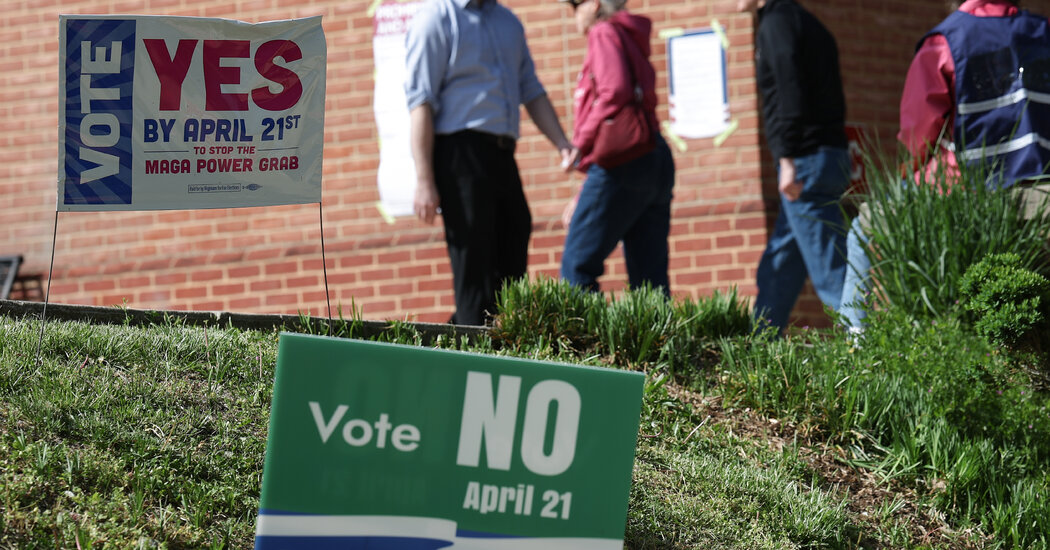
Virginia’s Supreme Court on Friday nullified a voter-approved measure that would have empowered Democratic state lawmakers to draw the state’s House map in a manner favorable to their party before upcoming midterm elections.
The 4-to-3 ruling represents a notable setback for the Democratic Party’s redistricting efforts, both within Virginia and in the broader national context of electoral map-drawing battles. The decision came approximately 17 days after Virginia voters approved the referendum, which had been seen by its proponents as a mechanism for the Democratic-controlled state legislature to potentially gain ground by redrawing up to four districts currently held by Republicans.
Here are four key aspects of the court’s decision and its implications:
Democrats Face National Redistricting Challenges.
The Virginia Supreme Court’s ruling adds to a series of challenges faced by Democrats in the ongoing national process of redrawing electoral districts. Following the referendum’s passage by approximately three percentage points last month, some political analysts had suggested that Democrats were achieving a more balanced outcome against Republican-led redistricting efforts across the country. Republican state lawmakers in Texas had initiated a significant redistricting push last year, reportedly at the urging of former President Trump, leading to widespread partisan maneuvering over district lines.
However, this perceived balance has shifted. A decision by the U.S. Supreme Court in late April, which reportedly weakened aspects of the landmark Voting Rights Act concerning electoral map challenges, appears to have encouraged Republican-controlled legislatures in states such as Tennessee, Alabama, and Louisiana to pursue new congressional district maps designed to benefit their party. Republicans in South Carolina have also reportedly begun exploring revisions to their state’s electoral maps in anticipation of the upcoming midterm elections.
With the Virginia decision, one of the more significant legislative successes for Democrats in the recent redistricting cycle has been overturned. The map envisioned by the Democratic legislature, if it had been implemented, would have reportedly left the state with only one district considered reliably Republican. Virginia’s congressional delegation currently consists of six Democrats and five Republicans, making any changes to district boundaries particularly impactful.
Following the ruling, former President Trump commented on social media, stating, “Huge win for the Republican Party, and America, in Virginia.”
Republican Advantage in Redistricting, But Midterm Outlook Complex.
While Republicans appear to have gained a strategic advantage in the national redistricting landscape following the Virginia decision and other state-level actions, the broader political forecast for the party ahead of the midterms remains nuanced. Analysts project that Democrats could face the loss of at least half a dozen districts currently considered safe, and potentially more, depending on the final outcomes of redistricting challenges and map approvals in Southern states where Republicans hold legislative majorities.
However, the redistricting battle represents only one component of the broader struggle for control of the House of Representatives. Republicans are simultaneously navigating several political challenges, including varying public approval ratings for the former president, public sentiment regarding ongoing international conflicts, and pressures from rising energy prices. These factors collectively contribute to a complex political environment that could influence voter behavior.
Reports indicate that some Republican representatives in swing districts have expressed concern about how current international events and domestic economic conditions might affect their re-election prospects in November. The political landscape is further complicated by reported disagreements between the former president and certain prominent international religious leaders regarding foreign policy matters, which have created internal friction within conservative political circles.
Virginia Court Cites Procedural Irregularity in Referendum Timing.
The Virginia Supreme Court’s decision to invalidate the referendum centered on a procedural issue related to its timing. The court determined that state lawmakers initiated the legislative process to place the measure on the ballot after the early voting period for the previous fall’s legislative contests had already begun. According to state law, the process for such a measure needed to be formally set in motion prior to the commencement of the election.
A significant portion of the legal arguments in the case revolved around the precise interpretation of when an “election” legally begins. The court ultimately concluded that the election period commenced with the start of early voting, not solely on Election Day itself. The majority opinion highlighted that by the time state lawmakers voted to advance the referendum, more than 1.3 million ballots had already been cast in the November 2025 election cycle, underscoring the procedural breach.
The court’s intervention, coming after voters had already cast their ballots on the referendum, was unusual. However, the majority opinion clarified that it had waited to resolve the constitutional question at the specific request of the Democratic-controlled state government, which had argued against a pre-referendum review.
The court stated in its opinion, “It is fair to ask whether we could have or should have reviewed the constitutionality of the proposed amendment prior to it being presented to the voters,” but noted that “Throughout this litigation, the Commonwealth has insisted that we cannot lawfully decide this case prior to the referendum.” This stance suggested the court respected the state’s preference to allow the democratic process to proceed to a popular vote before judicial intervention. The court also cited a precedent from 1958, where the Virginia Supreme Court had similarly reversed a referendum concerning state bonds after a public vote, indicating a history of post-vote judicial review in certain circumstances.
Potential for U.S. Supreme Court Appeal.
The legal dispute surrounding Virginia’s redistricting measure may not be concluded. Late Friday afternoon, legal representatives for the state of Virginia formally informed the Virginia Supreme Court of their intention to file an emergency petition with the U.S. Supreme Court, which is currently in an active term. Such an appeal, if pursued, would bring the matter to the nation’s highest judicial body.
The U.S. Supreme Court, currently characterized by a conservative majority, has previously demonstrated a nuanced approach to cases involving partisan redistricting. While it has allowed some latitude for political considerations in map drawing, as evidenced by its upholding of a Republican-drawn congressional map in Texas and a Democratic-drawn map in California, legal experts suggest that Democrats could face significant hurdles in persuading the court to take up this specific matter. A primary challenge stems from the fact that the Virginia Supreme Court’s decision was based on an interpretation of state law, rather than federal law or the U.S. Constitution.
Richard Hasen, an election law expert at the University of California, Los Angeles, commented on the potential appeal. He noted that while lawyers for the Virginia government might argue that the state court’s ruling inappropriately interferes with the state legislature’s authority, he considered such an argument a “long shot” given the procedural nature of the state court’s judgment. The office of Jay Jones, Virginia’s Attorney General and a Democrat, has confirmed it is actively evaluating its legal options for a potential challenge.
Maureen Edobor, an election law expert at Washington and Lee University School of Law, highlighted the U.S. Supreme Court’s past willingness to consider last-minute redistricting disputes, drawing parallels between the Virginia situation and a previous case in California. However, she tempered expectations for the Democrats, observing that given the U.S. Supreme Court’s current ideological composition, “I don’t think it looks good for the Democrats” regarding a favorable outcome.
Nick Corasaniti contributed reporting.
Why This Matters
This ruling from the Virginia Supreme Court carries significant implications for electoral politics, both within the Commonwealth and across the United States. Firstly, it immediately halts a Democratic-led initiative to redraw House districts, directly impacting the partisan balance and competitiveness of upcoming legislative elections in Virginia. The decision ensures that the state’s electoral map will not be redrawn by the Democratic legislature in a manner intended to create more favorable outcomes for their party, potentially preserving Republican strength in several districts.
Beyond Virginia, the case underscores the ongoing national struggle over redistricting, a process that shapes the political landscape for a decade. With the U.S. Supreme Court having recently weakened some federal oversight on electoral map challenges, state supreme courts and legislatures have become increasingly pivotal arenas for these battles. This Virginia decision reinforces a trend where state judicial bodies are actively scrutinizing and, at times, overturning redistricting efforts on procedural or constitutional grounds, even after public referendums.
Moreover, the potential appeal to the U.S. Supreme Court highlights the delicate balance between state sovereignty in election administration and federal judicial review. Should the nation’s highest court choose to hear a case decided purely on state law, it could signal a broader willingness to intervene in state-level electoral disputes, potentially setting new precedents for how redistricting challenges are adjudicated nationwide. The outcome of such appeals, often influenced by the court’s ideological leanings, can profoundly affect the fairness and partisan composition of legislative bodies, ultimately influencing policy-making and governmental control for years to come. The Virginia case, therefore, is not just about one state’s map but reflects the broader national contest for political power through the control of electoral boundaries.