
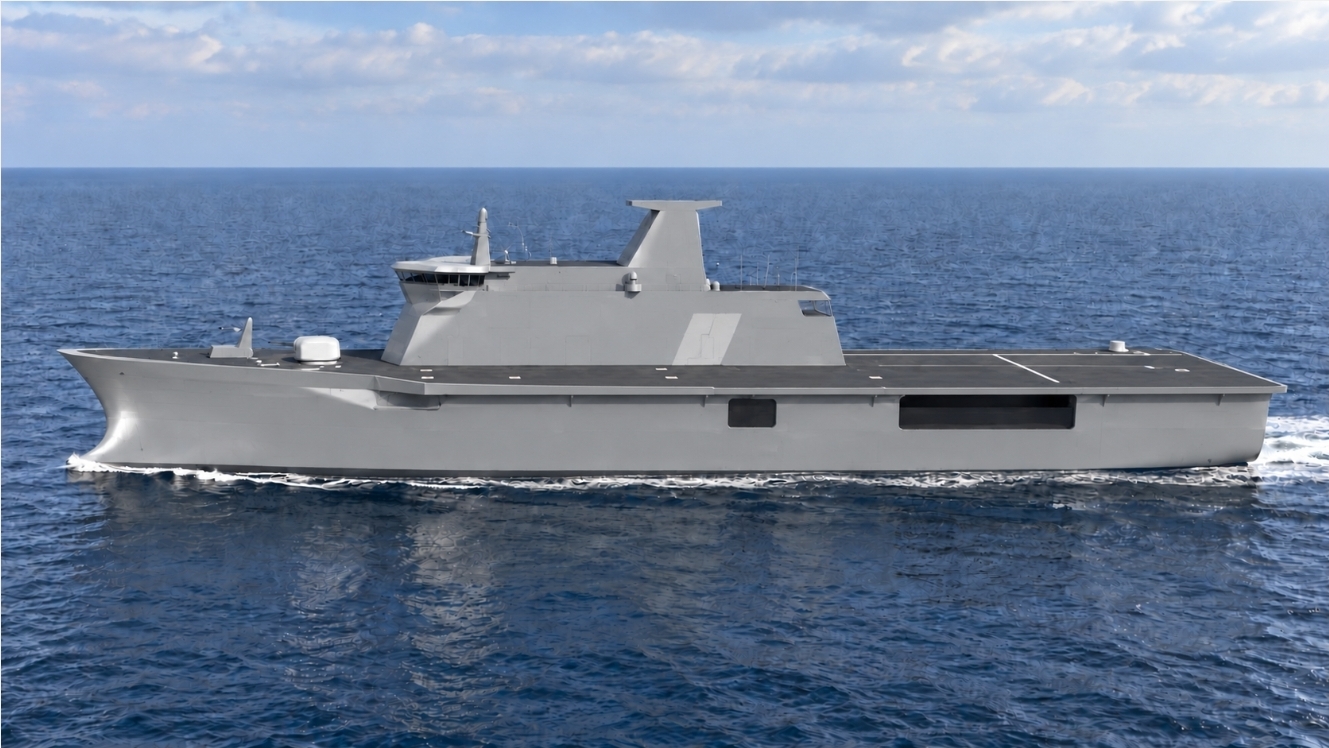
Conflicting Claims Emerge Over Construction Location of Anglo-Dutch Amphibious Ships
A significant divergence in statements has emerged regarding the future construction site of eight crucial amphibious transport ships, a joint project for the Royal Netherlands Navy and the Royal Navy under a £2.4 billion partnership. While a director from the Dutch shipbuilding group Damen has indicated its Romanian shipyard in Galati will undertake the construction of the vessels for the Netherlands, UK government ministers have consistently stated that all eight ships, including those for the Netherlands, will be built in the United Kingdom.
Damen’s Statement Points to Romania
Richard Keulen, Damen’s director of corporate strategy and innovation, recently provided comments to the Romanian news agency News.ro during the Euronaval exhibition in Paris. According to the report, Keulen stated that the next major project for Damen’s Galati shipyard in Romania will be the construction of amphibious transport ships specifically for the Dutch Navy. These vessels, he explained, are intended to support Dutch marine operations, functioning as advanced command platforms and critical logistics centres at sea.
Keulen noted that the specific design details of these ships are largely being kept confidential ahead of a scheduled defence exhibition in the Netherlands on 19 November, where more information is expected to be revealed. Furthermore, News.ro reported that Keulen mentioned the United Kingdom’s interest in joining the programme, with a potential plan to acquire four ships. However, he clarified that the final decision on Britain’s participation, and the practical arrangements for their involvement, ultimately rest with the respective governments.
UK Government Insists on British Construction
In notable contrast to Damen’s assertions, the UK government has repeatedly and publicly maintained that the entire fleet of eight ships will be constructed in Britain. This commitment was a central feature of the £2.4 billion UK-Netherlands partnership, which was formally announced at the NATO summit in Ankara in July. The agreement stipulates that both navies will operate four ships each, with the vessels expected to measure approximately 160 metres in length and displace around 15,000 tonnes.
At the time of the partnership’s announcement, the UK government’s official statement explicitly noted that “the vessels will be built in the UK to a Dutch design.” Then-Prime Minister Sir Keir Starmer reinforced this position, expressing “incredible pride that British shipyards will help deliver these ships.” He further articulated the broader strategic importance of the collaboration, stating: “This partnership is not just about building ships, it is also about delivering long term security.”
Further elaborating on the UK’s intent, Luke Pollard, the Minister for Defence Readiness and Industry, conveyed a strong message during a joint session of the Treasury and Defence Committees on 8 July. Pollard asserted that Britain would undertake the construction of all eight ships, including the four designated for the Netherlands. He explicitly stated that the UK would be “building them for the Netherlands as well.” While acknowledging that the specific shipyards involved had not yet been procured or named, Pollard outlined an ambition for the first ship to enter service “in the 2030s.” In a subsequent written answer to Parliament, he reiterated that these ships would form “the backbone of a strengthened UK-Netherlands amphibious force,” underscoring their strategic significance to both nations’ defence capabilities.
Uncertainty Amidst Unplaced Contracts and Geopolitical Considerations
Despite the unequivocal and differing statements from Damen and the UK government, a critical element remains unresolved: neither government has officially named a designer or a builder for the ships, and no formal contract has yet been placed. This absence of concrete contractual agreements contributes significantly to the ongoing uncertainty surrounding the project’s execution.
The Dutch maritime publication SWZ|Maritime reported in September that the precise location for the ships’ construction remained unclear. The report suggested that a British shipyard could potentially become involved if Damen were to select one as an alternative to its Galati facility. This consideration is partly influenced by Galati’s geographical location near the Black Sea, which could expose it to potential drone and missile attacks, particularly in the current geopolitical environment following the Russian invasion of Ukraine.
Observers note that the stated dimensions of the planned amphibious ships closely match Damen’s established Enforcer design, a versatile and modular platform frequently employed for similar naval vessels. Significantly, Keulen’s recent remarks did not specify where the Royal Navy’s four ships would be constructed. This omission leaves open the possibility that the Dutch and British components of the programme could ultimately be split between shipyards in different countries, despite the UK government’s stated preference for an entirely British build.
Shipbuilding Capabilities and Strategic Context
Damen’s Galati shipyard possesses a substantial track record in military vessel construction, having delivered over 30 naval ships for NATO and allied navies. Its notable previous projects include the HNLMS Den Helder, a combat support ship for the Dutch Navy. News.ro further reported that the Galati facility is scheduled to commence work next year on at least six anti-submarine frigates for the Netherlands and Belgium, in addition to completing a drone carrier for Portugal. This portfolio underscores the yard’s capacity and experience in handling complex naval construction projects.
Within the United Kingdom, several domestic shipyards are actively competing for the opportunity to build the amphibious ships. Prominent contenders include Navantia UK, which has publicly proposed its Belfast site, and Balaena, which is offering its own network of yards for the project. These bids reflect the UK’s industrial ambition to secure high-value defence contracts and to bolster its national shipbuilding capabilities as part of a broader industrial strategy.
Adding a strategic perspective, General Sir Gwyn Jenkins, the First Sea Lord, recently commented on the operational significance of these new vessels at the International Sea Power Conference in Oslo. He emphasized that the four new amphibious ships would substantially enhance the Royal Marines’ operational reach, thereby improving their global deployment capabilities and capacity for rapid crisis response.
Why This Matters
The ongoing uncertainty and conflicting statements regarding the construction location of the Anglo-Dutch amphibious transport ships hold significant implications across strategic, economic, and political domains for both the United Kingdom and the Netherlands, as well as for the broader NATO alliance.
Strategic Importance:These amphibious transport ships are critical assets for both the Royal Netherlands Navy and the Royal Navy. They form the core of their respective amphibious capabilities, enabling the projection of military power, rapid response to crises, conduct of humanitarian aid missions, and participation in complex multinational operations. Functioning as mobile sea bases, they are designed to deploy marines, vehicles, and equipment directly onto shorelines. The joint UK-Netherlands amphibious force is a foundational element of NATO’s maritime strength, enhancing interoperability and collective defence. Ensuring the timely and effective delivery of these ships is paramount for maintaining and strengthening the allied capacity to respond to evolving global security challenges, from expeditionary operations to safeguarding sea lanes.
Economic Impact and National Industrial Strategy:A defence procurement project valued at £2.4 billion represents a substantial economic investment. For the UK, securing the build of all eight ships domestically would provide a significant boost to its shipbuilding industry, supporting thousands of jobs directly in shipyards and indirectly across an extensive supply chain. This aligns with the UK government’s stated ambition to revitalize its national shipbuilding strategy, fostering critical industrial capabilities and promoting economic growth. Conversely, if Damen’s Galati yard secures the Dutch portion of the build, it would reinforce Romania’s position within the European defence industrial base and provide substantial economic benefits to that nation. The decision directly impacts national employment, skills development, and the long-term viability of major industrial sectors in the countries involved.
Geopolitical Considerations and Supply Chain Resilience:The mention of Galati’s proximity to the Black Sea and its potential exposure to Russian drone and missile attacks introduces a significant geopolitical dimension. While Galati has a proven track record, the current security environment in Eastern Europe necessitates careful consideration of supply chain resilience, strategic vulnerability, and the protection of critical defence assets. Distributing construction, or concentrating it in a potentially exposed area, requires robust risk assessments and mitigation strategies. This situation also highlights the broader challenge for European defence procurement in balancing cost-effectiveness, industrial capacity, and geopolitical realities in a complex security landscape.
Transparency and Political Accountability:The conflicting public statements from Damen and the UK government raise questions about transparency in defence procurement processes and the coordination between allied governments and industrial partners. For the UK government, its repeated assurances of an all-British build create a political imperative to deliver on those promises. A deviation from this stated policy could lead to scrutiny regarding government communication, accountability, and the efficient execution of major defence projects. For Damen, its public statements signal confidence in its Romanian operations and could influence market perceptions. Achieving clarity on who builds what, and where, is essential for maintaining public trust and ensuring accountability in significant defence expenditure.
Future of Anglo-Dutch Defence Cooperation:The UK-Netherlands amphibious partnership is a cornerstone of a long-standing and deep defence relationship, representing a model of bilateral military cooperation within NATO. How this significant joint procurement project is ultimately executed will serve as a bellwether for future collaborative defence initiatives between these two nations and potentially for wider European defence partnerships. Ensuring a mutually beneficial and transparent outcome, even if it involves distributed construction, is crucial for strengthening this vital alliance and setting a positive precedent for future NATO cooperation.