
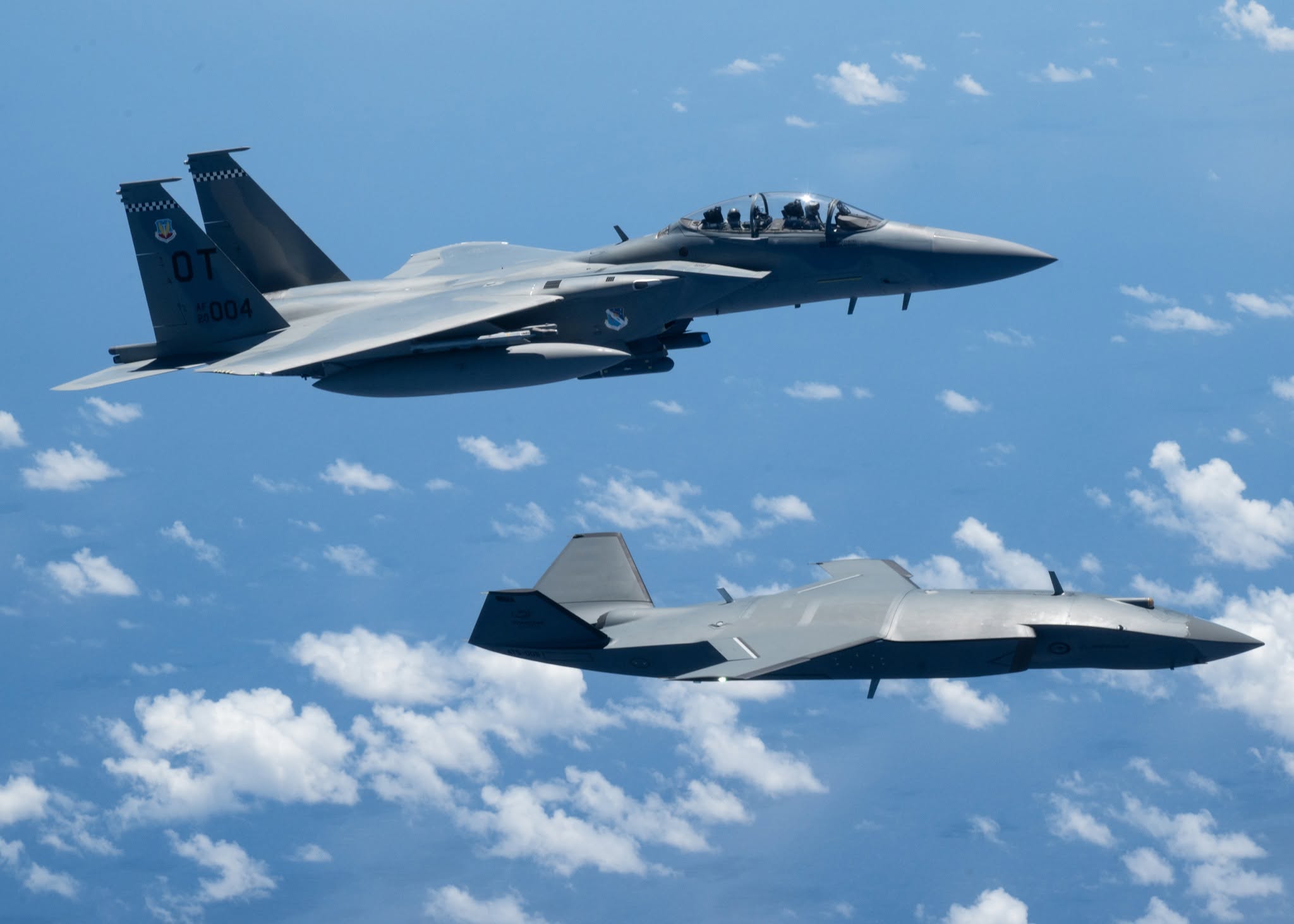
The United States Air Force recently achieved a significant milestone in its pursuit of advanced aerial combat capabilities, showcasing the future of human-machine teaming in a major Pacific exercise. An F-15EX Eagle II fighter jet flew in formation with an uncrewed Collaborative Combat Aircraft (CCA) over the Philippine Sea during Exercise Valiant Shield 26.
Pacific Air Forces (PACAF) officially announced this historic flight on July 1 through a social media post, highlighting its importance in demonstrating “the future of human-machine teaming in the theater.” This event marks a tangible step forward in integrating autonomous systems with traditional manned aircraft, a cornerstone of the Air Force’s vision for future warfare.
The F-15EX Eagle II involved in the exercise is currently in the region visiting Kadena Air Base in Japan. Its presence is part of a broader initiative to familiarize personnel with the aircraft in preparation for its permanent basing at Kadena in the coming years. This move underscores the F-15EX’s strategic importance for operations in the Indo-Pacific theatre.
The Collaborative Combat Aircraft participating in Valiant Shield was identified as Boeing’s MQ-28 Ghost Bat, an Australian-developed unmanned aerial vehicle (UAV). Its inclusion in the exercise is designed to provide Airmen with practical experience in operating manned fighters in conjunction with semi-autonomous drones, a crucial skill set for future combat scenarios.
Both the F-15EX and the broader concept of CCAs are projected to form integral parts of the U.S. Air Force’s future combat fleet. The F-15EX represents a heavily upgraded iteration of the venerable fourth-generation F-15 platform. It is envisioned not as a replacement, but as a complementary asset to advanced stealth fighters such as the F-22 Raptor and F-35 Lightning II. The F-15EX’s primary role is to act as a “missile truck,” capable of carrying a substantially larger ordnance payload, thereby extending the range and firepower of combat air patrols. The Air Force recently underscored its commitment to this platform by doubling its planned fleet size, increasing the procurement from 129 to a total of 267 aircraft.
Collaborative Combat Aircraft, meanwhile, are designed to significantly expand the Air Force’s “combat mass” – the sheer volume of aircraft and firepower it can bring to bear – at a lower acquisition and operational cost. Critically, these uncrewed platforms aim to reduce the exposure and risk to human pilots, who remain at the core of their operational formations. Initial versions of CCAs are expected to carry air-to-air weapons, enhancing offensive and defensive capabilities. Future iterations could be adapted for a diverse range of missions, including intelligence, surveillance, and reconnaissance (ISR), electronic attack, and even acting as decoys or communication nodes.
It is important to note that while the MQ-28 Ghost Bat was utilized in this exercise, the Air Force has formally committed to procuring other CCA models for its operational fleet: General Atomics’ FQ-42 and Anduril’s FQ-44. The use of the MQ-28 in Valiant Shield highlights its utility as a testbed or surrogate platform for developing and refining the operational concepts for human-machine teaming before the purpose-built CCAs become fully operational.
This flight over the Philippine Sea marks the first instance where the U.S. Air Force has publicly released imagery of a CCA flying in direct conjunction with a manned fighter. While previous tests of manned-unmanned teaming (MUM-T) have been conducted, they had not been visually documented in this manner. In October of the previous year, an F-22 pilot successfully controlled an MQ-20 “CCA surrogate” drone directly from the fighter’s cockpit during a test conducted in Nevada. More recently, in May, an F-35 pilot demonstrated control over an MQ-20 from a ground-based station. However, no prior tests involving the F-15EX specifically in a MUM-T capacity had been publicly announced.
A key aspect that remains undisclosed is whether the F-15EX pilot was actively controlling the MQ-28 Ghost Bat during the Valiant Shield flight. When questioned, a PACAF spokesperson stated that the command would not discuss “specific flight operations or tactical integration details,” maintaining operational security regarding these cutting-edge capabilities. This ambiguity underscores the ongoing and often classified nature of developing advanced human-machine teaming protocols.
Why This Matters
The flight of an F-15EX alongside an uncrewed Collaborative Combat Aircraft during Exercise Valiant Shield 26 represents more than just a technological demonstration; it signals a fundamental shift in military aviation strategy with far-reaching implications. This development is crucial for several reasons:
- Redefining Airpower and Combat Mass:The integration of CCAs with manned fighters allows the Air Force to significantly increase its “combat mass” without the prohibitive costs associated with building and maintaining a larger fleet of highly advanced manned aircraft. Drones can be produced more rapidly and cost-effectively, allowing for greater numerical superiority and distributed operations across a vast theater like the Indo-Pacific. This shifts the calculus of force projection and deterrence.
- Strategic Importance in the Indo-Pacific:The exercise’s location over the Philippine Sea is highly significant. This region is a focal point of geopolitical competition, particularly with China. Developing robust human-machine teaming capabilities allows the U.S. to project power, enhance its defensive posture, and maintain a technological edge in a theater where vast distances and potential adversaries with advanced capabilities present unique challenges. The F-15EX’s future basing in Japan further emphasizes this strategic focus.
- Reduced Risk to Human Pilots:A core tenet of the CCA program is to reduce the risk to human pilots. By employing autonomous drones for dangerous missions such as suppression of enemy air defenses, intelligence gathering in highly contested environments, or as forward scouts, the Air Force can preserve its most valuable assets—its highly trained personnel—while still achieving mission objectives. This ethical consideration influences future military doctrine and public perception.
- Accelerated Technological Advancement:This public demonstration indicates the rapid pace of development in AI, robotics, and autonomy in military applications. While the U.S. is a leader, other major powers are also investing heavily in similar technologies. The successful integration of CCAs could spark a new arms race in autonomous systems, compelling other nations to accelerate their own programs.
- Evolution of Warfare and Doctrine:The advent of human-machine teaming fundamentally alters the way air combat will be conceived and executed. Commanders will have new tools for deception, electronic warfare, multi-axis attacks, and extended sensor reach. This necessitates a complete rethinking of training, command and control structures, and operational doctrine, pushing military strategists to adapt to a future where autonomous systems play an increasingly vital role.
- Economic and Procurement Implications:The emphasis on more affordable, attritable (i.e., designed to be lost in combat) CCAs could reshape defense spending and procurement priorities. If CCAs prove effective and cost-efficient, it could lead to a rebalancing of investment between expensive manned platforms and lower-cost uncrewed systems, impacting defense industries globally.
In essence, this exercise is a harbinger of a new era in air warfare, demonstrating how advanced technology, strategic foresight, and innovative operational concepts are converging to redefine national security capabilities in the 21st century.