
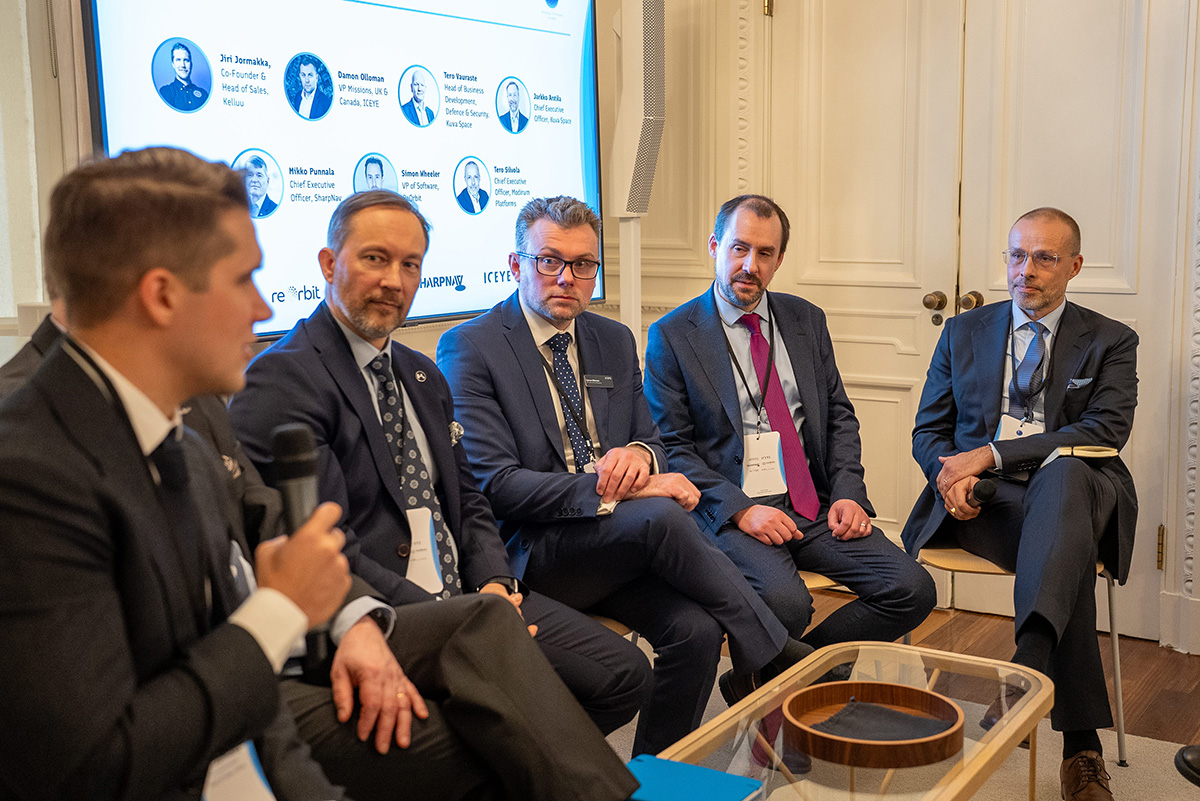
In London, Finland displayed its aeronautical and military capabilities as Helsinki aims for enhanced collaboration with the United Kingdom on robust European space and security technologies.
The significant discussions, convened at the Finnish Ambassador’s Residence and sponsored by the Embassy of Finland, centered on Earth Observation, Positioning, Navigation and Timing, as well as space-assisted operational understanding. This gathering united UK security sector representatives with six Finnish cosmic and safety technology enterprises: ICEYE, Kuva Space, Kelluu, Modirum Platforms, ReOrbit and SharpNav.
Commencing the proceedings, Ville Tavio, Finland’s Minister for Foreign Trade and Development, positioned the conversation amidst an evolving European safety landscape.
“Within the present global political situation, Europe needs to cultivate its proficiencies to boost its ability to operate independently and lessen external reliance. We must guarantee that European cosmic strengths are advanced optimally,”he stated.
Tavio contended that Finland and the UK were ideally positioned for more intimate collaboration, connecting security partnership with financial expansion and industrial prospects.
“Within this domain, we perceive that Finland and the UK would form a superb pairing. Both nations require expansion and affluence. Furthermore, we need commercial engagement and increased alliances with aligned and dependable nations and corporations.”
Ambassador Teemu Turunen emphasized the autonomy concept, cautioning that dependence on foreign providers entails tactical peril and asserting that“each reliance constitutes a susceptibility.”
The Finnish representatives underscored how their operational context, featuring a 1,300-kilometre frontier with Russia and common northern climates, has motivated the advancement of hybrid-purpose advancements intended for use in challenged and disputed contexts. Among the strengths showcased were synthetic aperture radar orbital visuals, multi-spectral terrestrial monitoring analyses, GPS-hardy guidance mechanisms, programmable orbital communication, low-level continuous intelligence, surveillance, and reconnaissance platforms, alongside safe, compatible operational frameworks.
Presenters emphasized the pertinence of such innovations for naval access routes, arctic operational zones, and robust management and supervision, especially in areas where electronic interference and restricted zones are anticipated. Major General (Ret.) Juha-Pekka Keränen, former Commander of the Finnish Air Force, noted that commercially-created cosmic innovations had already revolutionized situational understanding and aiming processes, underscoring the criticality of independent data retrieval and unified detection systems in cross-domain missions.
A following group debate examined real-world obstacles to collaboration, such as acquisition schedules and compatibility. Attendees urged for quicker trials, brief trial contracts, and prior involvement between governments and nascent innovation companies to transition innovations from showcasing to practical deployment.