
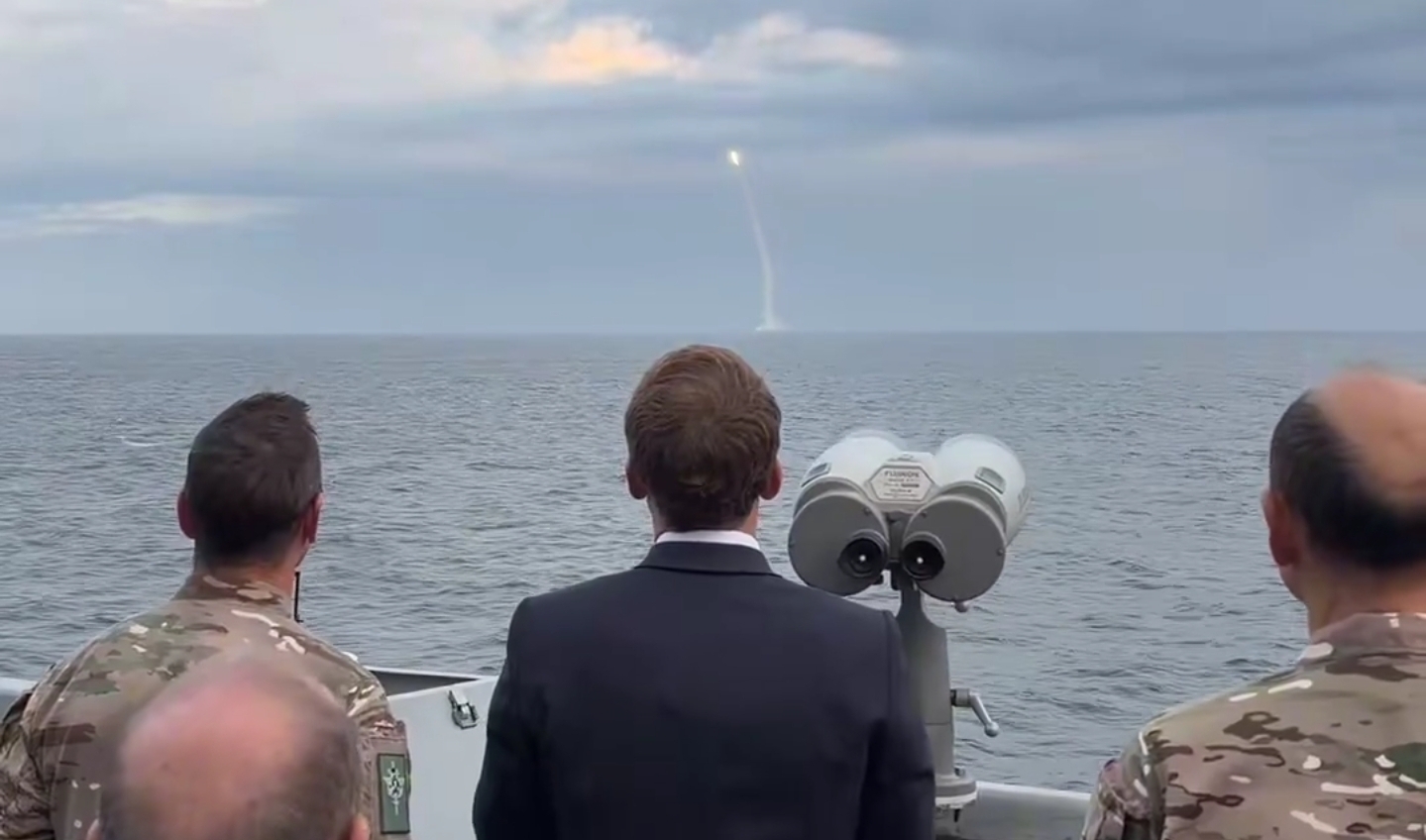
France has successfully conducted the first test firing of its new M51.3 ballistic missile from the nuclear-powered ballistic missile submarine (SSBN) *Le Vigilant*. The launch, which took place off Finistère in western Brittany, marks a significant milestone in the modernization of France’s strategic nuclear deterrent.
President Emmanuel Macron, who was aboard the multi-mission frigate *Auvergne* to observe the event, underscored the advanced capabilities demonstrated by the test. He stated, “Aboard the multi-mission frigate Auvergne, I witnessed the first firing of the new M51.3 ballistic missile from the nuclear-powered ballistic missile submarine Le Vigilant. Very few nations possess such expertise.” The missile, which was not fitted with a nuclear warhead as is standard practice for such tests, flew to a designated impact area in the North Atlantic, several hundred kilometres from any coastline.
The successful trial serves to validate the operational capability of *Le Vigilant*’s strategic weapon system following its recent emergence from a major overhaul, known in France as an IPER (Indisponibilité Pour Entretien et Réparations Majeures), before the submarine returns to its deterrent patrol cycle. This refit is critical to ensuring the long-term readiness and effectiveness of France’s SSBN fleet, which forms the cornerstone of its nuclear posture.
The M51.3 represents the third operational version of the M51 family of submarine-launched ballistic missiles. It was declared in service in October of the preceding year and incorporates several key enhancements over its predecessor, the M51.2. These improvements include increased range, enhanced accuracy, and superior penetration performance, crucial for overcoming advanced missile defence systems. The M51.3 also carries the newer TNO (Tête Nucléaire Océanique) warhead, further boosting its effectiveness. ArianeGroup, a joint venture between Airbus and Safran, is responsible for building the M51 missile family, which initially entered service in 2010. These advanced missiles arm the four submarines of the *Triomphant*-class, including *Le Vigilant*.
Looking to the future, a further version, the M51.4, was contracted to ArianeGroup in August of the previous year. This next iteration of the missile is anticipated to become operational during the next decade, coinciding with the planned deployment of France’s third-generation submarines, which will eventually replace the current *Triomphant*-class fleet. While France maintains strict classification over the missile’s exact capabilities, published range figures for the M51 family generally fall between 8,000 and 10,000 kilometres, although these numbers remain unconfirmed by French authorities.
President Macron leveraged the occasion to highlight his administration’s commitment to defence spending and national security. He asserted that he initiated the renewal of French military capabilities in 2017, leading to a projected doubling of the armed forces budget over a ten-year period. Furthermore, he announced the launch this year of a program for hypersonic and maneuvering strategic missiles, which are intended to arm the airborne component of France’s deterrent. This initiative refers to the successor weapon for the ASMP-A (Air-Sol Moyenne Portée Amélioré) carried by Rafale fighter squadrons, ensuring the continuous modernization of all facets of the French nuclear triad, albeit a primarily sea and air-based one.
A distinctive aspect of France’s nuclear strategy is its complete national control and independence. France designs, builds, and owns every element of its deterrent, from the nuclear warhead itself to the missile delivery system and the submarines that carry them. This contrasts sharply with the United Kingdom, whose Royal Navy draws its Trident II D5 missiles from a common pool held at King’s Bay in Georgia, United States, highlighting France’s deep-seated commitment to strategic autonomy.
Despite these differences in procurement and doctrine, France and the United Kingdom have recently demonstrated closer cooperation on nuclear matters than at any point since the Second World War. Under the Northwood Declaration, signed last year, both nations agreed to coordinate their deterrents and made an unprecedented joint statement. They declared that there is no extreme threat to Europe that would not prompt a response by both countries, marking a significant evolution in their bilateral security relationship. President Macron concluded his remarks by reaffirming that French nuclear deterrence “protects us and will continue to protect us,” underscoring its enduring role in national defence.
Why This Matters
The successful test firing of the M51.3 ballistic missile by France carries significant implications for national, European, and global security. Firstly, it emphatically reinforces **France’s strategic autonomy** as one of the world’s independent nuclear powers. Unlike other NATO allies who rely on extended deterrence from the United States, France maintains a fully sovereign nuclear arsenal, designing and producing every component from warheads to submarines. This independence grants France unique leverage and decision-making freedom on the international stage, influencing European security architecture and its role within alliances.
Secondly, the test directly impacts the **credibility and modernization of France’s nuclear deterrence**. In an increasingly volatile global environment, marked by renewed geopolitical tensions and conventional warfare in Europe, a reliable and modern nuclear deterrent is paramount. The M51.3’s enhanced range, accuracy, and penetration capabilities demonstrate France’s commitment to maintaining a robust deterrent force that can overcome evolving anti-missile technologies, thereby deterring potential adversaries from aggression against French interests or those of its allies. This ongoing modernization, including future versions like the M51.4 and new-generation submarines, signals a long-term commitment to its nuclear posture.
Thirdly, this event showcases **France’s advanced technological and industrial prowess**. The development and deployment of sophisticated ballistic missiles and nuclear-powered submarines require cutting-edge engineering, manufacturing, and scientific capabilities. The involvement of entities like the DGA, Atomic Energy Commission, ArianeGroup, and Naval Group underscores France’s ability to innovate and execute highly complex defence projects, supporting high-tech domestic industries and generating skilled employment.
Finally, the test sends a clear **geopolitical signal**. At a time when the war in Ukraine has reshaped security perceptions across Europe, France’s display of its nuclear capabilities serves as a message to both allies and potential adversaries. It reaffirms France’s resolve to defend its national interests and contribute to the collective security of Europe. The unprecedented Northwood Declaration with the United Kingdom further highlights a coordinated approach to extreme threats within Europe, albeit with distinct national nuclear forces, adding another layer of complexity and potential stability to the continent’s security landscape.