
A significant number of former Airmen, exceeding three dozen, are currently campaigning for seats in the U.S. Congress, encompassing candidates from the Democratic, Republican, and various third-party or independent affiliations. This diverse group includes individuals who served as both officers and enlisted personnel across the Active Duty Air Force, Air National Guard, and Air Force Reserve components. Their ranks include both incumbent members seeking re-election and individuals new to the political arena.
The upcoming election cycle coincides with the departure of several prominent military veterans from the legislative body. Among them is Representative Don Bacon (R-Neb.), a retired brigadier general of the Air Force, who has played a key role in legislation directly impacting his former service. His contributions include advocating for the recapitalization of Air National Guard fighter squadrons, scrutinizing the concept of pass-through funding within the Air Force budget, and contributing to discussions on the 2050 force design strategy. Representative Bacon’s district notably encompasses Offutt Air Force Base in Nebraska, headquarters to U.S. Strategic Command.
Representative Bacon is currently the highest-ranking among the 15 Air Force veterans serving in the present Congress. He is not alone in his departure, as Representative Vern Buchanan (R-Fla.) and Representative Barry Loudermilk (R-Ga.), both Air Force veterans, are also retiring. Senator Lindsey Graham (R-S.C.), a distinguished “total force Airman” with service across all three Air Force components, continues his tenure in the Senate, actively participating in national security and defense policy debates.
Despite these departures, the representation of former Airmen in Congress could potentially increase in the next legislative session, pending the outcomes of the upcoming elections. A cohort of new candidates, many of whom are either projected to win or are considered highly competitive in their respective House races, includes:
- Chris McGowan(R-Iowa) is widely favored in his contest. He served in the U.S. Air Force and the Iowa Air National Guard. After attending Undergraduate Pilot Training, he reclassified as an intelligence officer, according to his official biography.
- Jace Yarborough(R-Texas), also heavily favored, has completed active duty service and continues to serve in the Air Force Reserve. An attorney, he has publicly highlighted his legal work challenging military policies related to past vaccine mandates, religious discrimination, taxpayer-funded abortion travel, and diversity, equity, and inclusion initiatives.
- David Flippo(R-Nev.) is considered slightly favored in his race. He is a retired U.S. Air Force lieutenant colonel and a former maintenance and logistics officer. His official biography credits him with establishing three combat bases in Iraq. He previously stated he received a Bronze Star for valor but later clarified that his award was a Bronze Star without the valor device.
- Carlos De La Cruz(R-Texas) is engaged in a race identified by pollsters as a toss-up. He served 20 years in the Air Force as a Military Working Dog handler and an intelligence professional, undertaking multiple deployments to the Middle East.
- Rebecca Bennett(D-N.J.) is competing in a tightly contested race. She is a former U.S. Navy helicopter pilot who now serves in the Air National Guard.
- Eric Conroy(R-Ohio) is currently viewed as a slight underdog. A graduate of the U.S. Air Force Academy, he is a former intelligence officer who supported Special Operations units and later served with the Central Intelligence Agency (CIA).
- Kristina Knickerbocker(D-Ohio) is also considered a slight underdog. An Air Force major and a nurse, she has served in both Active Duty and Reserve capacities. She is campaigning to represent the congressional district that includes Wright-Patterson Air Force Base, Ohio.
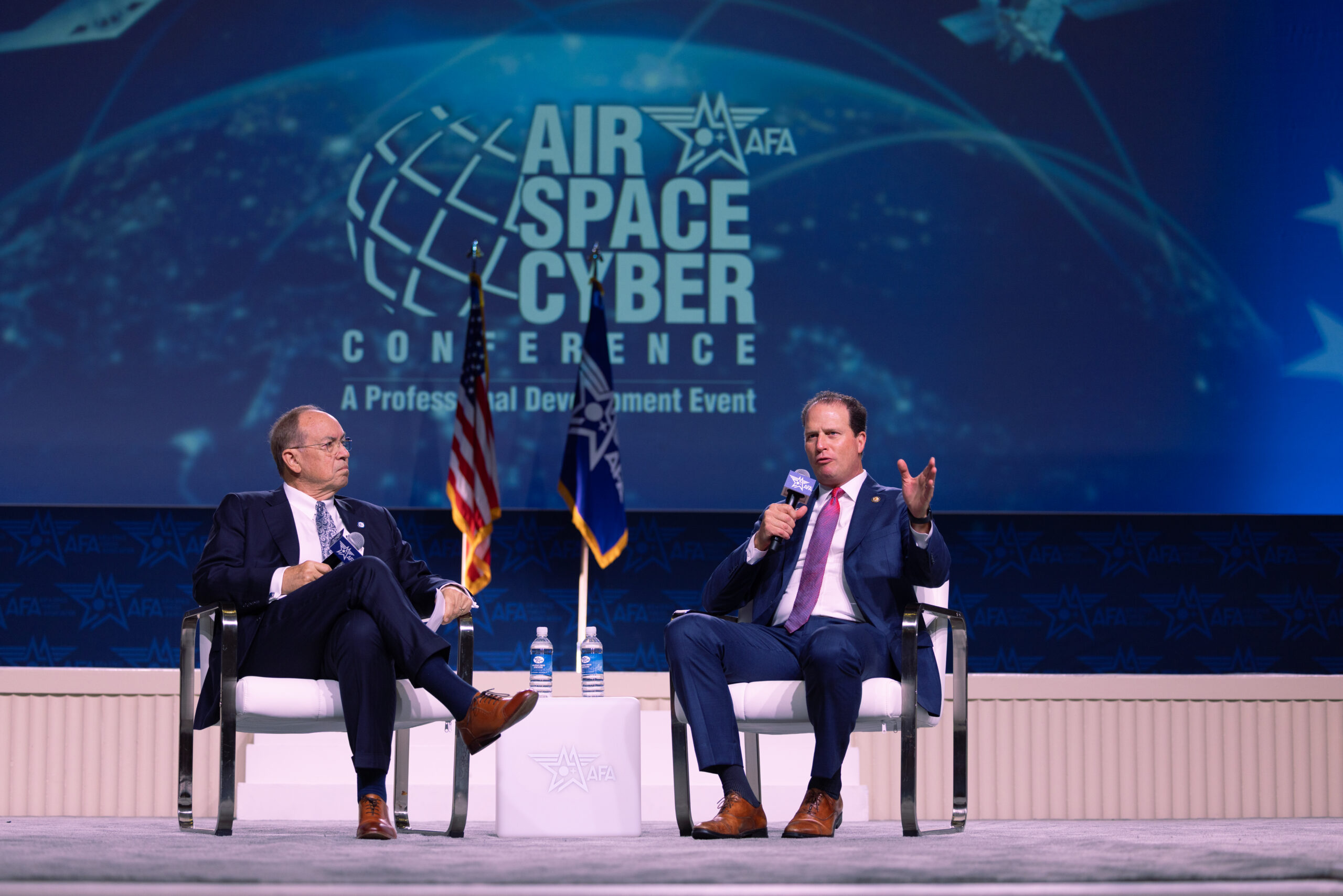
When combined with House incumbents running in secure seats and Senators whose terms are not up for re-election in this cycle, these incoming members could significantly bolster the number of individuals with Air Force backgrounds in the Capitol. Among the current and potentially future representatives, former F-22 pilot Representative August Pfluger (R-Texas) is notable as the sole fighter pilot. In September, at the Air & Space Forces Association’s Air, Space & Cyber conference, Representative Pfluger publicly called for more “wingmen” to join him in the legislative body.
“I am the only fifth-generation pilot in Congress,” Representative Pfluger stated. “I need some wingmen to come join me. … God bless my Navy SEAL friends, and they are dear friends, but we’ve got a lot of them in Congress. What we don’t have is a lot of air and space expertise.”
Representative Pfluger, who faces minimal challenge in his re-election bid, could be positioned for a leadership role within the Republican conference, depending on the broader outcomes of the general election, according to reports from Punchbowl News. Another Air Force veteran whose leadership status may be influenced by the election results is Senator Roger Wicker (R-Miss.). A former Air Force Judge Advocate General (JAG) officer, Senator Wicker currently chairs the Senate Armed Services Committee. Should Democrats secure a majority in the Senate, he would transition to serving as the ranking member of the committee.
Identified Air Force Veterans Running for Congress in the Upcoming Election Cycle*
* Air & Space Forces Magazine made every effort to include all Air Force veterans running for Congress in this list. It is possible that one or more veterans who have not publicized their service may also be among the hundreds of challengers seeking seats in the House and Senate.
Why This Matters
The increasing number of former Airmen seeking and potentially gaining seats in Congress carries significant implications for national defense policy, military oversight, and the broader legislative agenda. The presence of individuals with direct experience in air and space operations, logistics, intelligence, and military culture can provide invaluable institutional knowledge to congressional committees responsible for armed services, appropriations, and foreign affairs. Their unique perspectives can inform debates on military readiness, defense spending, technological advancements, and the welfare of service members and their families. For instance, discussions on aircraft procurement, space force development, and personnel issues like healthcare and housing often benefit from the nuanced understanding that only those with firsthand experience can offer.
Furthermore, the representation of specific military branches can influence the allocation of resources and strategic priorities within the defense budget. As highlighted by Representative Pfluger, an increase in “air and space expertise” could lead to a more informed and perhaps more assertive congressional stance on Air Force and Space Force needs, potentially balancing the influence of other service branches that are historically well-represented. This could affect decisions on force structure, modernization efforts, and the strategic direction of the nation’s air and space power. The departure of experienced legislators like Representative Bacon, who championed specific Air National Guard initiatives, underscores the importance of new voices filling these roles to ensure continuity and advocacy for critical defense components.
Beyond defense specifics, military veterans, regardless of branch, often bring a distinct set of leadership skills, a sense of public service, and a pragmatic approach to problem-solving to the legislative process. Their diverse backgrounds—from pilot to intelligence officer to nurse—reflect the multifaceted nature of the Air Force itself and can enrich congressional deliberations across a wide range of domestic and international issues. While military service does not dictate political affiliation, the shared experience of serving in uniform can sometimes foster a bipartisan approach to national security challenges. Ultimately, the influx of these veterans into Congress has the potential to reshape legislative priorities, improve oversight of the military, and ensure that policymaking is grounded in a deep understanding of the challenges and capabilities of the U.S. armed forces.