
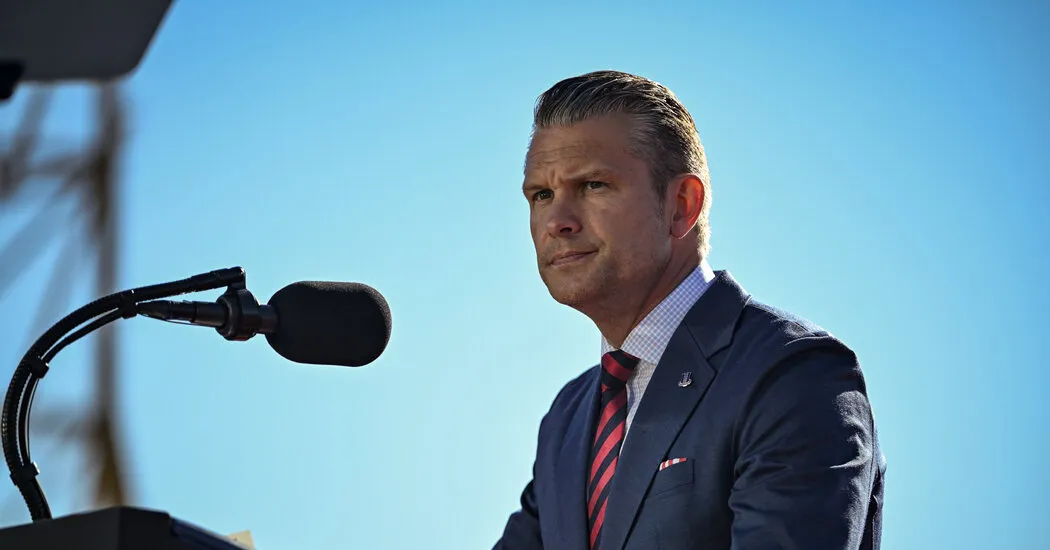
U.S. Defense Secretary Pete Hegseth conducted an unannounced visit to Israel on Monday, where he met with Prime Minister Benjamin Netanyahu. The visit came a day after President Donald Trump publicly endorsed Mr. Netanyahu, who is currently engaged in a closely contested election campaign ahead of the Oct. 27 vote.
Secretary Hegseth’s trip underscored growing frustration within the Trump administration regarding diplomatic efforts that have, to date, failed to yield a lasting resolution to the ongoing military campaign in Iran. This frustration has been accompanied by public threats from President Trump to initiate new strikes against Iranian targets.
The meeting between Secretary Hegseth and Prime Minister Netanyahu also included Israel’s Defense Minister, Israel Katz. It took place at the Ovda Israeli Air Force base, located in the southern part of the country, according to Doron Spielman, a spokesman for the prime minister’s office. The choice of location, a key military installation, suggested a focus on strategic and security discussions.
While specific details of the discussions between Secretary Hegseth and his Israeli counterparts were not immediately disclosed, the timing and participants indicated a focus on regional security challenges, particularly those involving Iran, as well as the broader strategic alliance between the United States and Israel.
Mr. Spielman declined to comment directly on whether the possibility of attacking Iran was discussed during the high-level talks. He stated that the officials focused on the collaborative efforts between the two nations in countering “threats in the region,” a phrase commonly used by both U.S. and Israeli officials to refer to Iran’s regional activities and nuclear ambitions.
During his unannounced tour, Secretary Hegseth also visited troops assigned to U.S. Central Command (CENTCOM), the operational command responsible for American military operations across the Middle East. On Tuesday, he posted photographs on social media depicting himself engaging with soldiers in front of a fighter jet. However, his posts did not specify the location of this visit, nor did they explicitly confirm his travel to Israel or his meeting with Prime Minister Netanyahu, maintaining an element of discretion around his movements.
The presence of American soldiers and refueling aircraft in Israel has been a feature of the regional security landscape since the United States and Israel commenced military action against Iran in late February. This deployment underscores the joint nature of the ongoing campaign and the close operational coordination between the two allies.
The initial report of Secretary Hegseth’s trip to Israel and his meeting with Prime Minister Netanyahu was first broken by the news outlet Axios, highlighting the often-covert nature of high-level diplomatic and military engagements in volatile regions.
President Trump’s public pronouncements regarding Iran have been characterized by a degree of inconsistency. In late September, during an address to the United Nations General Assembly, he suggested that Washington could pursue renewed military action and issued a direct threat to “annihilate” Iran. However, earlier this month, the President utilized social media to state that he would not launch a new attack before the midterm elections scheduled for November, creating uncertainty about the timing and resolve of potential U.S. military actions.
On Sunday, in response to President Trump’s endorsement, Prime Minister Netanyahu issued a statement expressing gratitude and reiterated a long-standing joint commitment from both nations: that Israel and the United States would collectively prevent Iran from acquiring nuclear weapons. This statement aligns with a core strategic objective shared by Washington and Jerusalem.
Despite the President’s oscillating public rhetoric, the U.S. military has reportedly prepared new strike plans targeting Iran. These preparations are said to include the potential deployment of additional forces to the Middle East, indicating a readiness for escalated military engagement should diplomatic efforts continue to falter or if political directives change. The continued development of these plans, even amidst varied public messaging from the President, highlights the ongoing strategic calculations within the Pentagon.
Many regional analysts suggest a high probability that the United States will ultimately decide to conduct strikes against Iran in the coming weeks or months. This assessment is largely based on the significant divergence in negotiating positions between the Trump administration and Tehran, which appears to have stalled any progress towards a diplomatic resolution to the current hostilities.
Raz Zimmt, who serves as the director of the Iran program at the Institute for National Security Studies, a prominent Tel Aviv-based research group, articulated this sentiment. He stated, “The baseline expectation in Iran, and in Israel, is that it’s a matter of when the war restarts, not if,” reflecting a pervasive sense of inevitability regarding further conflict escalation.
Mr. Zimmt further commented on the potential outcomes of such actions, adding, “An airstrike alone will probably not achieve the goals the U.S. and Israel hope to complete — but it might give Trump an image of victory and a way out of the war.” This perspective suggests that while military action might not resolve the underlying issues, it could serve domestic political purposes for the U.S. President.
The Israeli election is scheduled for October 27. Current opinion polls indicate that Prime Minister Netanyahu is facing a significant challenge and is trailing Gadi Eisenkot, a former chief of staff of the Israeli military who previously served under Mr. Netanyahu’s leadership. The competitive nature of this election amplifies the political significance of foreign endorsements and high-level visits.
On Tuesday, Mr. Netanyahu released a video statement in which he urged voters to support his re-election bid. In his appeal, he asserted that he was the individual President Trump desired by his side to “finish the job once and for all,” explicitly referencing the ongoing military campaign against Iran. This statement highlights Mr. Netanyahu’s strategy of leveraging his strong relationship with the U.S. administration to bolster his electoral prospects.
Further signaling heightened tensions and preparedness, the Israeli military announced on Monday that it had canceled soldiers’ leave beginning Thursday, just ahead of the upcoming election. This measure is typically enacted during periods of elevated security concerns.
Maj. Gen. Eyal Zamir, the chief of staff of the Israeli military, reinforced this message on Tuesday, stating that the country’s forces were maintaining “a high level of alertness and readiness” in the week leading up to the elections. He indicated that this heightened state was necessary to safeguard against potential “external interference,” a term that could encompass a range of threats from regional adversaries to cyberattacks aimed at disrupting the electoral process.
Adam Rasgon contributed reporting to this article.
Why This Matters
The confluence of U.S. Defense Secretary Hegseth’s unannounced visit to Israel, President Trump’s explicit endorsement of Prime Minister Netanyahu, and the ongoing military tensions with Iran carries significant geopolitical weight. First, it underscores the enduring strategic alliance between the United States and Israel, particularly in their shared concerns regarding Iran’s regional influence and nuclear program. The high-level, clandestine nature of the visit emphasizes the urgency and sensitivity of these discussions.
Second, the timing of the visit, days before a critical Israeli election where Prime Minister Netanyahu is trailing, highlights the intertwining of foreign policy with domestic politics. President Trump’s endorsement and Secretary Hegseth’s presence offer a powerful, visible show of support that Mr. Netanyahu is actively leveraging to appeal to voters. This suggests that U.S. actions can directly impact the outcome of democratic processes in allied nations, raising questions about political interference and diplomatic norms.
Third, the escalating rhetoric and military preparations concerning Iran signal a potentially critical juncture in the region. The U.S. administration’s stated frustration with diplomatic failures, coupled with the U.S. military’s reported strike plans and the Israeli military’s heightened alert, indicate that a renewed or expanded military conflict with Iran could be imminent. Such an escalation would have profound implications for regional stability, global energy markets, and international relations, potentially drawing in other regional and global powers. The expert analysis suggesting that renewed conflict is a matter of “when, not if,” combined with the possibility that military action might serve primarily domestic political purposes for the U.S. President, adds further complexity to an already volatile situation.
Ultimately, this complex set of events reflects a period of heightened uncertainty and potential instability in the Middle East, with significant implications for the future of U.S.-Israeli relations, Iran’s regional standing, and the broader global security landscape.