
The auditory content of this piece is presented by the Air & Space Forces Association, commemorating and aiding our service members, guardians, and their kin. Discover additional information at afa.org
MACDILL AIR FORCE BASE, Fla.—On March 4, at the primary facility of U.S. Central Command situated here, defense authorities spearheading the operation disclosed that the U.S. intends to dramatically increase its military might directed at Iran, specifically targeting its capital, Tehran.
Aerial bombardments are intensifying, and further fighter contingents are being dispatched.
“We’re not merely striking their current assets,” Adm. Brad Cooper, CENTCOM commander, stated. “We’re eradicating their capacity for reconstruction. Consequently, as we progress into the subsequent stage of this endeavor, we will deconstruct Iran’s prospective missile manufacturing capacity.”
Before the briefing at 5 p.m. Eastern Time, within the preceding 72 hours, Cooper stated, U.S. bombing aircraft hit 200 sites. B-2 aircraft executed a portion of these bombardments, targeting profoundly entrenched ballistic missile launch sites utilizing 2,000-pound munitions designed to penetrate hardened structures—seemingly GBU-31 JDAMs. Additionally, B-1B Lancer and B-52H Stratofortress bombing planes have conducted assaults within Iran, in areas such as near Tehran.
The U.K.’s resolution to grant the U.S. permission to utilize its installations located at Diego Garcia in the Indian Ocean and RAF Fairford, U.K., is expediting the assaults. Availability of these sites cuts the operational durations by half in contrast to the two-way journeys bombing aircraft previously undertook from the U.S.
Additionally, the U.S. has attacked an Iranian vessel transporting unmanned aerial vehicles, which, according to Cooper, possessed dimensions comparable to a World War II aircraft carrier.
Cooper stated that a 90 percent reduction has occurred in the initiation of ballistic missile attacks by Iran from the commencement of hostilities.
Iran retaliated with fresh menaces.
“Through pertinent mediators, Iran has issued a caution to nations harboring ground facilities and corporations supplying uplink transmissions for anti-Iranian insurgent groups,” a source cited by Tasnim, an Iranian quasi-official news outlet. The Tasnim report indicated that Iran declared “suitable measures will be enacted,” signaling a clear heightening in space-oriented assaults.
CENTCOM has assaulted Iran’s counterpart to the U.S. Space Command, Cooper noted, thereby “diminishing their capacity to menace Americans.”
Iran’s reprisal has largely proven counterproductive. Nations in the Gulf region, which had intended to remain uninvolved, have suffered hits from Iranian projectiles and unmanned aircraft.
“Those dozen nations are quite displeased, and I anticipate collaborating with all allies prepared to partake in this endeavor,” Cooper said.
Pete Hegseth, the Secretary of Defense, chose not to identify certain Gulf states that have permitted greater stationing and aerial passage for U.S. planes, but mentioned these nations are now cooperating more intimately with the Pentagon.
“Indeed, by striking allied countries that would typically prefer to remain uninvolved, Iran’s actions have effectively drawn them into the U.S. sphere of influence,” Hegseth remarked. “Consequently, the UAE, Qatar, Bahrain, Saudi [Arabia], Kuwait, and others are affirming, ‘We stand with you. We will fire alongside you. We will soar alongside you. We will protect with you. We will grant you additional stationing rights’—much of which remains undisclosed and will not be discussed—yet it is actually solidifying the cohesion of the opposition, enabling us to concentrate precisely where necessary.”
Numerous regional nations deploy U.S.-manufactured Patriot and THAAD systems, and have also intensified their fighter aircraft surveillance.
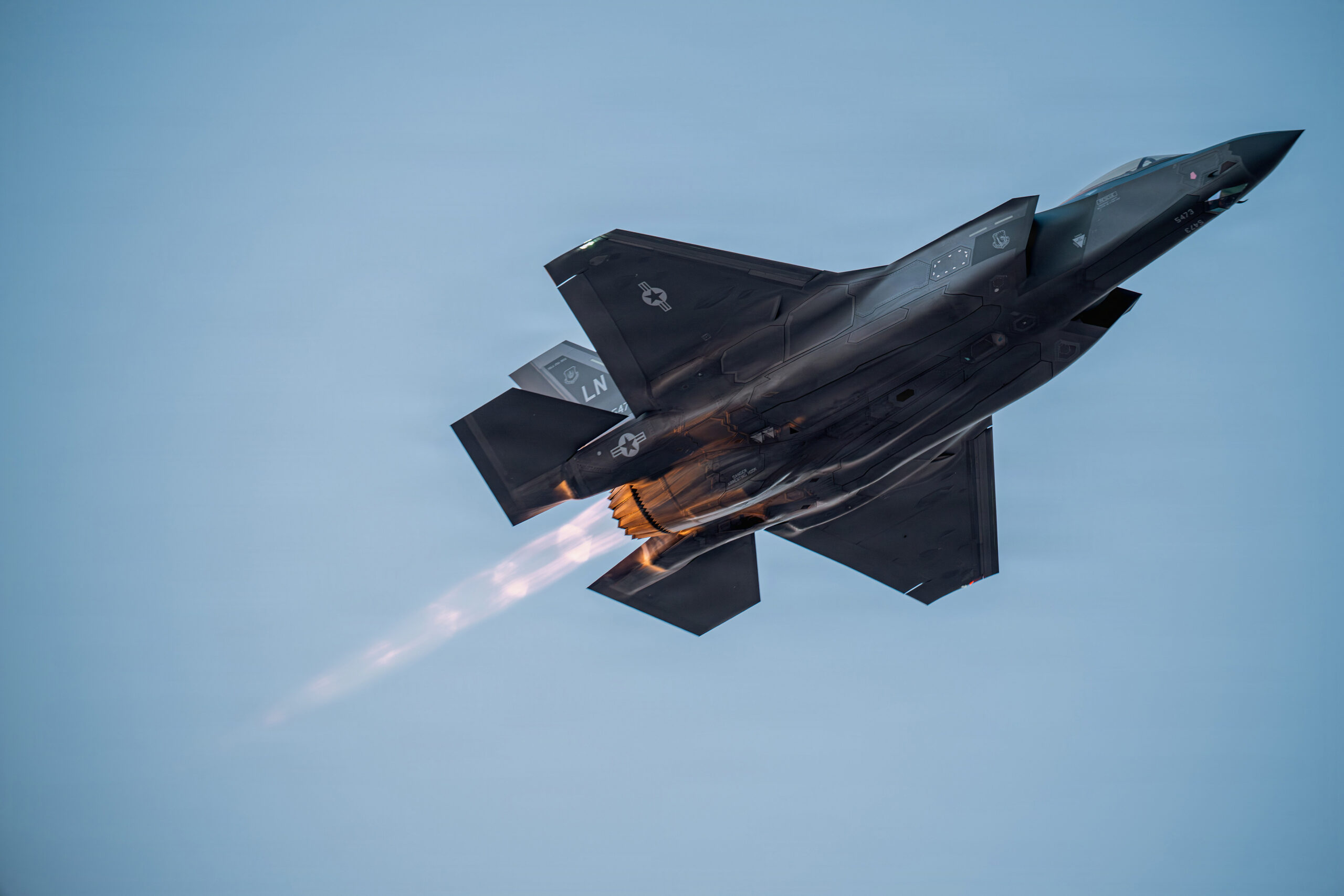
The U.K. has augmented its protective footprint in the area. This led to the Royal Air Force’s inaugural combat air-to-air interception, when an F-35B jet brought down an unmanned aerial vehicle above Jordan. Qatar intercepted two Iranian Su-24 bombing aircraft, and an Israeli F-35 brought down a Yak-130, marking the initial documented aerial neutralization of a manned aircraft by an F-35.
Cooper declared it constituted “the most cohesive air defense system in the history of the Middle East.”
The auditory content of this piece is presented by the Air & Space Forces Association, commemorating and aiding our service members, guardians, and their kin. Discover additional information at afa.org