
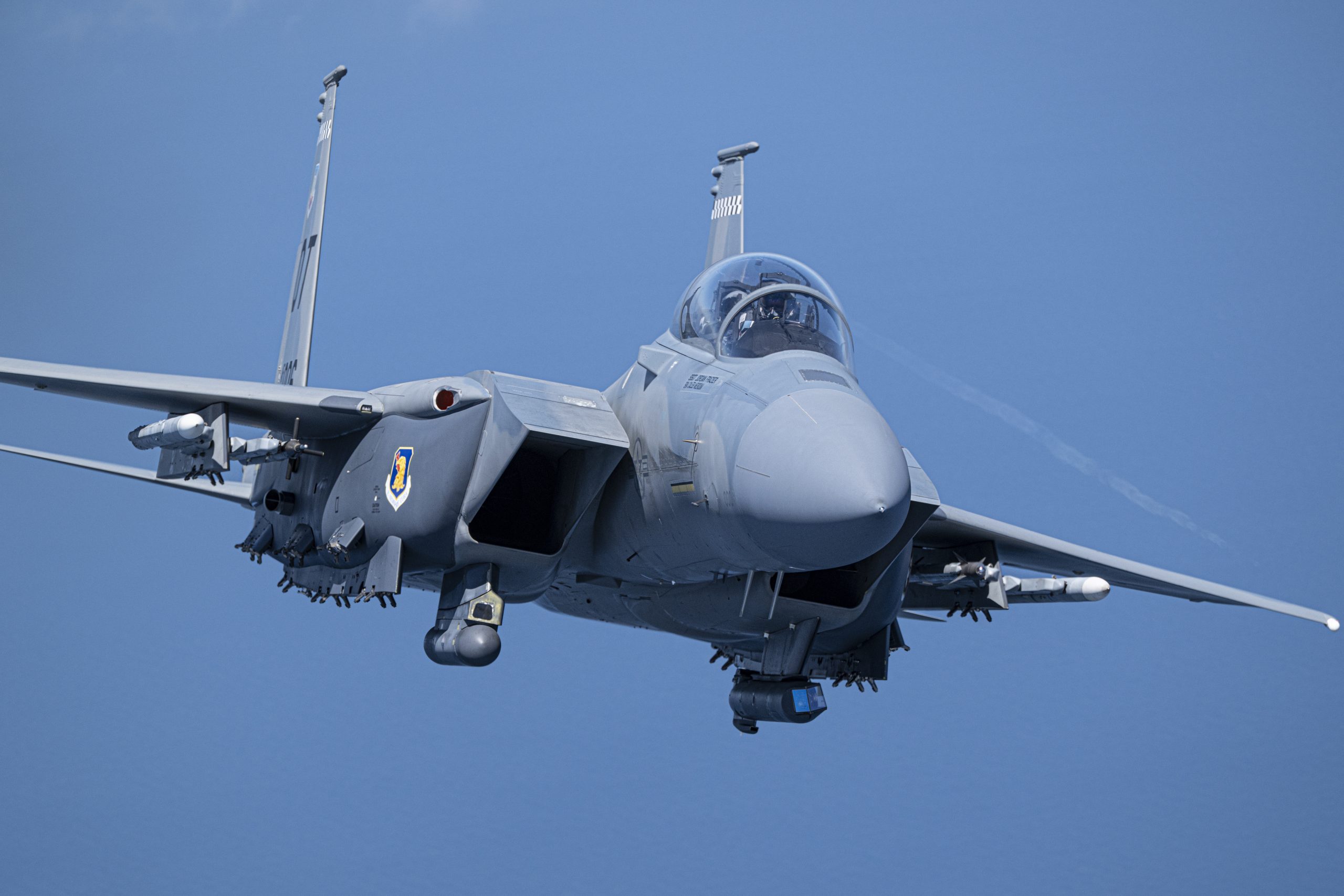
The arrival of the first F-15EX Eagle II fighter jets at Kadena Air Base in Okinawa, Japan, has been delayed by one year, with initial deliveries now projected for 2027. The full contingent of 36 planned F-15EX fighters is subsequently anticipated to be operational at the base by 2028. This updated timeline was communicated by Air Force Secretary Troy Meink during his testimony before the Senate Armed Services Committee on May 21.
During his address, Secretary Meink also indicated that the Air Force is actively collaborating with Boeing, the manufacturer of the F-15EX, to explore strategies for increasing the current production rate of two fighters per month. This effort aims to accelerate deliveries, ensuring that Kadena and other designated bases receive their new fourth-generation fighter aircraft as efficiently as possible.
Kadena Air Base occupies a critically strategic location in the Indo-Pacific region, primarily due to its close geographical proximity to Taiwan. This positioning renders it a vital asset for the United States in its broader strategy to maintain regional stability and deter potential military aggression, particularly in scenarios involving China. Consequently, the Air Force has consistently emphasized the importance of maintaining a robust and ready fighter force at Kadena, considering it a foundational element of its Indo-Pacific defense posture.
For several decades, the 18th Wing, permanently stationed at Kadena, operated the F-15C/D Eagles, which served as the primary air superiority fighter aircraft. However, these aging jets commenced their phased retirement in November 2022. Since their withdrawal, the Air Force has adopted a temporary rotation strategy, deploying various other fighter aircraft to Kadena on an interim basis to sustain operational readiness. Most recently, F-22 Raptor stealth fighters, drawn from Joint Base Elmendorf-Richardson, Alaska, and Joint Base Langley-Eustis, Virginia, arrived at the base in early May as part of these rotational deployments.
In 2024, the Air Force formally announced its plan to permanently station 36 new F-15EXs at Kadena, with initial deliveries originally scheduled for spring 2026. This timeline, however, was disrupted in 2025 when Boeing’s F-15EX production facility in St. Louis, Missouri, experienced a month-long strike. This industrial action significantly impacted the manufacturing schedule, directly contributing to the current delays in the F-15EX program.
As a direct consequence of these production setbacks, several U.S. Air Force and Air National Guard bases slated to receive the F-15EX have experienced delays. In addition to Kadena, the Air Force has already identified four other bases that will host the new fighter aircraft:
- Portland Air National Guard Base, Oregon
- Fresno Air National Guard Base, California
- Naval Air Station Joint Reserve Base New Orleans, Louisiana
- Selfridge Air National Guard Base, Michigan
Further basing decisions for the F-15EX are expected to be announced in the near future. The Air Force signaled a substantial increase in its commitment to the F-15EX program in April, revealing plans to more than double its total procurement from an initial 129 jets to 267. This expanded acquisition reflects the service’s ongoing objective to modernize its fighter fleet, maintain a balanced mix of fourth and fifth-generation capabilities, and ensure sufficient capacity for global operations. Complementing this effort, Senators Ted Budd (R-N.C.) and Jeanne Shaheen (D-N.H.) have introduced legislation that, if enacted, would authorize the Air Force to acquire an even greater number, up to 329 F-15EX aircraft. This bipartisan legislative support underscores a recognition of the aircraft’s operational value and importance.
During his testimony, Secretary Meink informed lawmakers that the specific units designated for the next phase of F-15EX assignments have not yet been finalized. He clarified that these future allocations would be distributed among Active Duty, Air National Guard, and Air Force Reserve units. The Air Force intends to conduct a comprehensive strategic basing process to meticulously evaluate and determine where these additional F-15EXs should be assigned, considering various factors such as operational requirements, existing infrastructure, and strategic geographical considerations.
A significant aspect of the proposed legislation by Senators Budd and Shaheen is the provision that would permit the Air Force to award multiyear procurement contracts for fighter programs. Secretary Meink highlighted the F-15EX as a prime example of how such multiyear procurement authorities would substantially benefit the Air Force in acquiring critical new aircraft more efficiently.
“Because of the instability in the [F-15EX] production rates and the unknown future, the contractor [Boeing] just couldn’t make the investments necessary to tool up and improve, and really modernizing how they’re doing production of that aircraft,” Meink explained. He further elaborated that the long-term stability provided by multiyear contracts enables contractors to make essential capital investments in tooling, advanced technology, and workforce development. These investments ultimately contribute to cost savings for the government over the lifespan of the program and facilitate quicker production cycles, thereby ensuring the timely delivery of crucial defense assets. Limiting contracts to a year-to-year basis, Meink argued, introduces inherent inefficiencies, whereas multiyear contracts streamline the procurement process for both aircraft and essential spare parts.
Why This Matters
The delayed arrival of F-15EX Eagle II fighters at Kadena Air Base carries significant implications for U.S. defense strategy, regional stability, and the efficiency of military procurement. Firstly, Kadena’s role as a forward operating base, strategically positioned near the East China Sea and Taiwan, is paramount. The consistent presence of modern, permanently stationed fighter aircraft is a critical component of the United States’ deterrence posture against potential adversaries, particularly in maintaining a credible defense presence in the Indo-Pacific. A delay in replacing the retired F-15C/Ds means that the U.S. continues to rely on temporary deployments, which can introduce logistical complexities, increase operational costs, and potentially create gaps in consistent readiness and local expertise compared to a permanently assigned squadron. This impacts both the U.S. ability to project power and reassure its allies, such as Japan and South Korea, of its unwavering commitment to regional security.
Secondly, the F-15EX itself represents a substantial upgrade for the Air Force’s fourth-generation fleet. While a non-stealth fighter, it incorporates advanced avionics, an open mission system architecture, and enhanced weapon-carrying capabilities that make it highly relevant in contemporary air combat scenarios. Its ability to integrate seamlessly with fifth-generation fighters like the F-22 and F-35 provides a cost-effective way to augment air superiority and strike capabilities, ensuring the Air Force maintains a diverse and capable fleet. Delays in its production and deployment affect the Air Force’s broader modernization strategy, which aims to balance the acquisition of cutting-edge stealth platforms with capable, more affordable, and higher-capacity non-stealth fighters.
Thirdly, the discussion surrounding multiyear procurement contracts highlights a fundamental challenge in defense manufacturing and budgeting. Secretary Meink’s advocacy for multiyear contracting underscores how predictable, long-term commitments can foster a healthier and more efficient defense industrial base. When manufacturers like Boeing have greater certainty regarding future orders, they are more inclined to invest in facility upgrades, optimize supply chains, train specialized workforces, and implement process improvements. This stability can lead to greater efficiency, reduced unit costs, and faster production rates over time, ultimately delivering better value to taxpayers and ensuring the timely delivery of vital military equipment. Conversely, annual procurement cycles often introduce uncertainty, making it difficult for contractors to plan effectively, leading to inefficiencies and potentially higher costs. The F-15EX program’s production setbacks, exacerbated by a factory strike, underscore the vulnerabilities in the defense supply chain and workforce, emphasizing the need for robust and flexible acquisition strategies to support national security objectives.