
California Law Protecting Immigration Aid Workers Sparks Free Speech Debate
A new California law aimed at protecting immigration aid workers from doxxing and threats has ignited a significant controversy, drawing national attention to the intersection of privacy, free speech, and political activism. The legislation, signed into law last week by Governor Gavin Newsom, expands an existing state program that shields the addresses of vulnerable residents, but its inclusion of immigration service providers has become a flashpoint, largely fueled by a conservative online influencer.
Background: California’s “Safe at Home” Program
The new bill originated as an effort to address fears among immigration aid workers, who reported increasing instances of doxxing and threats, particularly during heightened immigration enforcement operations in California. Democratic state lawmakers presented the measure as a straightforward expansion of the state’s longstanding “Safe at Home” program.
The “Safe at Home” program, similar to initiatives in many other U.S. states, was initially established in the 1990s to protect survivors of domestic violence and stalking victims by keeping their residential addresses confidential in public records. Over the years, some states have broadened the scope of these programs to include other at-risk groups, such as abortion-clinic workers or law enforcement officers.
In California, previous expansions of the “Safe at Home” program have generally not provoked widespread free speech controversies. For example, last year, the state added health workers who provide gender-related treatment to the list of protected individuals with minimal public debate or opposition.
The Controversy Ignites: The “Stop Nick Shirley Act”
The current legislation, however, faced immediate and intense opposition upon its proposal to include immigration aid providers. The controversy significantly escalated after a Republican opponent of the bill dubbed it “The Stop Nick Shirley Act,” a catchy nickname that quickly gained traction among conservative media and online communities.
Nick Shirley, a 24-year-old YouTube influencer, has rapidly gained prominence within the “MAGA” (Make America Great Again) movement. His viral videos often claim to expose alleged fraud in social service programs, particularly in Democratic-led states. Last year, Shirley’s videos targeting Minnesota child care centers, predominantly run by Somali immigrants, garnered attention, including from former President Donald Trump. Shirley subsequently brought his focus to California, where he recorded videos outside the homes of licensed child care providers, many of whom were immigrants, and the offices of hospice care providers.
Shirley’s advocacy centers on exposing what he describes as fraud, and Republican opponents of the California bill have largely attacked it on free speech grounds, asserting that it would hinder efforts to uncover and publicize problems within public programs. Immigration aid groups, conversely, have faced criticism from supporters of Mr. Trump for providing a range of services, including food and legal assistance, to undocumented residents, who have become particularly vulnerable to deportation amid stricter immigration policies.
Provisions of the New Law and Differing Interpretations
The California bill, which is the first in the nation to extend address protection to workers and volunteers for immigration support services facing threats of violence or harassment, includes specific provisions regarding legal recourse. Starting in October 2027, the law states that an individual whose address is protected can sue someone who posts their image or personal information online, provided the individual had previously requested in writing that the information not be shared publicly.
Democratic proponents of the bill assert that its scope is narrow, restricting only the posting of violent threats with the intent to cause imminent harm. Mia Bonta, the Bay Area assemblywoman who introduced the bill, emphatically stated that it was “150,000 percent absolutely not” inspired by Mr. Shirley. A spokeswoman for Governor Gavin Newsom echoed this sentiment, arguing that the law would have no discernible impact on the conservative influencer’s activities.
Conversely, Mr. Shirley and his supporters contend that the bill was specifically crafted to deter him from publishing videos about alleged fraud in social service programs for immigrants. They particularly object to the provision that allows protected aid workers to initiate lawsuits against those who share their information.
Nick Shirley’s Campaign and Public Reaction
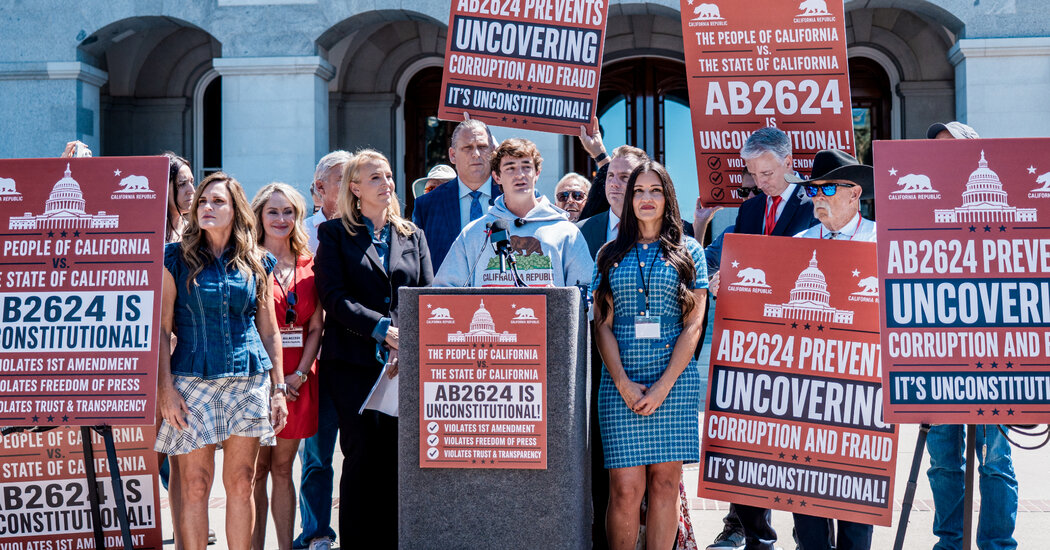
With nearly 2 million YouTube subscribers and an online merchandise store branded the “Anti Fraud Club,” Mr. Shirley has transformed the fight against this new law into a high-profile cause. He has successfully drawn national attention to what might otherwise have remained a relatively obscure piece of state legislation. Through viral video clips, appearances on Fox News, and a rally at the State Capitol, Mr. Shirley has played a pivotal role in reshaping the narrative around the address protection bill, framing it as a conflict over exposing fraud and safeguarding free speech.
Speaking at a rally in Sacramento, Mr. Shirley declared, “Welcome to the Cali-fraudia Republic. Here in California, the politicians, instead of going after the fraudsters, they’ve now gone after those that are going to expose the fraud.” The plaza outside the State Capitol briefly resembled a “MAGA” street fair, featuring booths selling political merchandise and posters celebrating immigration enforcement agents. The event also saw the presence of masked counter-protesters, whose drumming and trumpet blares were kept at a distance by police after an initial altercation during the rally’s opening prayer led to three detentions by the California Highway Patrol.
Mr. Shirley addressed the crowd after chants of his name, joined on stage by several Republican lawmakers and political candidates. Multiple speakers at the rally expressed their anticipation for the law to be challenged and ultimately overturned in court.
In an interview following the rally, Mr. Shirley characterized claims that the bill was not directed at him as a “lie.” He argued that the new law is unnecessary, as existing statutes already prohibit doxxing and violent threats. “They’re making a protected class by specifically saying ‘immigration support service providers,’” he stated. Mr. Shirley also voiced concerns that the law could be used against him, potentially making him liable for inciting individuals who commit crimes, leading to fines of at least $4,000.
Legal Scrutiny and First Amendment Concerns
In California, recent expansions of the “Safe at Home” program have generally benefited groups politically aligned with the state’s Democratic-controlled legislature. Democrats maintain that these particular groups of workers are most frequently targeted by opponents through doxxing.
However, the precise threshold for who deserves such enhanced privacy protections remains unclear, and courts may examine the rationale behind California’s decision to grant a higher level of privacy to specific groups. Eugene Volokh, a First Amendment scholar at the University of California, Los Angeles, School of Law, suggested that the bill could be vulnerable to legal challenge on the grounds that it selectively protects one group over others. Mr. Volokh stated that a court “might say this is unconstitutional because it specially protects immigration service providers,” potentially ruling that “you can’t single out threats and incitement against immigration service providers from threats and incitement against other people who might be just as vulnerable as they are.”
Early drafts of the bill included broader prohibitions on posting information, which free speech advocates had argued would violate constitutional rights. However, the legislation was subsequently narrowed in scope. Carolyn Iodice, legislative and policy director with the Foundation for Individual Rights and Expression (FIRE), a non-profit organization promoting free speech, had initially criticized the bill. She now believes that the final version, with its high legal bar for proving “threats or incitement,” should not impede Mr. Shirley’s core activities.
Why This Matters
- Protection for Vulnerable Workers:This law represents a significant effort to safeguard individuals who provide essential immigration support services, often in politically charged environments where they may face harassment, doxxing, and threats. Its effectiveness in enhancing the safety and privacy of these workers, and potentially encouraging their continued service, is a key consideration.
- The Evolving Balance of Free Speech and Privacy:The controversy surrounding this bill highlights the ongoing tension in democratic societies between the fundamental right to free expression, particularly online, and the equally important need to protect individuals from targeted harassment, privacy breaches, and potential violence. This law tests how states define the boundaries of these rights in the digital age.
- Impact on Public Accountability and Online Activism:Critics argue that the law could “chill” legitimate efforts to expose alleged fraud or misconduct in public programs, particularly by citizen journalists and online activists. Conversely, proponents argue it prevents the weaponization of personal information to intimidate service providers. The outcome of this debate and potential legal challenges could set precedents for online investigative journalism and activism.
- Political Polarization and Social Media:The rapid politicization of this bill, largely through the amplification power of social media and figures like Nick Shirley, underscores how online platforms can quickly turn local legislative actions into national culture war battles. It demonstrates the growing influence of social media influencers in shaping public opinion and mobilizing political opposition.
- Legal Precedent and Constitutional Challenges:The potential for legal challenges based on First Amendment grounds, particularly concerning the selective protection of certain groups, could have far-reaching implications. Court rulings on this California law might influence how other states approach similar legislation, impacting future expansions of privacy protections and the interpretation of free speech rights across the United States.
California Law Protecting Immigration Advocates Ignites Free Speech Debate
A newly enacted California law, designed to shield immigration service providers from intense harassment, has sparked a contentious debate over its potential impact on free speech. While proponents assert the legislation is a necessary measure to protect individuals and organizations facing escalating threats, critics argue it could inadvertently chill legitimate expression and be widely misunderstood by the public.
The Legislative Context and Proponents’ Rationale
The legislation, championed by California Assemblymember Mia Bonta (D-Oakland), aims to curb harassment directed at groups assisting immigrants. Proponents, including the Coalition for Humane Immigrant Rights of Los Angeles (CHIRLA), describe a climate of fear and intimidation that they report has intensified particularly since the beginning of former President Donald Trump’s second term in office.
Angelica Salas, Executive Director of CHIRLA, which collaborated with Assemblymember Bonta on the bill’s development, articulated the sentiment among advocates: “We are an enemy that they feel is their patriotic duty to go after.” Salas recounted a personal experience illustrating the severity of the harassment, stating that someone had shown up at her mother’s home looking for her. Such incidents, proponents argue, highlight the urgent need for legal protections.
Assemblymember Bonta emphasized that the law specifically targets comments that “threaten or incite violence,” clarifying its narrow scope. She maintains that the bill does not restrict critical reporting by journalists or the online activities of figures like Nick Shirley, an online personality whose content often targets immigrant support groups. Bonta asserted that her bill has been misrepresented by opponents who have tried to attach it to Mr. Shirley, and that he was “not being honest with his viewers.” For proponents, the law is a vital tool to create a safer environment for those providing essential services to vulnerable immigrant communities, allowing them to carry out their work without fear of physical harm or intimidation.
Concerns Over Free Speech and Interpretation
Despite the stated intent, legal experts and civil liberties advocates have raised significant concerns regarding the law’s practical application and potential chilling effect on speech. Ms. Iodice, a legal analyst, acknowledged the bill’s aim to protect against specific acts of threats and incitement to violence. However, she warned that individuals receiving legal demands related to the law might not fully grasp this specific limitation, potentially leading them to self-censor more broadly.
“The law could wind up chilling some speech because people who receive legal demands that they not post images or information may not know that they are only prohibited from making comments that threaten or incite violence,” Ms. Iodice explained. This ambiguity, critics contend, could lead individuals to err on the side of caution, suppressing non-threatening speech out of fear of legal repercussions. Opponents argue that while protecting individuals from violence is paramount, the language and potential misinterpretation of the law could inadvertently infringe upon constitutionally protected forms of expression, creating a precedent that could be misused in other contexts.
Political Naming and Misinformation
The debate surrounding the bill has been further complicated by its informal moniker, the “Stop Nick Shirley Act,” a name coined by Republican Assemblymember Carl DeMaio. This unofficial title has circulated widely online, leading many of Mr. Shirley’s followers to believe it is the bill’s formal designation, despite it not being so.
Assemblymember DeMaio defended his choice, stating that he used the popular figure’s name to draw attention to what he views as a problematic piece of legislation. “It’s the best way to simplify the scheme that they’re trying to hide,” DeMaio commented, adding, “A bad bill needs public transparency, and I’m not going to apologize for that.” He clarified that he had no direct communication with Mr. Shirley when he originated the nickname during a committee hearing earlier this spring, suggesting it was a strategic move to garner public attention.
Assemblymember Bonta, however, strongly condemned this tactic, accusing opponents of misrepresenting her bill for “personal gain” and “more clicks.” She asserted that such actions undermine the integrity of the legislative process. “I am greatly disappointed that our legislative process can be so ambushed, if you will, by ill-intended legislators and people who are likely wanting to get more clicks for their own personal gain,” she stated. This political maneuvering highlights the increasing role of online narratives and social media in shaping public perception of legislative actions, often divorcing them from their formal legal context and leading to widespread misinformation.
Why This Matters
This California law and the surrounding controversy underscore several critical issues in contemporary society, extending beyond the state’s borders. Firstly, it highlights the escalating challenges faced by advocacy groups, particularly those working with vulnerable immigrant communities, who report increased harassment and threats in an increasingly polarized political climate. The law represents a legislative attempt to provide legal recourse and protection, reflecting a broader societal concern for the safety of those engaged in public service and humanitarian work.
Secondly, the debate profoundly impacts the delicate balance between protecting individuals from harm and safeguarding fundamental free speech rights. The fear of a “chilling effect,” where individuals self-censor legitimate speech due to ambiguity or misunderstanding of legal boundaries, is a persistent concern in civil liberties discourse. How courts interpret and enforce this law will be closely watched, as it could set precedents for similar legislation aimed at regulating online conduct and protecting specific groups from targeted harassment in other jurisdictions.
Finally, the incident reveals the pervasive influence of political messaging and misinformation in the legislative process. The deliberate coining of a misleading moniker and its subsequent viral spread illustrate how public understanding of complex legal matters can be distorted, often for political advantage. This phenomenon challenges the integrity of legislative debate and public discourse, making it harder for citizens to engage with policy based on accurate information. The outcome of this debate will not only affect immigration advocates in California but also contribute to the ongoing national and international conversation about online harassment, free speech, and political accountability.