
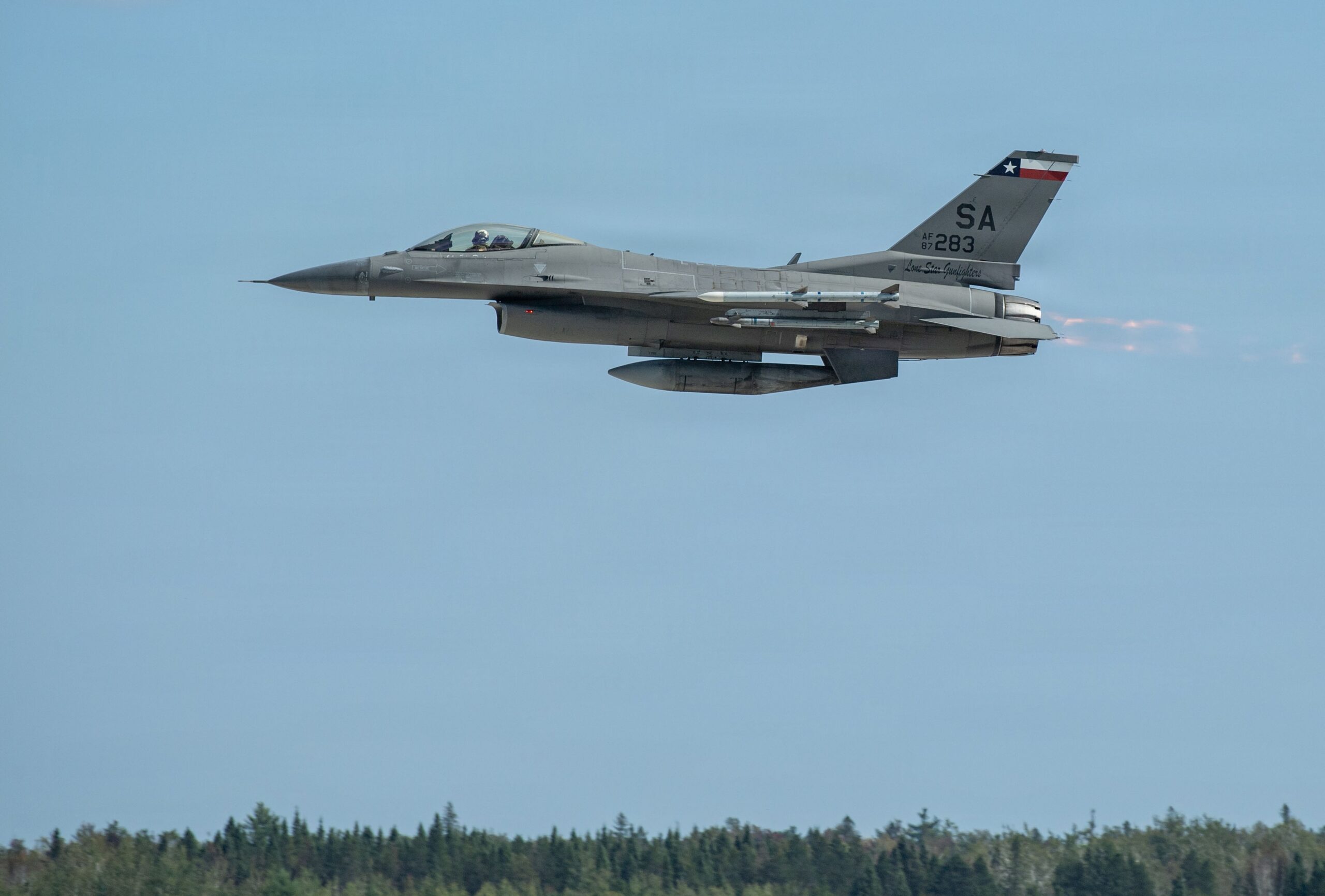
U.S. F-16 Fighter Jet Crashes During Training in Michigan; Pilot Ejects Safely
An F-16 Fighting Falcon assigned to the Texas Air National Guard’s 149th Fighter Wing crashed on September 17, 2023, during a routine training mission at the Alpena Combat Readiness Training Center in northern Michigan. The aircraft’s sole pilot successfully ejected from the jet before impact and is reported to be in stable condition at a local hospital. Authorities have confirmed no other injuries were sustained in connection with the incident.
The Michigan State Police indicated via social media that the pilot was in stable condition, and the immediate area of the crash was secured. The incident occurred in the afternoon, during an exercise known as “Operation Northern Cactus.” This training operation is designed to prepare personnel and equipment for deployment to what the wing describes as an “austere environment,” simulating conditions they might encounter in real-world combat or support scenarios.
The F-16, a single-engine, supersonic multirole fighter aircraft, is based at Joint Base San Antonio-Lackland, Texas. The 149th Fighter Wing, part of the Air National Guard, conducts various missions, including air superiority and close air support, training its pilots and ground crews to maintain combat readiness for both state and federal assignments.
Preliminary reports, including audio recordings from air traffic control obtained by the website LiveATC, suggest that the crashed aircraft may have suffered a bird strike. The wingman, flying alongside the stricken F-16 as part of the “BUCK 11 flight,” reportedly informed air traffic control of the potential bird strike and the pilot’s intention to bail out or eject. Bird strikes, while relatively uncommon for fighter jets, can cause significant damage to engines and airframes, leading to catastrophic failures.
Following the crash, imagery posted to social media platforms depicted a substantial plume of black smoke rising from the impact site, visible from a considerable distance. Local authorities, including the State Police, swiftly implemented an evacuation order for buildings within a one-mile radius of the crash. This precautionary measure was taken due to concerns over a “hazardous chemical spill.”
F-16 aircraft, like many modern fighter jets, carry hydrazine, a highly toxic chemical. Hydrazine is used to fuel the jet’s Emergency Power Unit (EPU), a crucial system designed to provide backup hydraulic and electrical power to the aircraft’s flight controls and other critical systems in the event of an engine failure. A breach of the EPU or its fuel lines during a crash can release hydrazine, posing serious health risks to anyone exposed through inhalation, ingestion, or skin contact. Emergency response teams, equipped with specialized hazmat gear, were deployed to manage the spill and mitigate environmental contamination.
The Alpena Combat Readiness Training Center, where the incident occurred, is a Michigan Air National Guard facility located in the northern part of the state, approximately an hour’s drive northeast of Traverse City. It serves as a vital training hub for military units from across the United States, offering diverse air-to-ground and air-to-air training environments, including live-fire ranges and electronic warfare training areas.
The 149th Fighter Wing has confirmed that an official investigation into the cause of the crash is underway. Military aviation accident investigations are typically comprehensive, involving experts in metallurgy, aerodynamics, human factors, and aircraft maintenance. The objective is to identify all contributing factors to the incident, not merely the immediate cause, in order to implement corrective actions and prevent similar occurrences in the future.
Why This Matters
The crash of an F-16 fighter jet during a training exercise, while fortunately resulting in the pilot’s safe ejection, carries significant implications across several dimensions:
Military Readiness and Safety:This incident underscores the inherent risks involved in military aviation training, which is nonetheless critical for maintaining combat readiness. Exercises like “Operation Northern Cactus” are essential for pilots and ground crews to practice complex maneuvers and operational procedures in realistic, high-stress environments. The challenge for military forces lies in balancing the need for rigorous, realistic training with the imperative of ensuring the highest possible safety standards. Every crash, regardless of its cause, prompts a thorough review of training protocols, equipment maintenance, and operational procedures to identify areas for improvement.
Pilot Safety Systems:The successful ejection of the pilot highlights the effectiveness of modern aviation safety systems. Ejection seats are designed as a last resort, providing pilots with a chance of survival in otherwise catastrophic situations. The fact that the pilot is in stable condition is a testament to the engineering and regular maintenance of these life-saving technologies, as well as the rigorous training pilots receive for emergency procedures.
Environmental and Public Health Concerns:The evacuation of the crash site due to a hydrazine spill brings to light the environmental and public health risks associated with military aircraft accidents. Hydrazine, a highly toxic substance, necessitates immediate and careful handling by specialized hazardous materials teams. Such incidents highlight the importance of robust emergency response plans, close coordination between military and civilian authorities, and public awareness regarding potential dangers in areas where military training occurs.
Economic Impact:An F-16 Fighting Falcon represents a significant financial investment, with the cost of a single unit running into tens of millions of dollars. The loss of such an advanced aircraft is a substantial economic blow, requiring resources for investigation, cleanup, and eventual replacement. It also impacts the overall fleet size and operational capacity, albeit minimally for a single aircraft.
Transparency and Trust:The prompt announcement of the crash and the initiation of an investigation are crucial for maintaining public trust. The military’s commitment to thoroughly investigate such incidents, share findings where appropriate, and implement lessons learned is vital for reassuring the public that safety remains a top priority, both for military personnel and the civilian population living near training areas.