
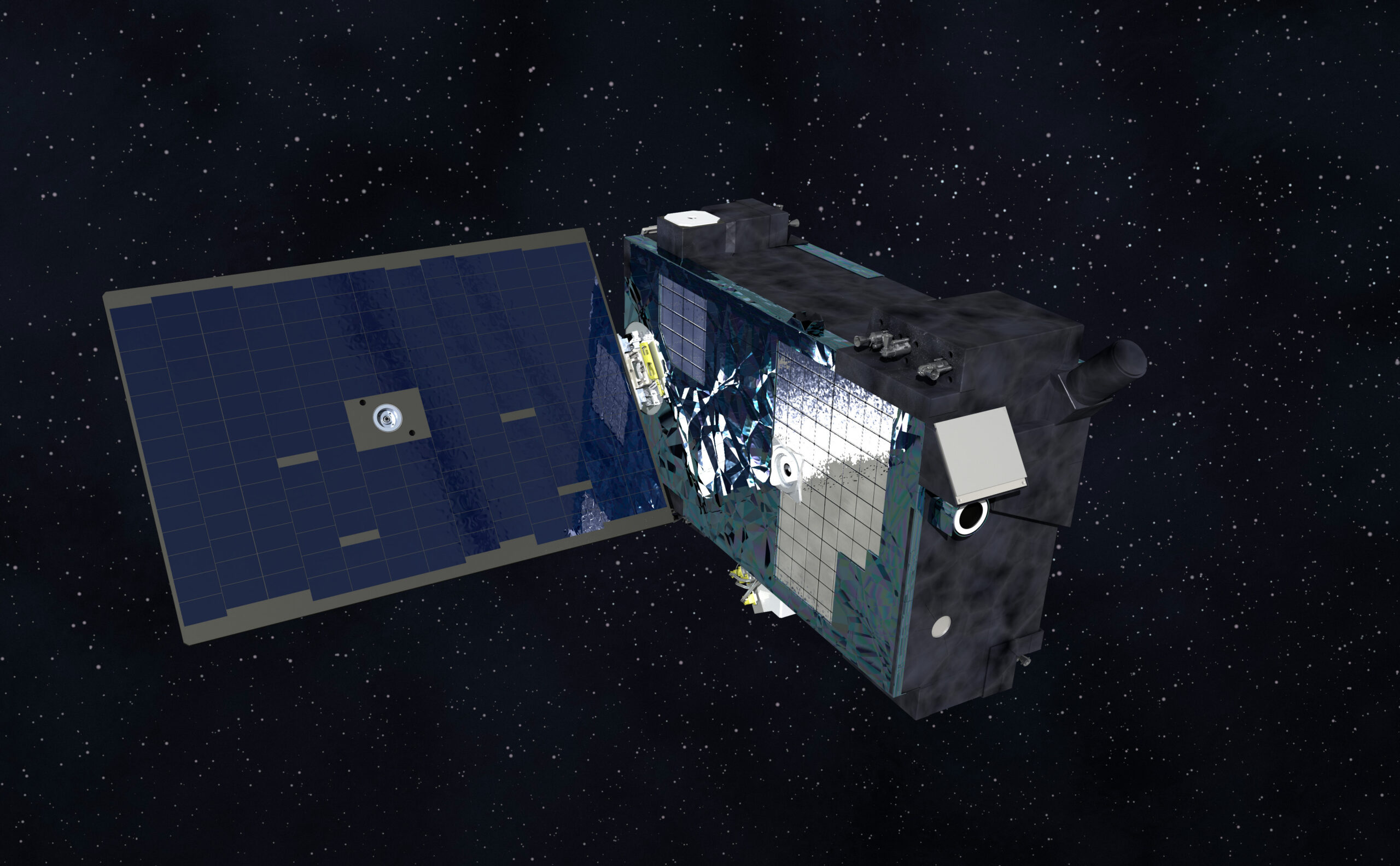
The U.S. Space Force and the Defense Innovation Unit (DIU) have selected two companies, Northrop Grumman and True Anomaly, to develop prototype small satellites designed to track both friendly and adversary spacecraft in geosynchronous orbit (GEO). This initiative, known as the GEO High-Resolution Optical Space-Based Tactical Reconnaissance (GHOST-R) program, aims to leverage low-cost, commercially-derived technology to enhance America’s space domain awareness.
The Pentagon’s technology accelerator, DIU, announced the selection on September 18 via LinkedIn, marking a significant step in a broader, multi-billion dollar Space Force endeavor known as RG-XX. The ultimate objective of RG-XX is to establish a robust fleet of reconnaissance satellites by the end of the current decade, augmenting existing capabilities and addressing critical gaps in space surveillance.
Col. Bryon McClain, acting portfolio acquisition executive for space combat power, emphasized the Space Force’s commitment to innovation in both speed and affordability. “This approach burns down technical risk, drives down lifecycle costs, and gets vital capability to the warfighter faster to ensure a more resilient architecture,” McClain stated. He further noted that successful prototypes from GHOST-R are intended to transition directly into the program of record for RG-XX, underscoring the program’s strategic importance.
The drive towards a lower-cost, commercially-based space surveillance capability gained momentum in 2024. At that time, then-acting space acquisition executive Maj. Gen. Stephen Purdy indicated that this shift was partly influenced by a push from U.S. Space Command for more unclassified opportunities to collaborate with international allies and private industry. This collaborative approach seeks to foster broader participation and innovation, potentially reducing development timelines and costs while strengthening partnerships.
Beyond partnership opportunities, the new approach directly addresses two pressing needs identified by U.S. Space Command: the requirement for more maneuverable satellites and a significant enhancement in space domain awareness (SDA). Improved SDA is crucial for closing existing gaps in the ability to characterize, track, and understand the activities of objects in space, particularly those of concern. Gen. Stephen Whiting, Commander of Space Command, recently reiterated the critical importance of these capabilities. Speaking at the AMOS Conference in Maui, Hawaii, on September 16, Whiting called for improved on-orbit targeting and tracking, highlighting space domain awareness as fundamental to the counterspace mission.
“To be able to negate threats in space, we must be able to find, fix, track, and target those threats,” Whiting asserted. He acknowledged that while “targeting in the space domain is maturing, but it still has a long way to go.” The GHOST-R and RG-XX programs are designed to accelerate this maturation process, providing the necessary tools to maintain situational superiority in an increasingly contested domain.
In April, the Space Force took another significant step by selecting 14 companies to form an industry consortium known as Andromeda. This consortium will compete for task orders under contracts potentially worth up to $6.2 billion. The scope of work for the Andromeda consortium will encompass not only the maneuverable RG-XX reconnaissance satellites but also a separate fleet of surveillance satellites designated SG-XX, further diversifying and strengthening the nation’s space-based intelligence assets.
Under the GHOST-R program, Northrop Grumman and True Anomaly’s prototype satellites are projected to launch in 2028. Following their deployment, these spacecraft will undergo a series of rigorous demonstrations. These demonstrations are designed to prove their capability to collect high-resolution imagery of target satellites and conduct weekly observations, ensuring consistent monitoring. Should these tests prove successful, the prototype spacecraft are slated to transition into operational RG-XX platforms by 2029, rapidly contributing to the overall constellation.
In parallel with the demonstration phase, both selected firms are required to present a comprehensive plan for scaling their satellite designs into a full constellation. This future constellation would be capable of tracking all publicly catalogued objects in geosynchronous orbit, providing an unprecedented level of awareness and monitoring capabilities for the Space Force.
Northrop Grumman, already an incumbent prime contractor for the existing Geosynchronous Space Situational Awareness Program (GSSAP), announced that its GHOST-R design will incorporate its ESPASat-L platform, a high-rate production bus. The optical payloads for Northrop Grumman’s prototypes will be built by TRL 11, a company based in Irvine, California. In a press release, Northrop Grumman stated that this award “expands the company’s role in commercial, low-cost, proliferated space systems and builds on the success of the Northrop Grumman-built Geosynchronous Space Situational Awareness Program,” leveraging its extensive experience in the field.
True Anomaly, in its own statement, confirmed that it would leverage its Jackal spacecraft platform and its Mosaic ground system for the GHOST-R program. CEO Even Rogers highlighted the bespoke nature of their technology: “Jackal and Mosaic were purpose-built for this mission, delivering superior maneuverability, sensing, and autonomy at a price point that enables scale without compromising performance.”
True Anomaly recently showcased the advanced maneuverability of its Jackal spacecraft during the Space Force’s Victus Haze responsive space mission. During this mission, the Jackal demonstrated its ability to approach a designated target – a satellite built by Rocket Lab – capture imagery, characterize the object, and engage in a “space-to-space pursuit” of the vehicle, as detailed in a July statement from the company. These demonstrated capabilities align closely with the maneuverability requirements for the GHOST-R and RG-XX programs.
Complementing these hardware-focused initiatives, the DIU recently issued another space-related solicitation. This new project is aimed at fostering the development of advanced artificial intelligence (AI) tools capable of distinguishing between friendly objects and potential threats in space. The solicitation seeks software that can “ingest and fuse massive streams of multi-source data,” including satellite imagery, geospatial data, and live video feeds. The objective is to automate advanced cross-data correlation, enabling the architecture to “uncover hidden patterns, complex operational relationships, and predictive threat behaviors far beyond the capabilities of human analysis alone,” thereby significantly enhancing the effectiveness of space domain awareness and threat assessment.
Why This Matters
The GHOST-R program, and the broader RG-XX initiative, represent a pivotal shift in how the United States approaches space defense and domain awareness. In an era where space is increasingly recognized as a contested domain, the ability to accurately track, identify, and characterize objects – both friendly and adversarial – in geosynchronous orbit (GEO) is paramount for national security. GEO, located approximately 36,000 kilometers above the Earth, is home to critical U.S. assets, including communication, navigation, and intelligence satellites that underpin modern military operations and civilian infrastructure. Protecting these assets requires unparalleled situational awareness.
This initiative underscores several key strategic implications:
- Enhanced National Security:By improving the ability to “find, fix, track, and target” objects in space, the U.S. gains a significant advantage in deterring aggression and responding to threats. Superior space domain awareness allows for early detection of potentially hostile maneuvers, informs decision-making, and safeguards vital space capabilities from disruption or attack. It is foundational to the counterspace mission, ensuring the U.S. can protect its assets and, if necessary, negate threats.
- Fostering Commercial Innovation and Cost Efficiency:The Space Force’s pivot to leverage low-cost, commercially-derived technology signifies a strategic recognition of the rapidly advancing private space sector. This approach promises to accelerate development cycles, reduce acquisition and lifecycle costs, and inject agility into military procurement. By partnering with companies like Northrop Grumman and True Anomaly, the government can tap into commercial innovation, creating a more resilient and distributed satellite architecture that is harder for adversaries to target comprehensively.
- Increased Resiliency and Deterrence:A proliferated constellation of small, maneuverable satellites built with commercial technology offers inherent resilience. Such a distributed architecture is less susceptible to single points of failure and more challenging for adversaries to degrade. This resilience enhances deterrence by demonstrating that attacks on U.S. space assets would yield limited strategic advantage. The ability to deploy satellites more quickly and affordably also means the U.S. can replenish or augment its capabilities faster in a crisis.
- Strengthening Alliances:The emphasis on unclassified systems and commercial partnerships facilitates greater collaboration with allies. Sharing space domain awareness data and capabilities through unclassified channels strengthens collective security, builds trust, and allows for a more coordinated response to global space challenges.
- Advancing Critical Technologies:The GHOST-R program drives innovation in satellite maneuverability, high-resolution optical sensing, and artificial intelligence for data fusion and threat detection. These technological advancements have dual-use potential, benefiting both military and civilian space applications, and reinforcing America’s leadership in the space sector. The DIU’s focus on AI for threat detection is particularly crucial, as the sheer volume of space data makes human analysis increasingly impractical.
In essence, GHOST-R and RG-XX are not merely about building more satellites; they represent a fundamental modernization of space-based reconnaissance and security. They embody a strategic shift towards speed, affordability, and resilience, ensuring the U.S. maintains its critical advantage in space, protects its vital orbital assets, and upholds global stability in an increasingly complex and competitive celestial environment.