
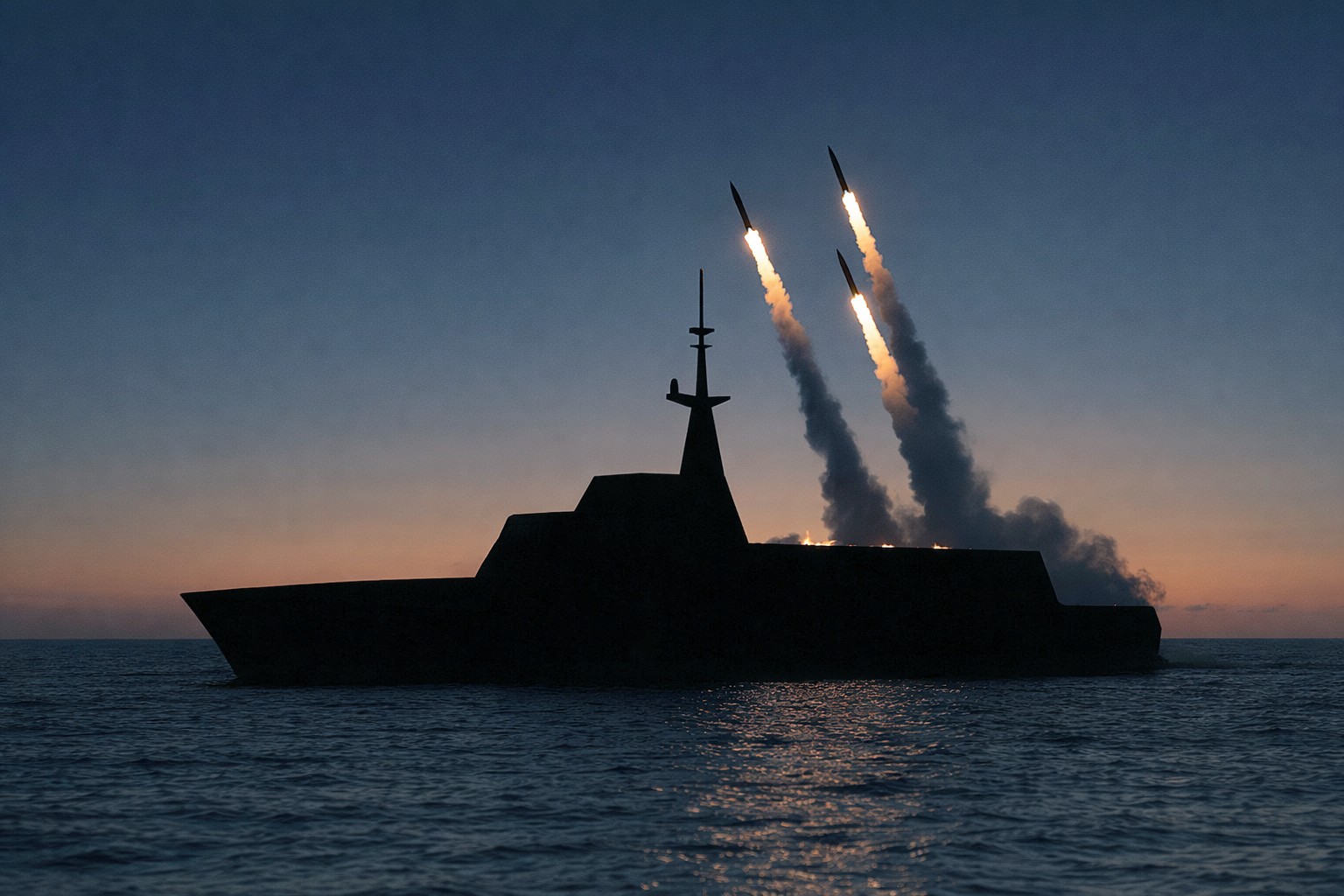
The Royal Navy is soliciting contributions from the industrial sector regarding innovative adaptable armaments intended to counteract a multitude of unmanned dangers, as it moves towards an upcoming “blended naval force” integrating human-operated and self-governing vessels. This information comes from a Call for Information (CFI) published by the Ministry of Defence.
This announcement pertains toProject METIS, an acronym forModular Effects, Tactical Interchangeable System, which seeks to create modular systems designed to deploy economical impactors against unmanned aerial vehicles (UAVs) and other autonomous hazards. The undertaking is presently in its initial market interaction stage and is purposed to collect data from industry regarding prospective answers prior to the commencement of any official acquisition procedure.
As stated by the Ministry of Defence, the endeavor aims to assist the Royal Navy in addressing the escalating danger presented by autonomous platforms in various operational spheres. The CFI indicates that the department necessitates“affordable countermeasures to combat the overwhelming quantity of dangers arising from the widespread adoption of unmanned systems (UXS) to supplement existing sophisticated missile armaments.”
Project METIS constitutes a component of the Royal Navy’s wider transition towards a blended operational framework, integrating conventional vessels with self-governing and remotely controlled units. The CFI highlights that as the naval service progresses towards this paradigm, it plans to progressively leverage self-governance and adaptable architectures, enabling proficiencies to be adjusted with greater speed in reaction to novel dangers.
As per the framework detailed in the text, the undertaking will furnish modularEnduring Operational Deployment Systemsor “PODS” designed to convey armaments or various impactors. These pods are meant to be readily affixed across diverse platforms, permitting operational configurations to be exchanged contingent on mission demands. The architecture is conceived to offer adaptability and expandability by facilitating the deployment of numerous affordable countermeasures in conjunction with more intricate armaments.
The Defence Ministry stated the initiative would embrace an extensive interconnected systems methodology geared towards providing volume and versatility. As per the CFI, this would entail deploying“a multitude of economical impactors offering adaptable operational configurations to enhance sophisticated armament systems within an progressively dynamic threat landscape.”
The envisioned systems are anticipated to counteract both airborne and maritime autonomous dangers, employing a blend of cyber and kinetic offensive techniques. Owing to the broad spectrum of potential hazards, the Defence Ministry foresees that diverse remedies might be necessary instead of a singular architecture.
The adaptable modules are projected to be interoperable with both human-operated and autonomous conveyances, permitting their deployment on vessels, land vehicles, or alternative platforms as needed. To facilitate swift integration and versatility, the modules are anticipated to employ uniform connection points for energy, thermal regulation, and command-and-supervision frameworks.
The CFI suggests that the modules will adhere to a container-based construction, modeled on the dimensions of a conventional 20-foot ISO container, with an approximate peak mass of 20 metric tons per attachment point. Proposed answers might also utilize more compact or varied spatial requirements to accommodate diverse platforms.
Although the systems might initially acquire targeting information from alternative sensors or conveyances, the Defence Ministry declared that considerable self-governance is preferable to diminish personnel burden and enable systems to function in various environments. The endeavor furthermore stresses substantial importance on longevity and expandability in manufacturing. The report specifies that remedies ought to be manufacturable in vast quantities utilizing resilient distribution networks, underscoring the imperative to augment capacity during a conflict situation.
Mission parameters detailed in the CFI stipulate that architectures must be able to function for prolonged durations devoid of upkeep and must not impede the functional readiness of their host platform. By way of illustration, units should be able to discharge daily for as long as a month without necessitating human involvement.
For showcasing objectives, the least functional capacity is anticipated to exhibit the aptitude to neutralize autonomous platforms from an autonomous naval vessel deployed offshore, whilst receiving directives from a human-crewed ship. Currently, the Defence Ministry has not mandated if remedies need to employ forceful or passive approaches.
The industry consultation period extends until early April, with firms urged to present replies via the Defence Ministry’s acquisition platform. Authorities emphasized that the CFI is solely a data collection endeavor and does not constitute an initial qualification phase for a subsequent acquisition. Enterprises that abstain from this phase will nonetheless be eligible to contend in any official tender issued subsequently pursuant to the Acquisition Statute of 2023.