
This article’s audio content is courteously provided by the Air & Space Forces Association, an organization dedicated to respecting and assisting our Airmen, Guardians, and their loved ones. Learn further details at afa.org
AURORA, Colo.—The Air Force intends to place Collaborative Combat Aircraft with Airmen for testing the semi-autonomous unmanned aerial vehicles by this summer, Gen. Dale R. White declared on Feb. 25 during AFA’s Warfare Symposium.
Col. Timothy Helfrich, who serves as the portfolio acquisition executive for fighter jets and sophisticated aircraft, further stated that the Air Force will expand upon a prior display this month, where an F-22 operated alongside a proxy drone, and will also operate with either one or both of the CCAs currently being developed.
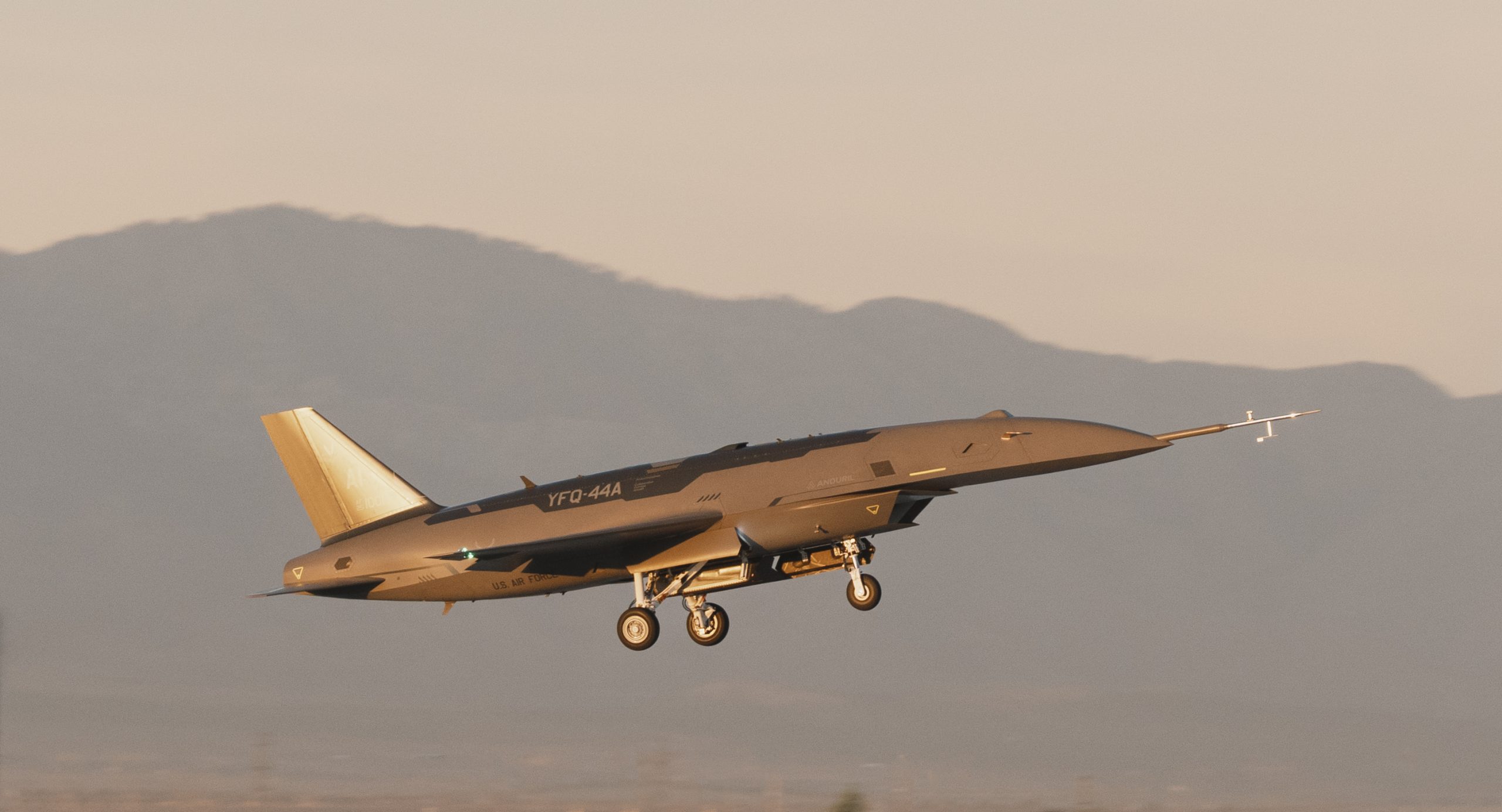
These key developments occur as the Air Force anticipates selecting between General Atomics’ YFQ-42A and Anduril Industries’ YFQ-44A airframes later this year, and also choosing between autonomy software solutions offered by Collins Aerospace and Shield AI. Both aircraft designs are intended to be software-agnostic.
“We are planning numerous demonstrations and evaluations, whether involving weaponry or command platforms, throughout the upcoming year, but a major milestone will involve… making the crucial determination to advance into what we refer to as EMD light, or engineering and manufacturing development light, and subsequent production,” Helfrich explained. “It’s about pinpointing the suppliers we will collaborate with for the Increment 1 initiative. This decision will be made this year, and then we will proceed quite rapidly into manufacturing.”
Over the past fortnight, USAF has experienced a surge of program advancements concerning its CCAs. General Atomics’ YFQ-42A completed its initial flight utilizing Collins’ mission software, an event the Air Force disclosed on Feb. 12. Just eleven days later, on Feb. 23, GA announced that its MQ-20 Avenger had successfully cooperated with an F-22 in flight above Edwards Air Force Base, Calif., and had successfully received directives from the Raptor pilot. On that very same day, Chief of Staff Gen. Kenneth S. Wilsbach revealed that Anduril’s YFQ-44A had commenced inert weapons assessments, with the General Atomics jet soon to follow. Subsequently, on Feb. 25, Helfrich disclosed that the YFQ-44A had flown—incorporating not just one, but two distinct autonomy software systems.
The present phase of developmental testing, led by contractors, will soon transition to operations helmed by the Air Force, according to Lt. Col. Matthew Jensen, commander of the Experimental Operations Unit.
“While [the vendors are] conducting the foundational and requisite tasks for applied sciences, we are simultaneously learning and training on the systems, beginning to validate certain concepts and theories, and this will significantly aid us as we shift the focus of our efforts from developmental testing to experimental operations, where the emphasis is on learning and refining ideas rather than on validating and verifying system requirements,” Jensen stated.
Notably, Jensen made no mention of initial operational test and evaluation, a standard procedure for most Air Force acquisition endeavors. White, addressing reporters, clarified that this omission was intentional.
“I hesitate to label it flight testing, because it’s an experimental operations unit,” White commented. “Its primary focus is operator acclimatization, as these individuals are the actual operators.”
The EOU, which was established in June 2025, has, until this point, generated “a multitude of theoretical concepts” regarding the tactics, techniques, procedures, and methodologies for how the Air Force will deploy CCAs, Jensen remarked.
However, once the unit actually receives the aircraft and the autonomy software—“this summer,” White confirmed—its personnel will be empowered to evaluate those concepts and adapt them to the unique characteristics of each system.
“As we… ascertain the true capabilities that each mission autonomy and each platform offers—as they are not identical—we will capitalize on their strengths, identify our vulnerabilities as a force, and endeavor to mitigate those weaknesses,” Jensen explained.
A crucial method for achieving this will involve flying the actual CCAs—not merely a substitute—in conjunction with manned fighter jets. Helfrich specified the objective as “integrating F-22s with our genuine CCA,” and Jensen mentioned his team would introduce CCAs to major exercises “as swiftly as possible.”
“[That] will likely catch some individuals by surprise when they arrive at Red Flag and think, ‘Why are these automated systems flying with us?’” Jensen pondered. “But rest assured, we will guide it and observe the outcomes.”
Officials will not solely be assessing the performance of the CCAs in these exercises, Brig. Gen. David C. Epperson, commander of the U.S. Air Force Warfare Center, further noted. They will also be observing how the human aviators react.
“That constitutes the core purpose of having the EOU and placing platforms directly into their control, so we can begin to gain experience and repetitions,” Epperson stated. “And what we will observe over time, as these [vendors] modify their mission autonomy and as we progress the program… we will develop a better understanding of how those alterations impact both the CCA and the human controller, and how we educate that aircrew going forward.”
The interplay between human and artificial intelligence will not be confined to aerial operations, Jensen added—the EOU has already determined its desire for pilots to be able to “debrief” with the autonomy software just as they currently do with each other following a mission.
“I envision being able to engage in dialogue with a large language model and articulate what the autonomous system performed at a specific moment and location, and receive the justifications for its actions,” he elaborated.
The insights garnered from these types of experimental operations will not merely inform the production decision Helfrich detailed; White indicated the data would contribute to the Air Force’s considerations regarding Increment 2 of the CCA program.
“We will initiate flights this summer, and we will commence the continuous refinement work later this year, towards the latter part of the year, once we accumulate progressively more data,” White concluded.
This article’s audio content is courteously provided by the Air & Space Forces Association, an organization dedicated to respecting and assisting our Airmen, Guardians, and their loved ones. Learn further details at afa.org