
**U.S. Military Strikes Iranian Oil Tankers Amid Escalating Tensions in Strait of Hormuz**
On September 5, 2026, the United States military conducted strikes against three Iranian oil tankers in international waters, marking a significant escalation in ongoing tensions between Washington and Tehran regarding maritime security in the Strait of Hormuz. The strikes, carried out by a combination of U.S. Air Force and Navy assets, including fighter jets and unmanned aerial vehicles, were described by U.S. officials as a direct response to an earlier Iranian ballistic missile attack targeting a U.S. aircraft carrier and a guided-missile destroyer. Neither U.S. vessel sustained hits in the preceding Iranian attack.
Admiral Brad Cooper, commander of U.S. Central Command (CENTCOM), issued a firm statement following the strikes, directly addressing Iran’s Islamic Revolutionary Guard Corps (IRGC). “Let the message to the IRGC be clear,” said Adm. Cooper. “If you shoot at our ships, we will impose an even higher economic cost—take out three of yours.” He further underscored the U.S. commitment to defense, asserting, “We will not hesitate to defend American forces, and if necessary, destroy Iran’s limited and exposed oil fleet.”
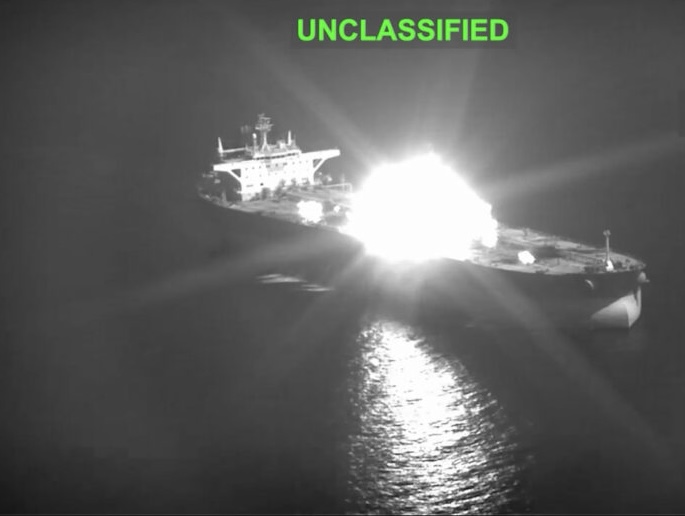
CENTCOM confirmed the successful targeting of the Iranian vessels. Two of the tankers, identified as the M/T Downy and the M/T Stark 1, were struck near Iranian coastal areas. The M/T Downy was hit near Kharg Island, a major Iranian oil terminal, while the M/T Stark 1 was targeted near Jask, a coastal city in Iran. Both were reported by CENTCOM to be “permanently disabled.” A third Iranian oil carrier was targeted in multiple locations within the Gulf of Oman, with CENTCOM stating it was rendered inoperable and “completely destroyed.” Prior to the strikes, U.S. forces issued warnings to the Iranian crews, advising them to abandon their ships. CENTCOM subsequently released video footage purporting to show the attacks on the vessels.
These U.S. attacks on Iranian oil tankers represent a notable shift in the Trump administration’s policy for deterring Iranian aggression against U.S. military forces and commercial vessels. Previously, U.S. retaliatory actions had typically focused on Iranian military targets, such as radar installations and surface-to-air missile batteries. The new policy explicitly targets Iranian economic assets, which the U.S. claims generate revenue for the IRGC, thereby integrating military deterrence with economic pressure tactics.
Iran’s foreign ministry swiftly condemned the strikes, characterizing them as a “war crime” intended to further America’s “economic war” against the Iranian homeland. Iranian officials argue that the deliberate targeting of civilian-registered vessels, even those owned by the state or linked to the IRGC, constitutes a violation of international law. In response, the IRGC stated in its own announcement that it had targeted “three oil tankers traveling through an unauthorized route in the Strait of Hormuz, as well as three vessels affiliated with the United States in other areas.” Independent confirmation of these claimed IRGC retaliatory strikes was not immediately available.
These military actions unfold within the broader context of the Trump administration’s ongoing ‘maximum pressure’ campaign against Iran. The U.S. aims to utilize a combination of economic sanctions and what it describes as a ‘blockade’ – referring to severe restrictions on Iran’s ability to export oil – to compel Tehran to cease its perceived attempts to exert control over international shipping lanes in the Strait of Hormuz and to agree to more stringent limitations on its nuclear program. The Strait of Hormuz, a narrow choke point at the mouth of the Persian Gulf, is strategically vital, with approximately a fifth of the world’s total oil consumption passing through its waters daily. Control, or even significant disruption, of this waterway carries profound implications for global energy markets and international trade.
Why This Matters
The U.S. military strikes on Iranian oil tankers represent a critical juncture in the ongoing geopolitical rivalry between the United States and Iran, carrying significant implications for regional stability, global energy markets, and international legal norms.
Escalation of Tensions and Risk of Wider Conflict:The direct targeting of Iranian economic assets, specifically oil tankers, marks a serious escalation from previous U.S. retaliatory actions that typically focused on military targets. This shift signals a willingness by the Trump administration to inflict economic pain directly as a deterrent, but it also increases the risk of a proportional or even disproportionate response from Iran. The Strait of Hormuz, through which a substantial portion of the world’s oil supply transits, is a critical flashpoint. Any sustained disruption or overt military conflict in this area would have immediate and severe consequences for global energy prices and international trade, potentially drawing in other regional and global powers. The sequence of events—an Iranian missile attack followed by U.S. strikes on Iranian economic assets, and then an Iranian counter-claim—underscores the volatile nature of the U.S.-Iran standoff. Each action carries the inherent risk of further retaliation, potentially spiraling into a wider regional conflict.
Impact on Global Energy Markets:Iran is a major oil producer, and its ability to export oil is central to its economy. The U.S. strikes, coupled with existing sanctions, aim to further cripple this revenue stream, particularly funds believed to support the IRGC. However, the targeting of tankers directly impacts the flow of oil. Even if temporary, such actions create uncertainty in the market, leading to price volatility and increasing insurance costs for shipping, which ultimately affects consumers worldwide. The threat of further attacks on commercial shipping, whether from the U.S. or Iran, could make transit through the Persian Gulf prohibitively risky or expensive, potentially destabilizing global commerce and increasing the risk to civilian maritime traffic in an already tense region.
Precedent for Future Conflicts and International Law:Iran’s condemnation of the strikes as “war crimes” highlights a contentious debate over the legality of targeting state-owned economic assets during peacetime or in a state of undeclared conflict. While the U.S. justifies its actions as self-defense and a means to counter state-sponsored terrorism, the precedent set by deliberately destroying oil tankers, even after warning crews, could redefine acceptable rules of engagement. This development could complicate future international responses to maritime aggression and blur the lines between military and economic warfare, potentially leading to a more volatile international environment where economic infrastructure becomes a more frequent target.
Regional Stability and Alliance Dynamics:The actions taken by both the U.S. and Iran have profound effects on the intricate web of alliances and rivalries in the Middle East. U.S. allies in the Gulf region, such as Saudi Arabia and the UAE, while generally supportive of pressure on Iran, are also acutely vulnerable to the destabilizing effects of open conflict. The strikes could embolden some actors while prompting others to seek de-escalation. The international community, including major powers like China and European nations with significant economic interests in the region, will be closely watching, potentially increasing diplomatic efforts to prevent a full-scale war.