
The auditory version of this piece is presented courtesy of the Air & Space Forces Association, an organization dedicated to recognizing and assisting our Airmen, Guardians, and their loved ones. Discover further details at afa.org
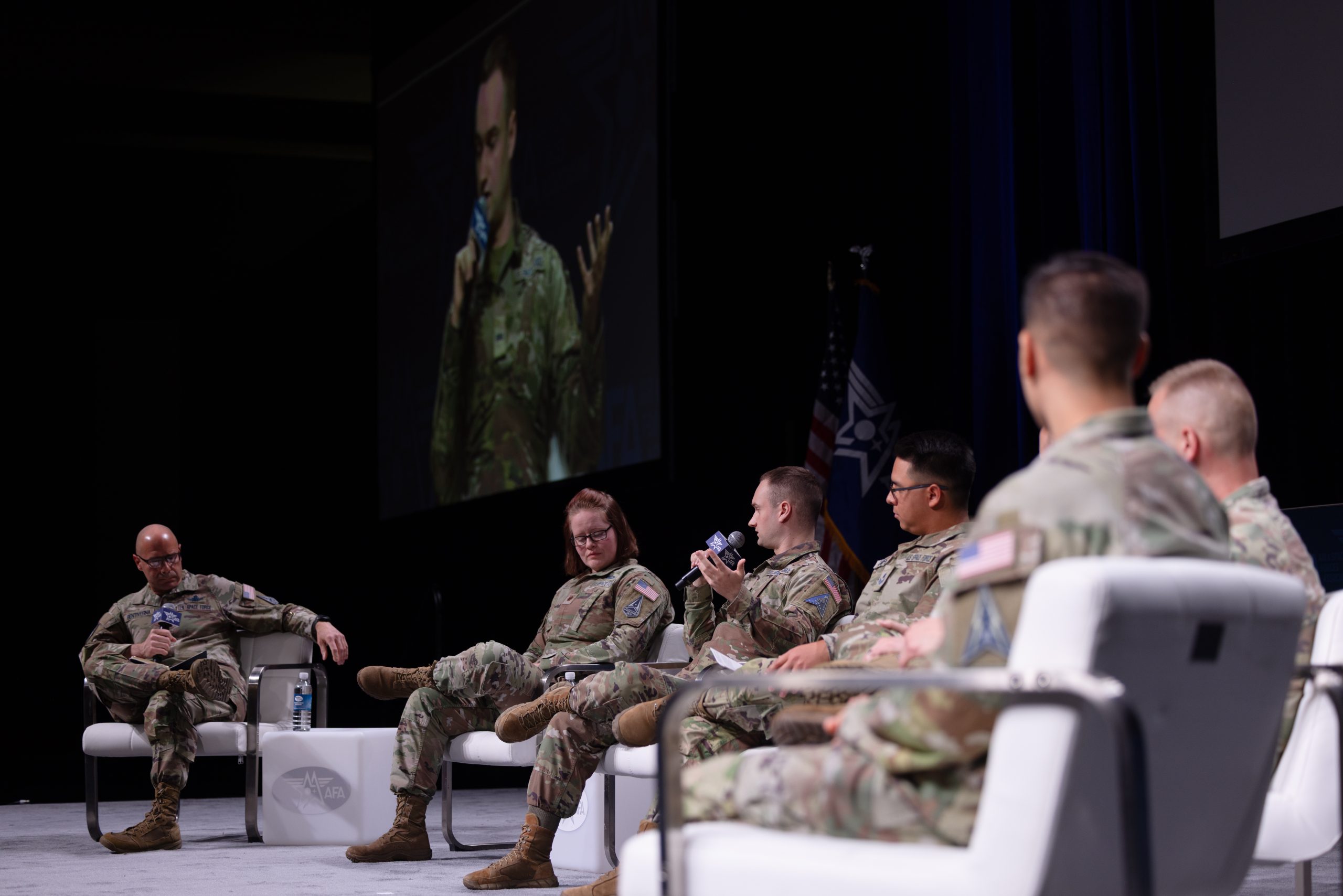
AURORA, Colo.—On February 24th, at AFA’s Warfare Symposium here, the recipients of the Space Force’s fourth yearly, organization-wide Polaris Awards were afforded the opportunity to elaborate on the deeds that resulted in their accolades, during a panel conversation led by Chief Master Sergeant of the Space Force John Bentivegna from the principal platform.
Introduced in 2022, the Polaris Awards encompass four distinct individual divisions along with a collective commendation, symbolizing the core tenets of the Space Force: Character, Connection, Commitment, and Courage.
Character Commendation: Maj. Adriane Payn, Space Force Component to the National Reconnaissance Offic
Major Payn functions as the chief for mission reliability for two of the country’s foremost electro-optical satellites. She directed an examination of over 1,650 production methods and components, guaranteeing the integrity of more than $6 billion worth of flight apparatus. Furthermore, Payn pinpointed a significant flaw within a software utility and organized efforts to avert its deployment, thereby preserving a month of the timeline and conserving $300,000 in capital.
According to the major, uncovering the software flaw represented a challenge to integrity, as her group detected the defect prior to the issue manifesting.
“No malfunction had occurred at that point, nothing had proceeded incorrectly,” she stated. “That was truly when integrity was paramount, as no one was urging us; the situation remained hypothetical.”
The unit might have disregarded the flaw or permitted the contractor to manage it.
“However, we refrained,” she mentioned. “We assumed responsibility.”
Her collective proceeded straight to the sub-contractor and rectified the imperfection to preempt any subsequent malfunctions.
Connection Commendation: Sgt. Michael Campos, 33rd Range and Adversary Squadron
Sergeant Campos strengthened inter-force cooperation by conducting three tactical instruction workshops concerning offensive cyber activities, thereby bridging the chasm separating the cyber and aerospace realms. Additionally, he delivered over 40 hours of specialized cyber instruction, readying an eight-person squad for their role in the Space Flag 25-2 drill.
Campos stated that the primary obstacle in the cyber arena involves elucidating his and his colleagues’ functions. His customary retort in such situations is to clarify that a cyber collapse would cause widespread disruption to numerous systems and command-and-control capabilities throughout a network.
“Our constant assertion is that we never engage in cyber activity purely for its own sake,” Campos remarked. “All our endeavors are designed to produce cascading impacts for alternative domains.”
Commitment Commendation: Spc. 4 Logan Pinder, 76th Intelligence, Monitoring, and Reconnaissance Squadron
Specialist Pinder assisted in establishing the Space Force’s unique, time-critical, multifaceted intelligence squadron. He self-instructed in sophisticated automation programming to devise a data transformer that decreased the processing time for 80-gigabyte files from 100 hours to merely five minutes, thereby activating operational functionality for a cutting-edge orbital sensor and preventing $850,000 in developmental expenditures. Furthermore, he originated the service’s initial multi-intelligence instruction pathway, constructing a framework of interdisciplinary teams and educating analysts to coalesce three distinct intelligence fields.
The specialist’s contingent recognized the 100-hour delay in acquiring intelligence from the detector, and it was Pinder who conveyed to his commanding officer his desire to attempt resolving it, instead of entrusting the undertaking to an external entity at an $850,000 cost.
Pinder required approximately three weeks to formulate the application that remedied the issue.
“Consequently, we commenced delivering actionable intelligence to the combatant at the precise moment it was required, rather than a full week following its conclusion,” Pinder remarked.
Pinder, an intelligence expert, expresses a wish for greater integration of intelligence with cyber capabilities throughout the service.
“My aspiration is to contribute to bridging the discrepancies between these diverse domains, as I believe it is unequivocally vital for us to collaborate, instead of operating independently within our distinct spheres,” Pinder conveyed.
Courage Commendation: 1st Lt. Robert Bartkowiak, 3rd Testing and Assessment Squadron
Lieutenant Bartkowiak received the honor for his efforts in extending the limits of examinations, which culminated in the identification of a novel system functionality. He established an alliance comprising 34 Department of Defense participants and non-military organizations, a move that aided in obtaining $42 million to back three principal undertakings and reactivating an inactive $10 million satellite for scrutiny and appraisal.
Right from its inception, the testing environment presents numerous hazards, Bartkowiak stated. This involves operations within a realm where personnel lack visual input and communication is restricted to their conveyances. Nevertheless, choices made throughout the assessment directly influence combatants utilizing the apparatus, he added.
His unit’s objective is to furnish the functionality and diminish perils, ensuring that users possess a trustworthy capability.
“Should I arrive for duty and declare, ‘we will not conduct this examination today,’ I am effectively communicating to the combatant that I will transfer this hazard to them, and they will proceed into conflict burdened by that hazard,” Bartkowiak explained.
Team Excellence Commendation: Team Archer, 37th Tactical Intelligence Squadron
The collective functioned as the principal Mission Delta 3 facilitator and occasion managers for Guardian Arena III, hosted by the Chief Master Sergeant of the Space Force. They arranged two localized and a single nationwide robotics contest, and brought to completion the establishment of the Space Force’s inaugural sophisticated foreign instrumentation signals intelligence conduit. Lacking prior experience in procurement or cyber, the team assumed responsibility for setting up a $1.7 million intelligence assistance system, permitting staff to conclude the multi-location undertaking ahead of schedule by two days.
First Lt. Christian Montelongo, the second-in-command, and Tech Sgt. Robert Powell, the flight leader, appeared on behalf of the collective at the commendations ceremony.
A significant portion of the collective’s triumph stemmed from the reliance leaders and their subordinates placed on one another and their comrades, Montelongo stated.
The unit performs what Montelongo termed “doctoral-level” scrutiny of physics challenges for the Space Force. The aim is to advance nascent Guardians directly from technical academies to that degree of examination swiftly.
“In essence, we must rely upon one another and our fundamental principles to genuinely achieve that,” Montelongo articulated. “We will present you with this array of challenges and assert that you are the authority on it, and we will depend on you to conduct this assessment independently.”
The auditory version of this piece is presented courtesy of the Air & Space Forces Association, an organization dedicated to recognizing and assisting our Airmen, Guardians, and their loved ones. Discover further details at afa.org