
The United States Space Force has successfully concluded the transfer of Air Force Reserve and Air National Guard members whose roles were encompassed by the innovative Personnel Management Act (PMA). This legislation established a new hybrid full-time and part-time force structure unique to the Space Force, aiming to streamline space-related operations and personnel management.
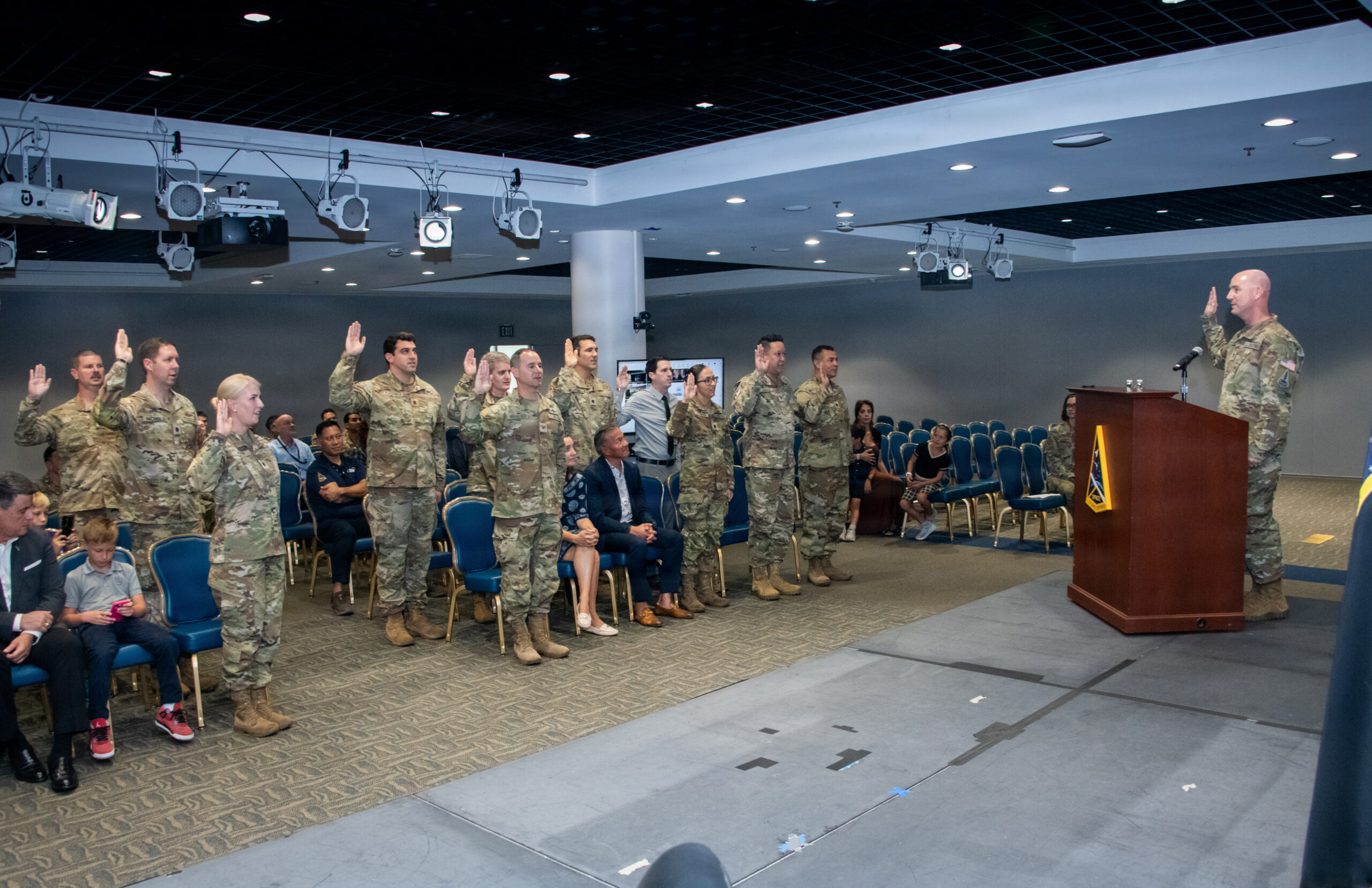
The final group of these transfers, comprising Air Force Reservists transitioning into part-time positions within the Space Force, formally swore into their new service on October 1, 2026. The principal transfer ceremony took place at Los Angeles Air Force Base, California, with additional service members participating remotely via video teleconference, according to an official service announcement. This ceremony marked a significant milestone in the Space Force’s evolution, bringing to fruition a multi-year effort to integrate specialized space talent from across the U.S. armed forces.
Over the past two and a half years, hundreds of Reservists and Guardsmen have transitioned into the Space Force as part of this unprecedented initiative. The goal has been to consolidate space-focused units and their personnel into a single, unified service component. This approach is designed to create a “no components” force, meaning the Space Force does not have separate Reserve or National Guard structures like other military branches. Instead, it offers Guardians the flexibility to transition between full-time (Active Duty) and part-time (Reserve-equivalent) positions with fewer administrative obstacles and bureaucratic hurdles, fostering greater agility in managing its specialized workforce.
The legislative foundation for these transfers was the Space Force Personnel Management Act, which was enacted in late 2023 as part of the fiscal year 2024 National Defense Authorization Act (NDAA). This act meticulously outlined the process for these transfers, initially focusing on personnel from the Air Force Reserve. Approximately one year later, lawmakers further directed that space-related missions within the Air National Guard would also be absorbed by the Space Force, rather than establishing a distinct Space National Guard, a concept that had been under consideration.
Officials had previously indicated that the implementation of the Personnel Management Act, or PMA, would be an extensive and multi-year undertaking, requiring careful planning and execution across various phases. This phased approach allowed for a systematic integration of personnel while ensuring mission continuity and proper administrative alignment.
The first major phase commenced in May 2024, even before the formalization of the Air National Guard space mission transfer. At this time, the U.S. Space Force (USSF) announced a six-month application window for members of the Air Force Reserve interested in transferring into the new service on a full-time basis. Following this application period, a series of selection boards were convened to evaluate candidates, ultimately identifying 380 Reservists for full-time transfer, with their transitions targeted for completion by April 2025.
Subsequently, in August 2025, the USSF began accepting applications from Air National Guardsmen for full-time transfer opportunities. Another rigorous selection board process led to the identification of 99 Guard members in early 2026, slated for transfer into full-time Space Force roles. These initial full-time transfers brought critical experience and expertise into the nascent service, bolstering its operational capabilities.
Separately, in September 2025, the Space Force initiated an application period specifically for Air Force Reservists seeking to transfer into part-time positions within the service. By April 2026, the Space Force announced the selection of 247 individuals for these roles, with the first cohort of part-time Guardians officially coming aboard in July 2026. This staggered approach ensured a manageable integration process for both full-time and part-time personnel.
The October 1, 2026, transfer ceremony specifically honored the last segment of this part-time cohort, marking the conclusion of the major, PMA-directed personnel movements from the Air Force Reserve and Air National Guard. While the primary transfer windows have now closed, Guard and Reserve members can still join the Space Force through its existing prior service program, which offers opportunities for experienced personnel from all branches to enlist or commission into the Space Force.
“The recently completed transfer cohort represented the final PMA-directed movement of [Air Reserve Component] members in the designated space-mission population,” a Space Force spokesperson confirmed to Air & Space Forces Magazine, underscoring the completion of this legislative mandate.
As part of this comprehensive transition, the Space Force officially assumed responsibility for all Air National Guard space missions on October 1, 2025. This integration ensures a unified command and control structure for all U.S. military space operations, a core tenet of the Space Force’s founding principles.
It is notable that the Space Force did not open a specific application window for Air National Guardsmen to transfer into part-time work roles, unlike the opportunities provided for Air Force Reservists. The spokesperson indicated that the USSF “will continue to evaluate manpower requirements and the potential need for subsequent transfer windows as part of the overall growth model,” suggesting that future opportunities may arise based on strategic needs.
The new members serving in a part-time capacity within the Space Force are officially designated as Guardians “Not on Sustained Duty.” These individuals are required to fulfill an annual service commitment equivalent to at least 36 days. This typically involves 48 four-hour Inactive Duty Training (IDT) periods and 12 Annual Training (AT) days per year, which is necessary to earn a “good year” towards retirement benefits, mirroring the service requirements of traditional Reserve components.
The influx of former Reservists and Guardsmen is critical for the Space Force, as these individuals bring a wealth of deep experience and specialized skills at a time when the service is undergoing rapid expansion. Officials emphasize the importance of this experienced talent to effectively manage the projected surge of brand-new Guardians entering the service directly from accession programs.
Deputy Chief of Space Operations for personnel, Katharine Kelley, highlighted this strategic challenge last month at the Air & Space Forces Association’s Air, Space & Cyber conference. “We’re trying to balance not having all of our accessions be brand new in terms of experience,” she stated. Kelley explained that an overabundance of inexperienced Guardians entering at the lowest ranks could potentially disrupt the service’s carefully structured grade hierarchy and operational readiness. “We’re looking for ways to make sure that we can kind of balance this as a sourcing model and a sustainment model for people,” she added, emphasizing the necessity of integrating seasoned professionals to mentor and lead the next generation of space operators.
Why This Matters
The completion of these transfers represents a pivotal moment for the U.S. Space Force and for American national security. Firstly, it finalizes the consolidation of military space operations under a single command, fulfilling a key objective behind the Space Force’s creation in 2019. This unification aims to enhance efficiency, reduce redundancy, and foster a more agile and cohesive response to the rapidly evolving threats and opportunities in the space domain.
Secondly, the innovative “no components” personnel model established by the Personnel Management Act sets a new precedent for military force management. By allowing Guardians to seamlessly transition between full-time and part-time roles, the Space Force gains unprecedented flexibility in leveraging specialized talent. This model acknowledges the unique demands of space operations, which often require highly skilled individuals who may also have significant civilian expertise. It could serve as a potential blueprint for other military branches seeking to adapt to modern workforce trends and retain critical skills.
Thirdly, the integration of experienced Air Force Reservists and Air National Guard members is crucial for the Space Force’s immediate operational effectiveness and long-term stability. As a relatively new service, the Space Force faces the challenge of rapidly building its ranks while maintaining a balanced force structure. These transfers bring seasoned professionals with institutional knowledge and practical expertise, preventing an imbalance of junior personnel and ensuring a robust leadership and mentorship pipeline. This infusion of experience is vital for developing and executing complex space missions, from satellite operations and cyber warfare to space domain awareness and missile warning.
Finally, this development underscores the growing importance of space as a critical theater of national security. By consolidating and optimizing its space personnel, the United States is signaling its commitment to maintaining superiority in a domain increasingly contested by global adversaries. The success of this personnel integration effort will directly impact the nation’s ability to protect its space assets, project power from space, and ensure freedom of navigation in orbit, thereby safeguarding economic interests and national defense capabilities.