
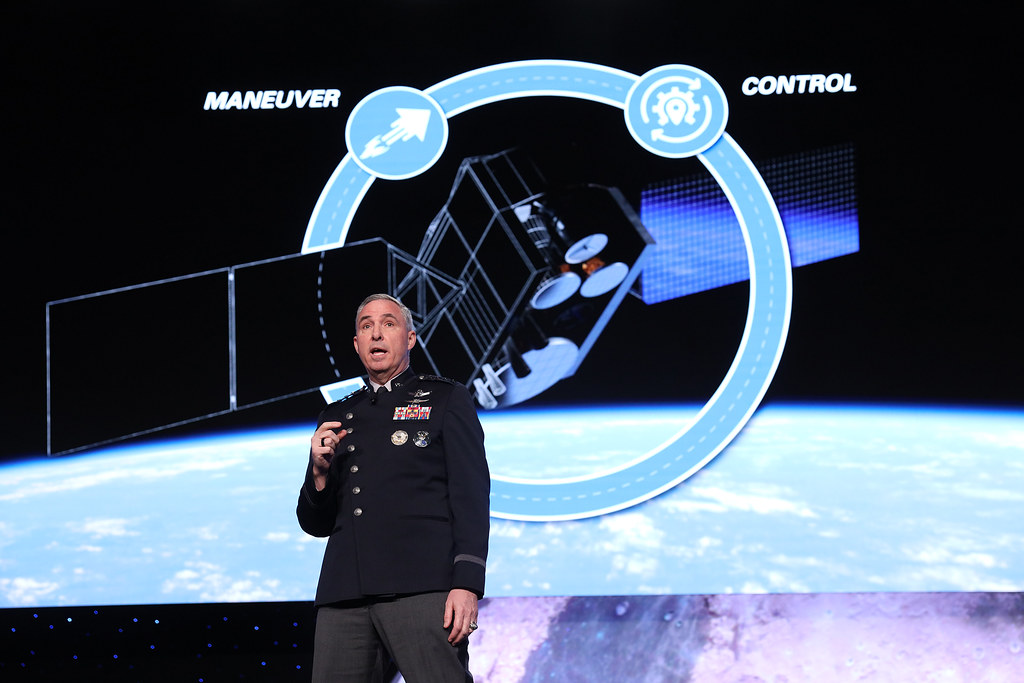
U.S. Space Command recently completed “Apollo Maneuvers 2026,” a significant exercise designed to test and refine the dynamic movement of satellites across various orbital altitudes. This initiative marks a strategic push by the command to master complex operational maneuvers in space, moving beyond traditional satellite operations focused primarily on orbital station-keeping.
The conclusion of Apollo Maneuvers 2026 was announced by U.S. Space Command (SPACECOM) in a Sept. 8 release. The exercise itself had been previewed a month prior by SPACECOM Commander Gen. Stephen Whiting, who articulated its purpose as a “live-fly” event intended to develop new tactics and ultimately inform future doctrine for maneuver warfare in the space domain.
The scope of the exercise was extensive, encompassing maneuvers in low-Earth orbit (LEO), which begins approximately 100 miles above the Earth’s surface; medium-Earth orbit (MEO); and geosynchronous orbit (GEO), which extends more than 22,000 miles out. Each of these orbital regimes hosts different types of critical satellites: LEO is increasingly populated by constellations for internet, remote sensing, and imaging; MEO is home to navigation satellites like GPS; and GEO is crucial for communication, weather monitoring, and missile warning systems due to its stationary position relative to the Earth’s surface. Practicing maneuvers across such a broad spectrum of orbits suggests a comprehensive approach to securing and operating in all contested areas of space.
While SPACECOM did not disclose specific details regarding the satellites utilized or the precise distances they moved, Gen. Whiting had previously indicated in August that the command would leverage “existing satellites” and collaborate with partners. The objective, he explained, was to “demonstrate what are some of the requirements and capabilities to be able to maneuver for advantage, not just maneuver when you have to change your orbital position.” This distinction is critical: traditional satellite maneuvers typically involve minor adjustments to maintain a desired orbit or avoid collision. “Maneuvering for advantage,” by contrast, implies a more proactive and strategic repositioning, potentially for surveillance, evasion from threats, or to establish a more favorable operational posture.
Under Gen. Whiting’s leadership, SPACECOM has been a vocal proponent for developing maneuver warfare capabilities in orbit. Historically, satellite operators have prioritized fuel conservation to extend the operational lifespan of their spacecraft, making extensive maneuvering a rarity. However, this long-standing approach is being re-evaluated due to several convergent factors. The decreasing cost of launching satellites has led to greater orbital congestion and the proliferation of satellite constellations. Concurrently, advancements in propulsion technologies, such as more efficient electric and ion engines, are making dynamic movements more feasible. The nascent development of in-orbit refueling and servicing spacecraft further promises to mitigate fuel constraints, allowing satellites to perform more frequent and complex maneuvers without prematurely exhausting their operational life.
For military space operations, the ability to maneuver is increasingly seen as essential for both defensive and potentially offensive purposes. Pentagon space leaders have consistently highlighted that static satellites present easier targets for adversaries possessing anti-satellite (ASAT) weapons, jamming capabilities, or cyberattack tools. Beyond mere evasion, however, Gen. Whiting has articulated a broader strategic imperative: the need for SPACECOM to develop capabilities that not only allow U.S. systems to survive but also to “hold adversaries’ systems at risk.” This implies a shift towards developing counter-space capabilities that could disrupt or neutralize hostile space assets, adding a new dimension to military deterrence and power projection.
Gen. Whiting reiterated this strategic vision in the release, stating, “To perform, survive, and gain advantage in the space domain, we need maneuverability and survivability in our capabilities.” This statement underscores the dual objective of the Apollo Maneuvers: to enhance the resilience of U.S. space assets while simultaneously exploring methods to gain operational superiority in an increasingly contested domain.
The name “Apollo Maneuvers” itself holds historical significance, echoing the U.S. Army’s 1941 Louisiana Maneuvers. Those World War II-era exercises were instrumental in testing and refining ground combat tactics for a new era of warfare. By invoking this parallel, SPACECOM signals its intent to similarly forge new doctrine for space warfare through practical, large-scale exercises. A key component of Apollo Maneuvers 2026 was the integration of international allies and commercial partners. Allies involved are members of the multinational Operation Olympic Defender, an initiative focused on strengthening deterrence and defending critical space capabilities. Furthermore, industry players participated through the Commercial Integration Cell, highlighting the increasing reliance of military space operations on commercial space infrastructure and services.
SPACECOM’s release emphasized the benefits of this collaborative approach: “The integration of allied, partner, and commercial capabilities strengthens joint and combined operations and enabled the validation of combined tactics, techniques and procedures.” This multi-stakeholder participation is reflective of the complex and interconnected nature of the modern space domain, where military, allied, and commercial assets often operate in close proximity and rely on shared infrastructure and data.
Why This Matters
The Apollo Maneuvers 2026 exercise represents a pivotal moment in the evolution of space operations and military doctrine, with profound implications across geopolitical, economic, and technological spheres.
**Geopolitical and Military Implications:** This exercise unequivocally signals the United States’ recognition of space as a critical and contested domain, mirroring the land, sea, and air theaters of traditional warfare. The shift from passive satellite operation to “maneuver warfare” indicates a proactive stance in an environment increasingly characterized by great power competition, particularly with nations like China and Russia developing sophisticated anti-satellite capabilities. By practicing dynamic operations, the U.S. aims to enhance its deterrence posture, demonstrating both the ability to protect its own assets and potentially disrupt those of adversaries. This development could accelerate an arms race in space, prompting other nations to invest further in their own maneuverable or counter-space capabilities, thereby escalating the militarization of space. The integration of allies underscores the collective security dimension, indicating that future space conflicts or competitions will likely involve multi-national coalitions.
**Economic and Societal Reliance on Space:** Modern society is profoundly dependent on space infrastructure. Global communication, navigation (GPS), weather forecasting, financial transactions, and even agriculture rely heavily on satellites. Any disruption or conflict in space, therefore, has immediate and severe terrestrial consequences. By enhancing the survivability and resilience of space assets through maneuvers, the U.S. aims to safeguard these vital services. However, a more dynamic and potentially confrontational approach to space operations also introduces new risks to the stability of the orbital environment, potentially increasing the likelihood of collisions or the generation of space debris, which could threaten all space users, commercial and military alike.
**Technological and Doctrinal Evolution:** The Apollo Maneuvers highlight a significant technological inflection point. Advances in propulsion, in-orbit servicing, and artificial intelligence for autonomous decision-making are making dynamic space operations feasible in ways they weren’t before. This exercise will directly inform the development of new military doctrine, moving beyond theoretical concepts to practical tactics, techniques, and procedures for operating in a potentially hostile space environment. This involves not just hardware and software but also training, command and control systems, and international protocols for collaboration. The involvement of commercial partners also underscores a growing trend where military space capabilities are intertwined with, and often leverage, private sector innovation and infrastructure, blurring the lines between military and civilian space activities and raising questions about their protection in times of conflict.