
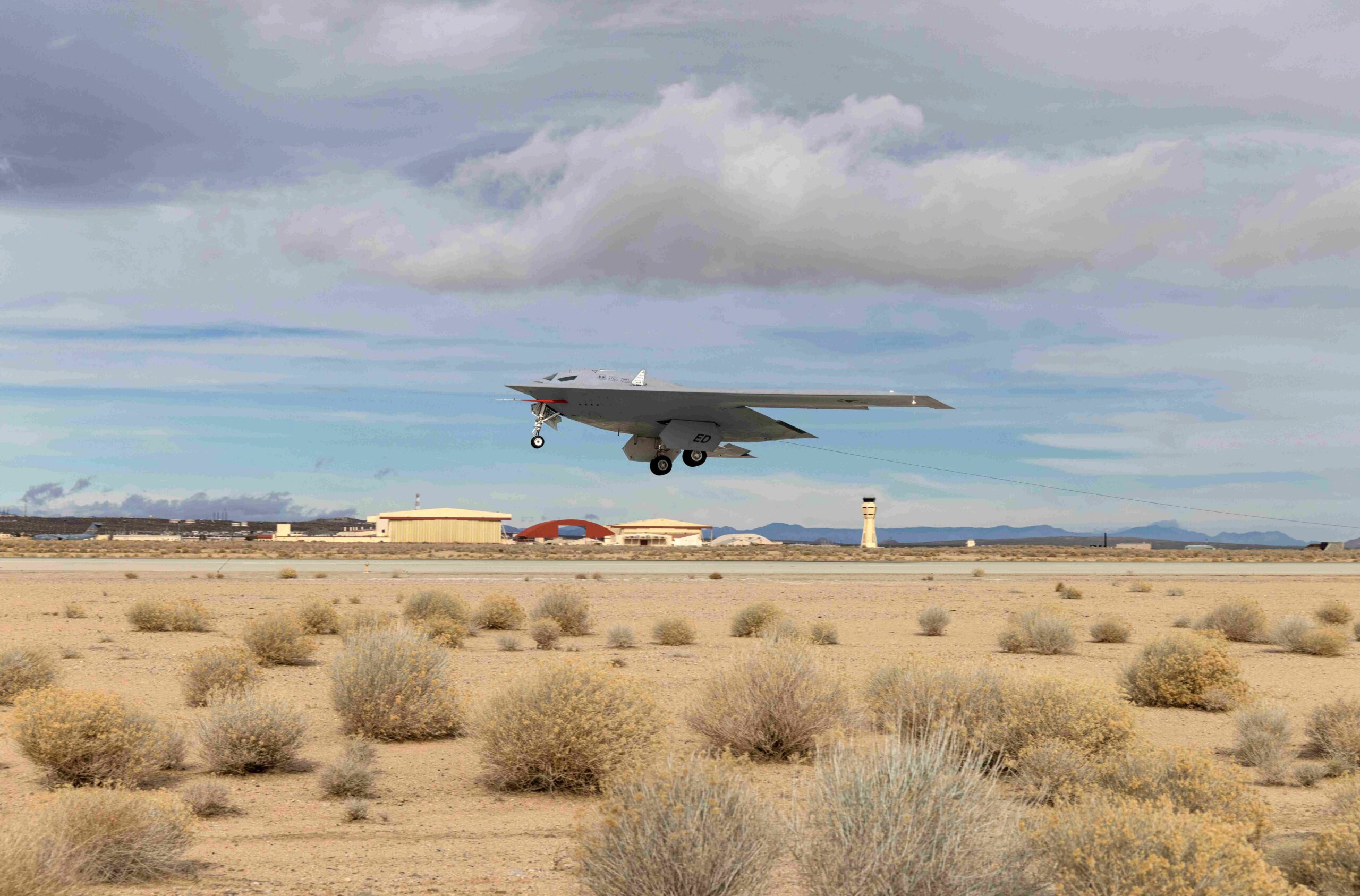
**Edwards Air Force Base, Calif.** — The B-21 Raider stealth bomber recently achieved a significant developmental milestone by completing a flight test that included both a developmental test pilot and an operational pilot, the U.S. Air Force announced on June 11. This unprecedented early integration of operational personnel into the testing process signals a strategic shift towards accelerated weapons development within the Air Force.
Traditionally, aircraft development proceeds through distinct phases. Developmental testing primarily focuses on ensuring an aircraft’s safety, airworthiness, and adherence to technical specifications. Following this, operational testing evaluates how the aircraft performs its intended combat missions, often involving pilots from active combat units. The B-21 program’s new approach deliberately blurs these lines, aiming to streamline the transition from design to combat readiness.
Col. Matt Guasco, commander of Air Force Operational Test and Evaluation Center’s Detachment 5 at Edwards Air Force Base, highlighted the novelty of this move. “We put an operational test member in the pilot seat with an Air Force Test Pilot School graduate in the other,” Guasco stated in an Air Force release. “In the history of modern test, we’ve never done that so early in a program.” This combined testing environment is designed to bridge the gap between confirming an aircraft’s basic functionality and verifying its readiness for real-world combat scenarios.
Gen. Dale White, who serves as the portfolio manager for critical major weapon systems including the B-21, the F-47 sixth-generation fighter (a designation for a future advanced aircraft program), the LGM-35A Sentinel nuclear missile, and the fleet of semi-autonomous Collaborative Combat Aircraft (CCA), emphasized that this approach reflects a broader acquisition philosophy. “It’s a smarter and faster mindset that leverages modern production and test tools with the proper sense of urgency,” White explained. He added that this urgency “challenges old processes and moves us to a more agile acquisition system,” ultimately bringing the U.S. closer to fielding “asymmetric lethality into the hands of the warfighter.” White reports directly to Deputy Secretary of Defense Steve Feinberg.
The early involvement of operational pilots in the B-21 testing aligns with a growing trend within the Air Force to integrate operator expertise into new weapons programs at earlier stages. This strategy aims to ensure that new systems meet practical combat requirements from their inception. For instance, in a July 2024 interview with Defense News, then-Air Force Assistant Secretary for Acquisition, Technology and Logistics Andrew Hunter noted how operators helped identify potential shortcomings in early CCA designs, underscoring his belief that “If [new systems] don’t scratch the operational itch, then we haven’t succeeded.”
The B-21 Raider, a long-range strategic bomber designed to be a key component of the U.S. nuclear triad, is intended to gradually replace the aging B-1 Lancer and B-2 Spirit fleets. Its stealth capabilities and open-architecture systems are expected to provide significant advantages in future high-end conflicts.
With the anticipated delivery of the second B-21 aircraft to Edwards in summer 2025, the testing program is poised to intensify further, moving beyond initial flight performance checks to a more rigorous evaluation of critical mission systems and weapons integration. This phase will be crucial for validating the bomber’s full combat potential.
The ongoing testing efforts are being led by the Raider Combined Test Force, a collaborative team comprising Airmen and civilians from the 412th Test Wing’s 420th Flight Test Squadron. They are working in conjunction with AFOTEC Detachment 5, the 53rd Wing’s 31st Test and Evaluation Squadron, and representatives from the prime contractor, Northrop Grumman. Lt. Col. Matthew Gray, squadron commander of the 420th and director of the Raider Combined Test Force, affirmed the value of this integrated approach: “Bringing operational testers onto the team at this early point now means we can evaluate the bomber’s true combat utility, not just its flying characteristics.”
During an all-call meeting with the test force team on June 8, Gen. White reiterated the critical importance of ensuring the B-21 program receives adequate resources and remains unhindered by bureaucratic delays. He stressed the imperative for the program to proceed with “urgency,” while simultaneously cautioning against “recklessness.” White voiced concerns about potential complacency, stating, “I worry that we don’t embrace urgency. I worry that talk is cheap. I worry about the courage to challenge leaders.” This sentiment underscores the delicate balance the Air Force seeks to strike between rapid innovation and maintaining rigorous standards in the development of its most advanced platforms.
Why This Matters
The B-21 Raider’s accelerated testing regimen, marked by the early integration of operational pilots, represents a significant paradigm shift in U.S. defense acquisition and technological development. This approach carries substantial implications for national security, international relations, and the future of military procurement.
Strategically, the B-21 is designed to be a cornerstone of the U.S. nuclear deterrence and conventional global strike capabilities, crucial for projecting power and maintaining stability in an increasingly complex geopolitical landscape. Expediting its combat readiness means the U.S. can field this advanced platform sooner, enhancing its ability to deter potential adversaries and respond to global threats. This is particularly relevant in the context of rising great power competition, where technological superiority and rapid deployment are increasingly vital.
From an acquisition standpoint, this method reflects a broader U.S. military effort to reform its historically lengthy and costly weapons development cycles. By combining developmental and operational testing phases, the Air Force aims to identify and address potential issues earlier, reducing redesigns, saving costs, and ultimately delivering more effective weapons systems to warfighters faster. If successful, this “smarter and faster” mindset could serve as a blueprint for future defense programs, potentially influencing how the U.S. develops everything from next-generation fighters to unmanned systems.
Operationally, getting the B-21 into service more quickly ensures that Airmen have the most advanced tools available to perform their missions effectively. The direct involvement of operational pilots from the outset means the bomber is being designed and refined with real-world combat scenarios in mind, aiming to maximize its “combat utility” rather than just its technical specifications. This focus on practical application is intended to improve crew effectiveness, mission success rates, and overall strategic advantage.
Furthermore, the emphasis on urgency articulated by Gen. White highlights the perceived need to outpace technological advancements by peer competitors. In a rapidly evolving security environment, the ability to rapidly innovate, test, and deploy cutting-edge technology is paramount. The B-21’s testing milestone underscores the U.S. commitment to maintaining its qualitative edge, which is essential for preserving deterrence and protecting national interests worldwide.