
Thales is poised to introduce a novel soldier-wearable electronic warfare apparatus, engineered to safeguard foot soldiers from drones and diverse radio-frequency threats. This development underscores the escalating significance of anti-UAS prowess at the personal combatant echelon.
Prior to the system’s formal revelation at the Future Soldier Technology conference, the UK Defence Journal conversed with Timothy Coley, Product Line Manager for cyber and electromagnetic activities at Thales. Their discussion focused on the company’s innovative Storm 2 system and the tactical challenge it is purposed to tackle.
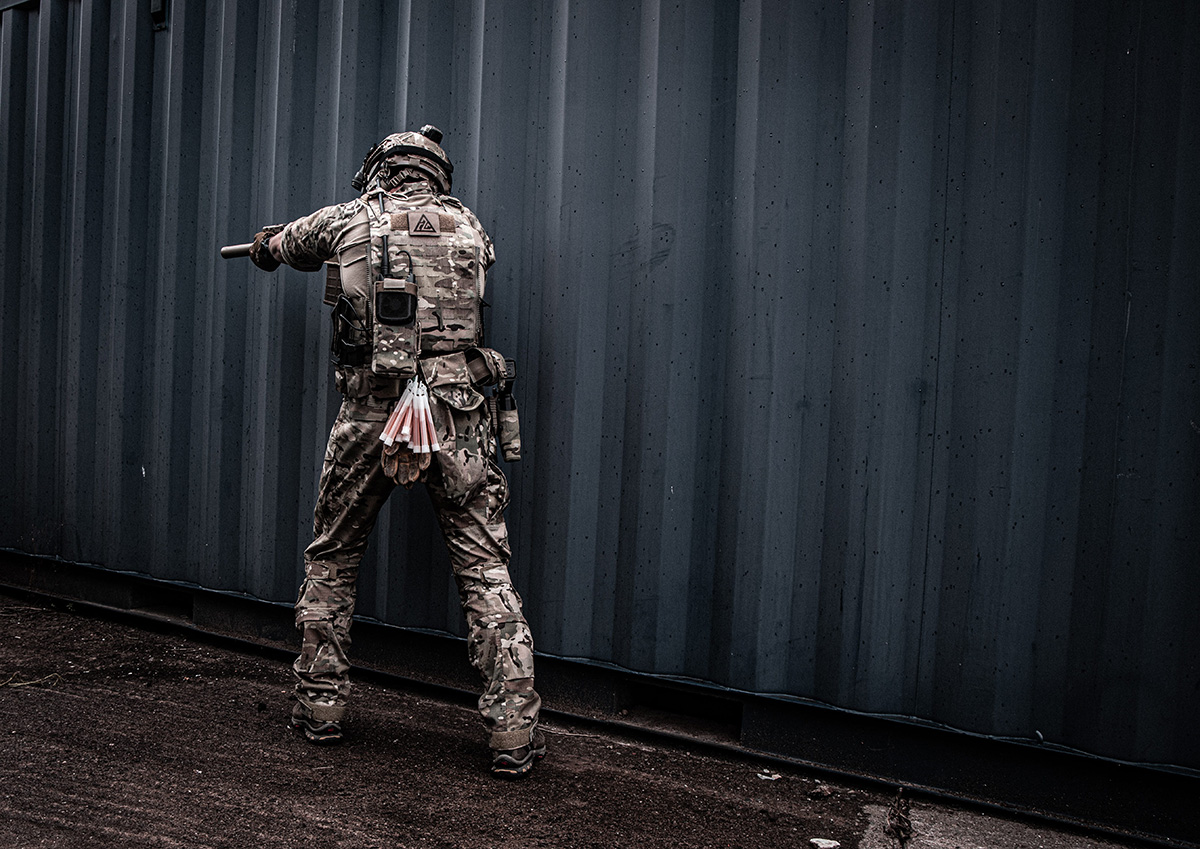
Storm 2 is an infantry-centric cyber and electromagnetic activities (CEMA) unit created for wear by individual soldiers. Centered on a software-defined radio with integrated computational capacity, the system is devised to identify and impede hostile RF transmissions from UAVs or remotely detonated ordnance. With a mass of approximately two kilograms, the device is considerably lighter than numerous conventional electronic countermeasure manpacks, which can be substantially bulkier and weightier.
Per Coley, the system was conceived to offer safeguards from RF-dependent dangers without imposing extra burden on soldiers already burdened with substantial gear.“Storm 2 shields soldiers from RF-based menaces in a compact design that avoids significant encumbrance, enabling unhindered movement and allowing them to accomplish their core objective on the combat zone,”he stated.
The apparatus stems from anti-IED endeavors, where EW tactics are employed to hinder radio-controlled improvised explosive devices from being activated from afar. Coley clarified that the system was swiftly reconfigured later, due to the escalating UAV menace on contemporary combat theaters.
“The initial purpose of Storm 2 was for anti-RC-IED scenarios, furnishing ground forces with safeguard against radio-triggered devices,”he mentioned.“We swiftly re-oriented it upon a client’s demand, within a few weeks’ span, to tackle an anti-UAS application by disrupting the connection between the remote pilot and the UAV.”
Storm 2 functions over a broad radio spectrum, spanning from 20 MHz to 6 GHz, enabling detection and interference with a variety of radio signals. While numerous civilian UAVs utilize the 2.4 GHz and 5.8 GHz ISM bands, the system can also be adapted to focus on alternative frequencies. This adaptability indicates the changing strategies employed by UAV pilots, who progressively modify the transmission channels of their remote command units to bypass established EW measures. Coley noted,“Various hostile entities are shifting the core frequencies of their ground control stations to evade existing interference tech.”He added,“Possessing the capacity to engage in that ongoing strategic dance of offense and defense in EW is crucial.”
The system utilizes responsive interference, signifying its dormant state until an adversarial transmission is identified. Inquiring about its distinction from conventional interferers, Coley explained that numerous devices broadcast ceaselessly, drawing energy and possibly disclosing their location.“A constant interferer is perpetually engaged, which means that it’s going to be efficacious, but it will use more energy and is simpler to pinpoint,”he articulated.“Conversely, a responsive interferer becomes active when the threat signal is detected, minimizing energy drain and making it harder to spot on the operational theater until it is truly needed.”Practically speaking, the system identifies RF emanations linked to UAV activities, encompassing both command channels and visual feeds. These signals can effectively serve as an activation prompt for the system to initiate its interference function.
Storm 2 can produce a maximum of 10 watts of emission strength. In response to inquiries about its protective range for an infantryman, Coley said exact values were challenging to furnish, as EW efficacy is significantly influenced by surrounding circumstances.“It truly hinges on the characteristics of the hostile transmission and the surroundings,”he remarked.“Extraneous RF signals, topography, atmospheric state, and the aerial’s placement concerning the recipient all collectively impact the reach attainable.”Power cell longevity is stated as up to four hours.
Upon inquiring about how long the system could feasibly function during a mission, Coley observed that the duration fluctuates contingent on the regularity with which the device needs to engage its interference function.“Because the system is responsive, the operational duration depends on how often hostile transmissions are identified and the duration for which interference is required,”he stated.“You may not always require utilizing the maximum ten-watt output based on the assignment.”
Thales has also carried out numerous client showcases and assessment tests. Upon inquiry regarding appeal from prospective clients, Coley stated that multiple military branches are actively evaluating the system.“We have had a range of prosperous tests and presentations covering both anti-IED and anti-UAS applications,”he said.“We also have active queries with various defense organizations.”
Storm 2 signifies a wider change in the military’s approach to electronic warfare on the combat zone. Conventional EW devices have often been fitted onto vehicles or borne in bulky backpacks by dedicated personnel. Storm 2, conversely, disperses EW safeguards among single combatants, enabling the feature to accompany forces and lessening dependence on a solitary interferer inside a formation. When asked how the system might be utilized in the field, Coley said the precise method would hinge upon the tactical doctrine embraced by every military branch.“Conventionally, a backpack unit could be carried by a few squad members,”he explained.“Storm 2 can provide personal security to every squad member, but not all combatants invariably bear identical gear or function.”
This notion may be particularly pertinent in contemporary hostilities where units deploy in more compact and scattered formations. Coley noted,“Engagements in Ukraine are not conducive to sizable squad or platoon formations.”He added,“The detection-to-engagement process means substantial concentrations of personnel are rapidly identified and attacked.”Storm 2 has also been engineered to alleviate the load imposed on the operating infantryman. Inquiring about instructional needs, Coley said the system has been intentionally crafted to demand scant operator involvement.“The operator merely activates it,”he stated.“We’ve engineered it for dormant and all-encompassing coverage because the menace might originate from any direction. The combatant’s role is to concentrate on the assignment, instead of managing EW gear.”
Thales considers the fusion of extensive frequency range, responsive interference function, and a two-kilogram physical dimension distinguishes Storm 2 from rival devices.“There are bulkier apparatuses that can offer comparable functionality but place a considerably heavier load on the soldier,”Coley pointed out.“There are also more compact units that solely function within predetermined frequency ranges. Delivering responsive functionality over an expansive spectrum in a two-kilogram unit is an unparalleled offering.”
Storm 2 is anticipated to be officially revealed at the Future Soldier Technology conference, where Thales intends to showcase the apparatus as an element of its wider EW and anti-UAV product line.