
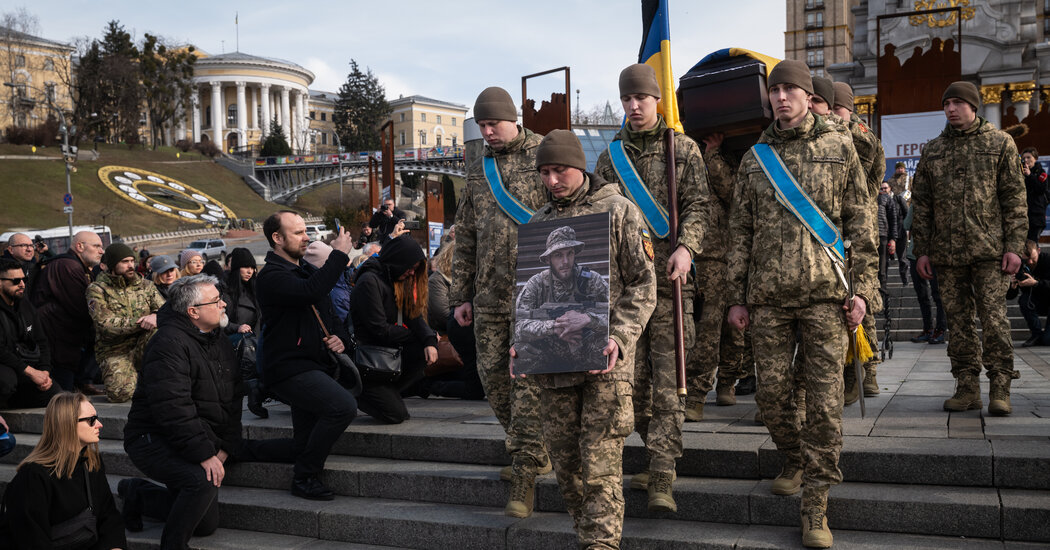
A new study reveals that more than two million Russian and Ukrainian military personnel have been killed or wounded over the four years since Russia launched its full-scale invasion of Ukraine in February 2022. This staggering figure represents a grim milestone as the protracted conflict continues, underscoring the immense human toll of the ongoing hostilities.
Published on Wednesday by the Washington-based Center for Strategic and International Studies (CSIS), the report indicates that Russia has sustained the heaviest losses. An estimated 1.4 million Russian troops have been killed or wounded since the February 2022 invasion. Of this total, the study estimates approximately 450,000 Russian soldiers have been killed, a figure that is reportedly four times higher than the total U.S. military fatalities across all wars combined since World War II.
Ukrainian forces, while facing a numerically superior adversary, have also endured significant casualties. The CSIS study projects Ukrainian losses to be between 525,000 and 625,000 killed or wounded, including an estimated 125,000 to 150,000 deaths.
Officials and analysts caution that precise casualty figures throughout the conflict have been notoriously difficult to ascertain. Moscow is widely believed to systematically underreport its war dead and injured, while Kyiv has maintained a policy of not disclosing official casualty statistics. Acknowledging these challenges, the CSIS study based its estimates on a variety of sources, including American and British government intelligence assessments, among other publicly available data points.
These grim statistics coincide with an assessment of Russia’s often slow and costly military progress in Ukraine. The study notes that in some operational areas, Russian forces have advanced at rates of less than 165 feet per day, indicating persistent tactical difficulties and strong Ukrainian resistance.
Despite the overall numerical advantage held by Russia, the report highlights periods of significant setbacks for Moscow. For instance, in February, Ukrainian forces reportedly gained more territory than they lost for the first time since 2023, initiating an offensive in the southern regions. Furthermore, the CSIS study states that “Russia’s territorial control in Ukraineshrankin the spring of 2026.” This period saw Russian forces losing more ground than they captured in both April and May of that year, resulting in a net loss of approximately 400 square kilometers. This marked Russia’s first monthly net territorial losses since August 2024, signaling renewed challenges for its military campaign.
In a notable development earlier this year, in February, Ukrainian forces received a temporary strategic advantage when Elon Musk’s Starlink satellite internet service unexpectedly blocked access for Russian troops. Analysts suggest this disruption provided Ukrainian units with a brief respite from drone assaults and enhanced their freedom of movement on the battlefield.
The study emphasizes the significant numerical disparity between the warring armies, estimating that approximately 400,000 Russian troops face about 250,000 Ukrainian soldiers on the front lines, representing an almost three-to-one advantage for Russia. Despite enduring heavy casualties, Russia has largely managed to maintain its troop levels due to its larger population base and aggressive recruitment strategies. These methods have included Russia’s first military draft since World War II, as well as the enlistment of felons and debtors. President Vladimir Putin has also reportedly offered substantial financial bounties to new recruits and has provided incentives, such as the dismissal of criminal charges, in exchange for military service.
Additionally, the report notes instances of external military support for Russia. In 2024 and 2025, North Korea reportedly dispatched over 10,000 soldiers to assist Russia in its efforts to regain control of the western Kursk region, where Ukraine had previously captured territory. However, the sustainability of Russia’s manpower strategy appears to be under strain. The study indicates that in 2026, Russia’s monthly casualty rates, estimated at 30,000 to 34,000, likely surpassed its recruitment rates of approximately 27,000 new personnel per month, suggesting a potential long-term deficit in force generation.
The release of the CSIS report comes amid shifting international dynamics, particularly concerning the United States’ engagement with the conflict. President Trump, at a summit in France last month, conveyed a stance of relative disengagement, indicating that the war in Ukraine was not among his top priorities, despite earlier claims that he could resolve the conflict within 24 hours.
Commenting on U.S. involvement, Mr. Trump stated, “Look, we have nothing to do with it,” adding, “It has no impact on us, other than we sell weapons” to Ukraine. He framed U.S. involvement more as a humanitarian endeavor, citing the high number of casualties on both sides as a reason to seek an end to the war. These remarks have been interpreted by some observers as signaling a new reality for U.S. allies in Europe. For decades, these allies have relied on American security assurances, a dynamic that the Trump administration has challenged. Conversely, proponents of continued support for Ukraine, including many members of the U.S. Congress, argue that preventing a Russian victory is crucial not only for Ukraine’s sovereignty but also to deter an emboldened President Putin from potentially threatening other NATO member states.
The ongoing situation in Ukraine is expected to be a central topic of discussion at an upcoming NATO summit scheduled for Tuesday in Ankara, Turkey. The CSIS study concludes that without sustained pressure from the United States and European allies, President Putin is likely to continue his war efforts despite the significant human and material costs.
Meanwhile, Ukraine has increasingly adopted a strategy of taking the conflict directly to Russian territory and annexed regions. The study highlights Ukraine’s growing effectiveness in employing drones, missiles, and an evolving air campaign to strike targets deep within Russia. Last month, Ukraine launched what was described as its largest drone assault on Moscow since the full-scale invasion began. This week, further drone attacks were reported, targeting the Russian capital and Crimea, the peninsula annexed by Moscow in 2014. According to a statement from the Russian Defense Ministry, a total of 419 drones were reportedly shot down during these recent attacks.
Seth G. Jones, one of the authors of the CSIS study, characterized the current period for Russia as “by far, its darkest period of the war since its February 2022 invasion of Ukraine.” Jones elaborated on the internal impact of the conflict, stating, “The war has come home to everyday Russians, who are paying the price of President Putin’s war with a sputtering economy, skyrocketing prices, a growing number of body bags coming back from the front lines and drone strikes in Russian cities.”
Why This Matters
The new CSIS report, detailing over two million military casualties, underscores the immense human cost of the Russia-Ukraine war, now entering its fifth year. This staggering figure highlights not only the scale of the conflict but also the profound demographic and societal impacts on both nations, particularly Russia, which has reportedly suffered disproportionately higher losses. The attrition rates detailed in the study, coupled with Russia’s reported recruitment challenges, raise questions about the long-term sustainability of its military campaign and its ability to maintain troop levels, even with coercive recruitment tactics.
For Ukraine, while its losses are numerically smaller, they represent a larger proportion of its comparatively smaller population and military, posing existential challenges to its defense capabilities and national resilience. The report’s findings on territorial shifts, including Russia’s recent net losses and Ukraine’s tactical gains, indicate that despite the overwhelming odds, the conflict remains dynamic and far from a decisive stalemate, with neither side achieving a conclusive victory.
Internationally, the study’s conclusions, particularly concerning the need for sustained external pressure on Russia, gain prominence amidst evolving geopolitical stances. President Trump’s declared disengagement from the conflict, contrasting with the views of many U.S. allies and congressional members, highlights a potential divergence in Western strategy. This shift could significantly alter the support landscape for Ukraine and reshape the future of European security arrangements, potentially emboldening Russia or compelling European nations to assume greater defense responsibilities.
Finally, Ukraine’s increasing ability to launch drone and missile attacks deep within Russian territory signals an escalation in tactics and brings the realities of war closer to the Russian populace. This could potentially influence domestic support for the conflict within Russia, adding another layer of complexity to President Putin’s strategic calculations and further challenging the narrative of a distant, controlled conflict. The ongoing conflict thus has far-reaching implications for global security, international alliances, and the future geopolitical order.