
U.S. Air Force and Space Force Advance Combat Decision-Making with Integrated AI Experiment
For the first time, members of the U.S. Space Force have actively collaborated with the Air Force in an advanced artificial intelligence (AI) experiment, focusing on complex command-and-control (C2) scenarios to accelerate combat decision-making. This significant event marks a new phase in the integration of AI across military domains, aiming to enhance the speed and effectiveness of strategic responses.
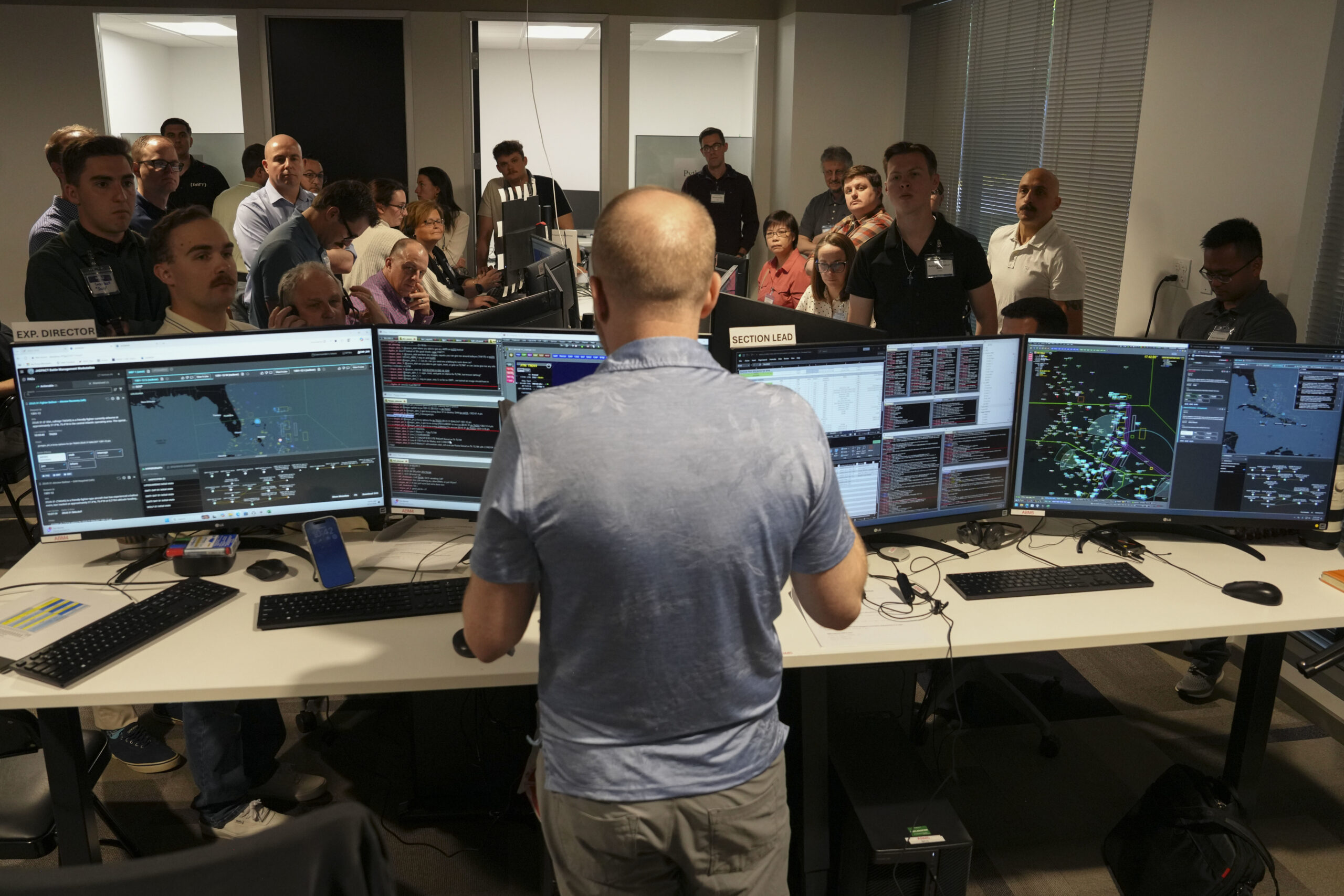
The experiment, known as the Multi-Decision Advantage Sprint for Human-Machine Teaming (MASH), brought together approximately 100 Guardians (Space Force personnel), Airmen, and civilians. Held over two weeks in Las Vegas this May, MASH built upon previous iterations of the Decision Advantage Sprints for Human-Machine Teaming (DASH) experiments. Its primary goal is to establish a “blueprint” for future multi-domain operations, as outlined in a release from the 505th Command and Control Wing.
Retired Air Force Col. George Dougherty, author of “Beast in the Machine: How Robotics and AI Will Transform Warfare and the Future of Human Conflict,” commented on the significance of these events. He stated in an email to Air & Space Forces Magazine that “The DASH/MASH events are requirements-development experiments conducted by the [Air Force] to clarify future directions for AI-enabled battle management.” Dougherty emphasized the innovative nature of DASH and MASH, which involve live experiments where defense technology innovators work directly alongside uniformed personnel to solve challenging technical problems related to integrating AI into battle management systems.
While Guardians from the 16th Electromagnetic Warfare Squadron under Mission Delta 3, based at Peterson Space Force Base, Colo., had previously observed DASH experiments, their participation in MASH marked their first active role in the fast-paced simulations. During the MASH experiment, Space Force Guardians collaborated with Airmen and software developers. Together, they leveraged advanced AI tools to address complex problems spanning the air, space, cyber, maritime, and ground domains. These tools, according to U.S. Air Force Col. John Ohlund, the Advanced Battle Management System Cross-Functional Team (ABMS-CFT) director, included Large Language Models, agentic data platforms, agentic workflows, and machine learning capabilities.
“The Combined Joint All-Domain Command and Control Campaign Plan demands that we make better, timelier decisions,” Ohlund stated. “By incorporating AI into our battle management architecture, we are ensuring our operators can rapidly process vast amounts of data and deliver lethal effects faster than ever before.” The evolution of the DASH events, now including the “multi” designation, signifies the increasing importance of battle management and command and control across diverse operational domains, Dougherty noted. USSF Col. Teina Stallings-Lilly, ABMS-CFT Deputy Director for Space Operations, further elaborated that this evolution reflects a shift among operators beyond simple decision support systems towards information processing at machine speeds.
Dougherty, who previously served as the director of innovation for the Department of the Air Force’s C3BM acquisition czar, explained that DASH/MASH experiments focus on discovering new applications for distributed battle networks and AI to advance battle management functions. An example provided was the ability to orchestrate rapid, real-time changes in battle responses to evolving circumstances. This capability allows battle managers to implement coordinated changes in real-time, a significant departure from past operational limitations.
What Happens in Vegas
The MASH experiment took place at the unclassified Shadow Operations-Nellis (ShOC-N) facility, hosted by the ABMS-CFT in partnership with the Air Force Research Lab (AFRL) and the 805th Combat Training Squadron. U.S. Space Force 1st Lt. Abby Warner, 16th Electromagnetic Warfare Squadron deputy flight commander, shared her perspective on the collaboration: “Working with Air Force battle managers opened my eyes to how the air domain tackles these challenges. Their focus on tempo, synchronization and rapid Courses of Action iteration mirrors what Space Force needs, especially when dealing with contested electromagnetic environments.”
Stallings-Lilly highlighted that the integration work performed during the experiment is instrumental in constructing the Department of the Air Force (DAF) Battle Network. This network represents the service’s contribution to the broader, ongoing Combined Joint All-Domain Command and Control (CJADC2) initiative, which aims to connect all information streams from any sensor to any shooter across the entire Pentagon. “As the operations integrator between the services, my goal is to bridge the gap between our domains,” Stallings-Lilly said. “By having our Guardians in the seat for this experiment, they are seeing the direct applicability of these AI tools and, in turn, are providing the expertise needed to build a truly integrated DAF Battle Network.”
Air Force Lt. Col. Corey Ellsworth, ABMS-CFT integration lead, affirmed that the battle management software utilized in MASH possesses “directly translatable” capabilities beyond the DAF, making it applicable for use by the Navy, Marine Corps, and Army. Ohlund elaborated on the rationale behind challenging the software with multi-domain problems: “The reason we challenge the software to solve multi-domain problems is because that’s the reality of the future fight. An Air Force air battle manager doesn’t have the authority to execute a space or cyber effect, but like any good staff officer, it’s their job to prepare the information and package the options for the general. We want the computers to do that work, to ruminate over every possible multi-domain effect; that way we can present the highest quality menu of decisions to the right commander, faster than ever before.”
Growing and Fielding Capabilities
In the lead-up to MASH, the Air Force conducted a series of three foundational DASH events, culminating in DASH 3. This earlier iteration involved personnel from the U.S. Air Force, Canada, and the United Kingdom, who tested and refined AI tools for their C2 networks. During DASH 3, seven teams—six from industry and one ShOC-N innovation team—collaborated with the U.S., U.K., and Canadian operators to evaluate multiple decision advantage tools designed to rapidly generate courses of action through various pathways.
“The capabilities produced by industry during the foundational DASH experiments successfully validated our core concepts. This proven maturity allowed us to confidently advance from isolated, single-function tests into the complex, integrated multi-function environment of MASH,” Ohlund stated. Coordination among project management, the Modeling and Simulation Team, AFRL, and Headquarters Air Force enabled the teams to synchronize multiple software services into a “single operational workflow,” according to a statement from Schultz (presumably referring to a named individual from the original source). Examples of AI recommendations included long-range kill chains, electromagnetic spectrum (EMS) battle management problems, space and cyber challenges, and rebasing aircraft.
For the recent MASH experiment, six industry software development teams worked alongside ShOC-N’s military software development team. Their efforts focused on developing tools that addressed three distinct decision functions:
- Recommending potential actions against a given target.
- Ranking a capability or set of capabilities best suited for each specified effect, and repeating the process for other provided effects.
- Given a list of matched effect-effector pairs, identifying and adding the additional capabilities required throughout the execution window to support the primary match, and reiterating this process for subsequent ranked pairs.
Throughout these tests, Airmen and Guardians actively “stress-tested” the decision logic embedded within their AI tools. Their objective was to identify any limitations and provide crucial feedback directly to the software developers, fostering an iterative improvement process. Elizabeth Frost, AFRL MASH lead, characterized this as a “true co-creation environment where software developers work directly with warfighters to ensure the tools meet their exact needs.”
The refinement of these tools, directly tailored to operator requirements, translates into significant gains in speed and a broader array of options for commanders. U.S. Air Force Capt. Adam Sochia, a 552nd Operations Support Squadron Air Battle Manager (ABM), provided a compelling example of this improvement: “A week ago, it took my team and me 50 minutes to an hour to get one tasking done. With the help of the tool, we were able to get five or six taskings done. Basically, in the amount of time that we can do one tasking, this tool gives us the data and accurate options to complete five or more additional taskings.”
Why This Matters
The MASH experiment represents a critical step in the ongoing transformation of military operations, with profound implications for national security and the future of warfare. Its significance can be understood through several key aspects:
Strategic Imperative for Decision Advantage:In an increasingly complex and contested global security environment, the ability to make faster, more informed decisions than adversaries is paramount. This “decision advantage” can be the decisive factor in military conflicts. Integrating AI into command and control systems directly addresses this imperative, allowing the U.S. military to process vast amounts of data at machine speeds, formulate response options, and act with unprecedented agility.
Advancing Multi-Domain Operations:Modern warfare spans multiple domains—air, space, cyber, maritime, and land. The Combined Joint All-Domain Command and Control (CJADC2) concept aims to seamlessly integrate these domains, enabling forces to connect any sensor to any shooter across the entire battlespace. MASH, by actively involving both Air Force and Space Force personnel and tackling multi-domain problems, is a tangible step towards realizing this ambitious goal, breaking down traditional service-specific operational silos.
Enhancing Human-Machine Teaming:The experiment is not about replacing human operators but augmenting their capabilities. By offloading data analysis and course-of-action generation to AI, human battle managers can focus on higher-level strategic thinking, judgment, and ethical considerations. The “co-creation environment” highlights a future where warfighters and AI systems work collaboratively, improving both efficiency and effectiveness.
Accelerating Technological Innovation:MASH serves as a catalyst for innovation in defense technology. By bringing together military operators, researchers, and defense tech companies in live experiments, it fosters rapid prototyping, testing, and refinement of cutting-edge AI, machine learning, and data platforms. This direct feedback loop ensures that the developed tools are practical, relevant, and meet the exact needs of warfighters.
Fostering Interoperability and Alliances:While MASH primarily focused on U.S. forces, the participation of international partners like Canada and the United Kingdom in previous DASH events underscores the importance of developing AI-enabled systems that can operate seamlessly within coalition frameworks. Future conflicts are likely to involve allied forces, and interoperable AI C2 systems will be crucial for effective multinational operations.
Redefining the Future of Warfare:The success of experiments like MASH points towards a significant shift in military doctrine and operational execution. AI will likely become deeply embedded in every aspect of strategic planning, battle management, and tactical response. This evolution could redefine concepts of speed, scale, and precision in future conflicts, ensuring that the U.S. military maintains a technological edge against potential adversaries.