
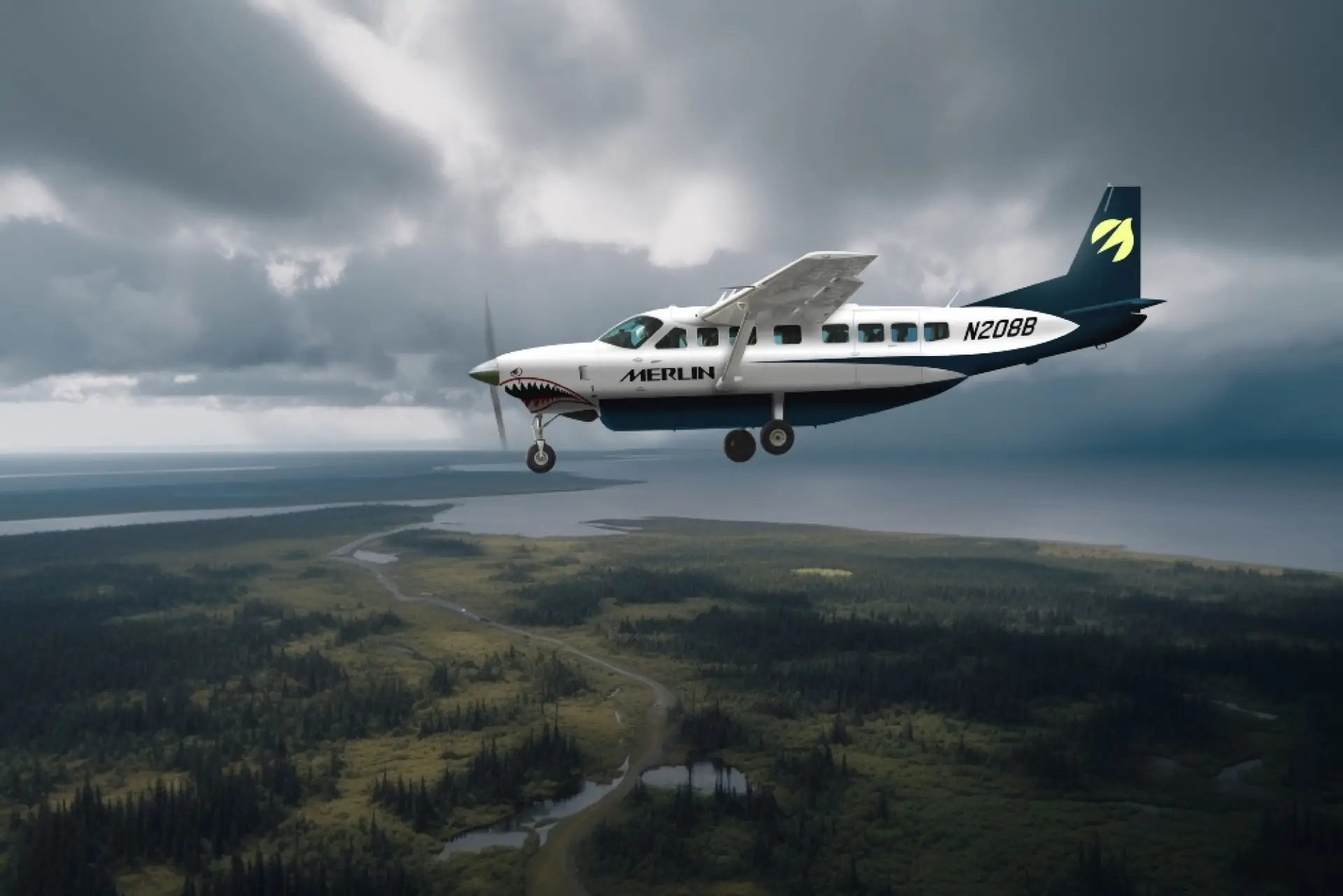
The U.S. Africa Command (AFRICOM) is preparing for a significant demonstration in Morocco this December, where it will evaluate the capability of a small, autonomous aircraft to conduct casualty evacuations from challenging and remote locations.
Autonomous aviation firm Merlin announced on November 11 that it has secured a $500,000 contract from AFRICOM for this demonstration mission, which is now scheduled for early December. Initially, a broader timeline of “early fiscal year 2027” had been mentioned, but subsequent company communications narrowed the window.
The upcoming demonstration will feature a Cessna 208B Grand Caravan aircraft, which has been specially modified with Merlin’s advanced autonomy system and equipped with an air-ambulance medical module. During the exercise, the aircraft is programmed to autonomously take off, navigate, and land at what is described as an “austere casualty collection site.” Following a simulated patient loading procedure, the aircraft will then autonomously fly back to its original departure point, showcasing its full mission capability without human intervention in the cockpit.
AFRICOM’s interest in autonomous casualty evacuation stems from a recognized operational gap. In July, the command extended an invitation to industry and academia to participate in an autonomous CASEVAC “challenge,” highlighting its urgent need for improved solutions in this critical area. Casualty evacuation, commonly referred to as CASEVAC, is the vital process of transporting wounded personnel from a battlefield or their unit’s operational area to a facility capable of providing more advanced emergency medical treatment.
The operational environment for AFRICOM presents unique and formidable challenges. The command’s area of responsibility spans vast distances across the African continent. Factors such as difficult terrain, persistent threats, limited existing infrastructure, unpredictable weather patterns, competing demands for aviation assets, and extensive lines of communication can frequently delay critical casualty movements. These delays can have severe consequences for wounded personnel.
Despite Africa being the world’s second-largest continent, AFRICOM operates with one of the smaller force postures among the U.S. combatant commands and a comparatively modest budget. Air Force Gen. Dagvin R.M. Anderson, commander of AFRICOM, testified before Congress in May, noting a 75 percent reduction in the command’s regional footprint over the past decade. Recent years have seen U.S. forces withdraw from key bases in Chad, Niger, and Somalia, further straining the command’s logistical and operational capabilities.
Nevertheless, counterinsurgency operations remain ongoing across the continent. AFRICOM has, in recent years, conducted dozens of airstrikes against terrorist groups like al-Shabaab and undertaken ground operations in countries such as Nigeria. In such a dynamic and resource-constrained environment, efficient and safe casualty evacuation becomes particularly complex and vital.
Merlin asserts that its autonomy system is engineered to directly address these challenges. The system is designed to autonomously plan the most optimal flight route based on a given tasking order. Crucially, it can dynamically replan routes in response to emerging threats or hazards encountered during the mission. The system also includes capabilities for communication with air traffic control and, significantly, can continue along its designated route even if its communications link is temporarily lost, ensuring mission continuity and safety.
An additional advantage highlighted by Merlin is the choice of aircraft. By utilizing a Cessna, a patient requiring transport on a litter can be loaded easily, “without rotor wash, winching, or special equipment.” This contrasts with the Air Force’s primary current casualty evacuation platform, the HH-60W helicopter, which requires more complex loading procedures. The simplicity of the Cessna’s design for medical transport enhances operational efficiency in austere settings.
AFRICOM’s interest in autonomous CASEVAC extends beyond merely compensating for a limited number of manned platforms. The command explicitly stated its hope to “reduce or eliminate exposure of pilots, aircrew, vehicle crews, and medical personnel during casualty movement.” This objective underscores a critical shift towards prioritizing the safety of military personnel in high-risk environments.
The U.S. Air Force has been actively exploring the concept of unmanned, autonomous aircraft for medical evacuations and search and rescue missions through initiatives such as its Agility Prime program and a Strategic Funding Initiative program co-funded with the Army. The practical application of this concept has recently been observed on the battlefield in Ukraine, where specialized drones have reportedly airlifted two Ukrainian troops out of combat zones, demonstrating the real-world potential of such technology.
More broadly, the U.S. military has expressed a keen interest in smaller, autonomous cargo aircraft, leading to a surge of innovative offerings from the defense industry. In September, Merlin, in collaboration with planemaker Textron Aviation, unveiled plans for a cockpit-less Cessna equipped with Merlin’s autonomy software, featuring a nose hatch opening into a large cargo bay. Competitors such as Reliable Robotics and Joby Aviation have also developed modified Cessna aircraft for similar autonomous applications.
Merlin emphasizes that its autonomy system is “aircraft-agnostic,” meaning it can be integrated into various types of aircraft. The success of the CASEVAC demo in Morocco could pave the way for scaling this critical capability onto larger platforms, such as the Beechcraft King Air aircraft. Furthermore, the firm states that this demonstration builds upon its previous work testing autonomy on the even larger C-130J aircraft for another major combatant command, U.S. Special Operations Command, indicating a broad applicability of their technology.
Matt George, CEO and Founder of Merlin, stated that the CASEVAC mission will “serve as a proving ground for autonomous aviation more broadly.” He elaborated, “Long distances, intermittent communications, and austere environments are among the most demanding conditions in which the military operates, and they are not unique to any one theater. A system proven under these conditions could support casualty evacuation, logistics, and personnel movement for other combatant commands, allied forces, and civil operators, as well as disaster response and medical transport missions worldwide.” This vision underscores the transformative potential of autonomous aircraft beyond military applications.
Why This Matters
The U.S. Africa Command’s demonstration of autonomous casualty evacuation (CASEVAC) represents a pivotal moment in military logistics, humanitarian aid, and the advancement of autonomous technology. For military operations, particularly in vast and challenging theaters like Africa, this innovation could dramatically enhance the speed and safety of medical response, directly saving lives by overcoming geographical barriers and reducing the “casualty evacuation gap.” It also minimizes the exposure of human pilots and medical personnel to combat zones, a critical factor in modern warfare.
Beyond the battlefield, the implications are far-reaching. A proven autonomous CASEVAC system could revolutionize disaster response and humanitarian efforts globally. In areas devastated by natural disasters or lacking infrastructure, such aircraft could deliver urgent medical supplies and evacuate injured individuals where manned aircraft might face prohibitive risks or logistical challenges. This technology promises to extend the reach of emergency medical care to populations in remote or dangerous locations, fostering greater resilience and humanitarian capacity.
From a technological perspective, this demonstration pushes the boundaries of aviation autonomy. The successful integration of autonomous flight control, dynamic route planning, and communication capabilities in a life-critical mission sets a new benchmark for reliability and safety. It will accelerate the development and adoption of autonomous systems across various sectors, including cargo transport, passenger travel, and environmental monitoring. The “aircraft-agnostic” nature of Merlin’s system also highlights the potential for rapid deployment across diverse fleets, reducing development costs and increasing scalability.
Ultimately, this initiative underscores a global trend towards leveraging advanced robotics and artificial intelligence to address complex logistical and safety challenges. It signifies a future where technology plays an increasingly critical role in protecting human lives, not only in military contexts but also in civil operations, disaster relief, and emergency services worldwide.