
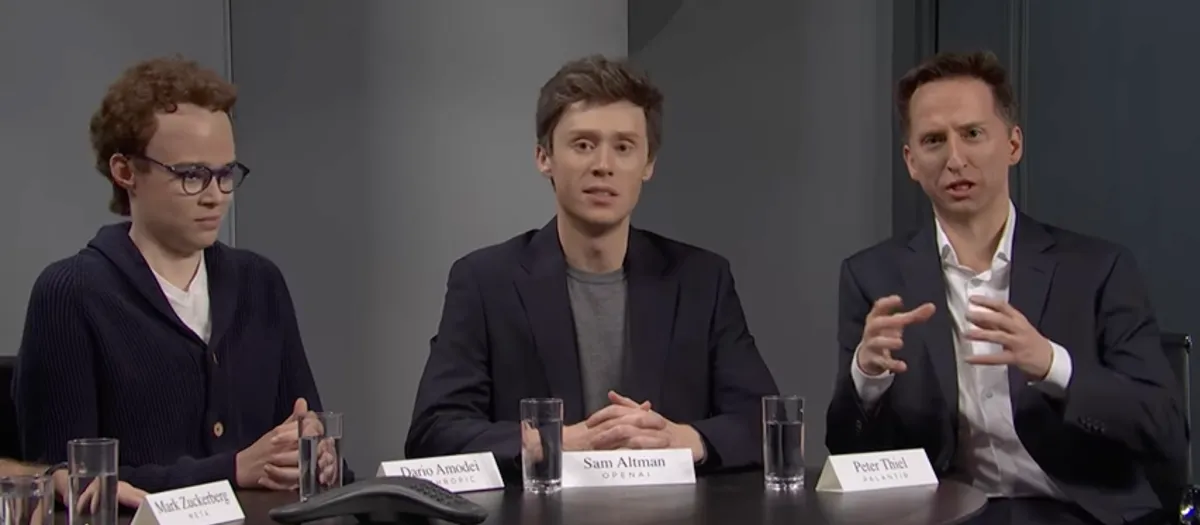
While awkward, creepy tech executives have become a recurring theme on Saturday Night Live, this week’s episode gave the cast a chance to show off all their impressions at once.
In a single sketch, we got James Austin Johnson as Peter Thiel, Ben Marshall as Sam Altman, Jane Wickline as Dario Amodei, Jeremy Culhane as Elon Musk, Andrew Dismukes as Mark Zuckerberg — and eventually, the recently departed Bowen Yang joined the fun as Jensen Huang.
Huang’s ouster from Nvidia (after admitting to an affair with a suspected Chinese spy) could have serious implications for the tech industry; it also provided a hook for some easy jokes about rich nerds being easy marks for women (or men) who are out of their league.
In the sketch, a CIA agent played by host John Mulaney (hilarious as ever, if not entirely confident about how to pronounce “Palantir” or “Nvidia”) attempts to painstakingly explain why these execs should be suspicious when someone attractive suddenly seems interested in them romantically. For Altman and Thiel’s sake, he added, “I hope this is obvious: Even though you’re gay, you can still be tricked by a spy.”
Johnson’s version of Thiel pushed back, insisting that that tech tycoons deserve more respect, given all they’ve done for the country. “Name one time technology has let us down,” he said, giving Mulaney a chance to remind viewers about flights being halted all across the United States on Friday night.
“Okay, name one more time,” the fictional Thiel said, leading to an obligatory mention of Microsoft Outlook going down on Thursday. When asked for a third example, Mulaney said, “No, I’m done naming times.”
“Look, I get it,” he said. “I can’t imagine how disorienting this has been for you, to go from being bug-eyed weirdos to being gods. I mean, never in the history of our species have people as pale and as strange as you a) survived, and b) been given all the world’s wealth and power.”
When you purchase through links in our articles, we may earn a small commission. This doesn’t affect our editorial independence.
{content}
Source:{feed_title}
Key Takeaways: SNL’s Tech Titans Take-Down
- A Star-Studded Skewering:SNL’s latest sketch gathered a remarkable ensemble of impressions, dissecting the public personas of tech’s most influential (and often awkward) figures, from Peter Thiel to Elon Musk.
- Reality Bites, Then Becomes Punchlines:The comedy hit home by referencing actual recent tech failures, such as nationwide flight halts and Microsoft Outlook outages, cleverly merging real-world frustrations with fictionalized tech-titan woes.
- The Myth of the ‘Tech God’ Exposed:Beyond the laughs, the segment delivered a sharp critique of the unprecedented power and wealth accumulated by individuals once considered “bug-eyed weirdos,” now navigating a world where they are often perceived as untouchable.
In an era where technology increasingly shapes every facet of our lives, it’s perhaps inevitable that the architects of this digital future become prime targets for satire. This past Saturday, NBC’s long-running sketch comedy institution, *Saturday Night Live*, once again proved its prowess as a cultural mirror, delivering a sketch that not only landed consistent laughs but also offered a surprisingly insightful commentary on the tech industry’s most prominent (and peculiar) personalities.
The Assembly of Awkward Power: A Who’s Who of Tech Impersonations
The premise was simple yet brilliant: host John Mulaney, playing a beleaguered CIA agent, attempts to impart crucial espionage awareness to a room full of tech moguls. What followed was a masterclass in impression work, featuring James Austin Johnson’s chillingly accurate Peter Thiel, Ben Marshall’s softly spoken Sam Altman, Jane Wickline’s composed Dario Amodei, Jeremy Culhane’s frenetic Elon Musk, and Andrew Dismukes’s eerily blank Mark Zuckerberg. The arrival of Bowen Yang as Jensen Huang completed the rogues’ gallery, setting the stage for a comedic dissection of vulnerability and hubris.
Mulaney’s character struggled to explain the obvious: that someone suddenly showing romantic interest in these titans might be a spy. His earnest plea, “I hope this is obvious: Even though you’re gay, you can still be tricked by a spy,” directed at Altman and Thiel, perfectly encapsulated the sketch’s blend of absurdity and pointed observation. These are individuals who command empires, yet are portrayed as almost childlike in their grasp of basic social dynamics, let alone geopolitical espionage.
When Tech Fails: From Silicon Valley to System-Wide Shutdowns
The sketch’s humor was amplified by its grounding in recent, frustrating realities. When Johnson’s Thiel proudly declared that tech tycoons deserve more respect for their contributions, challenging Mulaney to “Name one time technology has let us down,” the CIA agent was ready. His immediate retort, citing the nationwide flight halts that recently crippled air travel across the United States, struck a chord with anyone who had experienced the travel chaos firsthand.
The “Okay, name one more time” retort from the fictional Thiel led to an equally timely mention of Microsoft Outlook’s widespread outage just days prior. These references weren’t just easy jokes; they highlighted a growing public sentiment. For all the talk of innovation and progress, the bedrock infrastructure of our digital lives remains surprisingly fragile, susceptible to glitches that can bring entire industries to a standstill. The implied irony is palpable: the very “gods” who claim to be advancing humanity are often at the helm of systems that fail spectacularly, impacting millions.
The Fictional Fall of a Titan: Jensen Huang’s SNL Storyline
Perhaps the most audacious element of the sketch was its fictionalized portrayal of Jensen Huang’s “ouster” from Nvidia, following an admission of an affair with a suspected Chinese spy. It’s crucial to clarify that this storyline is a comedic invention for the sketch and does not reflect any real-world events concerning the actual Jensen Huang or Nvidia. The real Jensen Huang remains the highly successful and respected CEO of Nvidia, a company at the forefront of AI and graphics processing.
However, the inclusion of such a narrative, even in jest, speaks volumes about contemporary anxieties. It taps into fears surrounding corporate espionage, national security vulnerabilities, and the personal compromises powerful figures might face. The joke about “rich nerds being easy marks for women (or men) who are out of their league” is a blunt, albeit humorous, commentary on the perceived social awkwardness of some tech leaders, suggesting that their immense wealth doesn’t necessarily translate into worldly savvy or emotional intelligence. This fictional scandal, therefore, served as a potent, if fabricated, symbol of the potential vulnerabilities that could arise when power, wealth, and ego intersect.
From “Bug-Eyed Weirdos” to “Gods”: A Stark Monologue
The sketch culminated in Mulaney’s character delivering a monologue that transcended simple comedy, offering a profound cultural observation. “Look, I get it,” he said, “I can’t imagine how disorienting this has been for you, to go from being bug-eyed weirdos to being gods. I mean, never in the history of our species have people as pale and as strange as you a) survived, and b) been given all the world’s wealth and power.”
This statement, delivered with a mix of exasperation and genuine bewilderment, cuts to the core of public perception regarding tech’s elite. It acknowledges the almost accidental ascent of a particular archetype – often socially unconventional, intensely focused, and intellectually brilliant – to positions of unprecedented global influence. It challenges the romanticized notion of the tech visionary, replacing it with a more cynical view of power simply falling into the laps of those who happen to be in the right place at the right time with the right (often niche) skills.
The Bottom Line
SNL’s recent tech sketch was more than just a collection of celebrity impressions; it was a potent piece of social commentary. By lampooning the awkwardness, the perceived invulnerability, and the occasional real-world failures associated with tech’s most powerful figures, the show held a mirror up to an industry that often seems to operate in its own rarefied bubble. It reminds us that for all their revolutionary power, these titans are still subject to human foibles, public scrutiny, and the occasional system-wide crash. In a world increasingly shaped by algorithms and innovation, a good laugh at the expense of our digital overlords is not just entertaining – it’s a necessary act of demystification.