
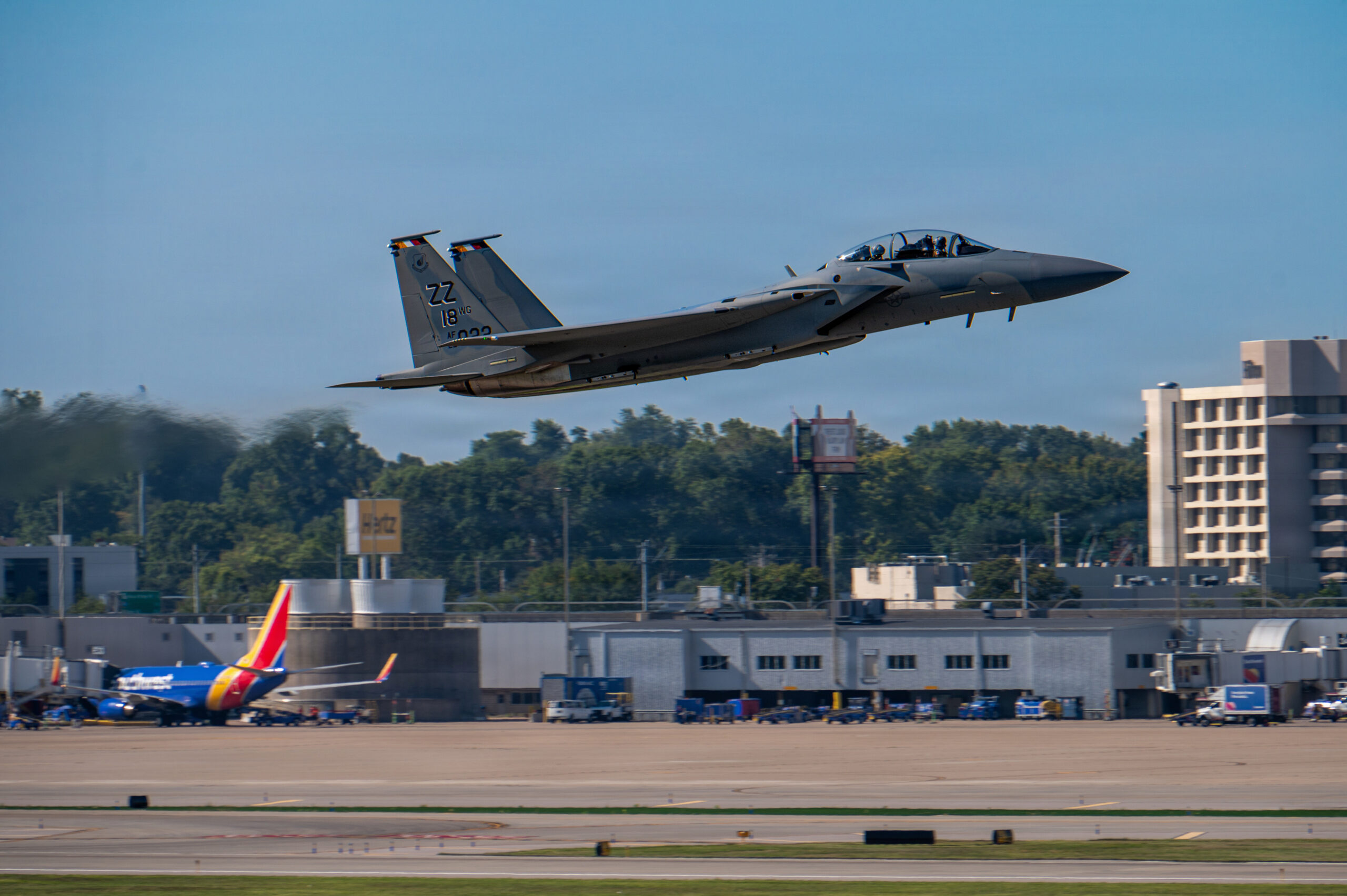
First F-15EX Fighter Jet for Permanent Overseas Basing Departs U.S. Facility
The first F-15EX fighter jet designated for permanent basing overseas by the U.S. Air Force departed Boeing’s production facilities in St. Louis on August 28, 2026. This delivery follows months of delays caused by a factory strike. The aircraft is ultimately bound for Kadena Air Base in Japan, where it will join the 18th Wing, but its immediate destination is Portland, Oregon, for further preparations.
Brig. Gen. John Gallemore, commander of the 18th Wing, commented on the significance of this development in a recent release: “This is an important next step toward bringing the F-15EX home to Kadena. Our team is ready to welcome the F-15EX, and this is another milestone that brings us closer to putting this capability in the hands of the Airmen who will fly, maintain and employ it from Japan.”
This particular F-15EX, known as the Eagle II, is the first to display the historic and distinctive “ZZ” tail flash of the 18th Wing. While it has now departed the factory, its permanent arrival at Kadena is projected for sometime in fiscal year 2027, which commences on October 1.

As of September 8, spokespeople for Headquarters Air Force, the 18th Wing, and the Air National Guard had not provided immediate responses to inquiries regarding further details on the aircraft’s deployment timeline and specifics.
This newly delivered jet represents the first of 36 F-15EX aircraft slated for permanent stationing at Kadena. The F-15EX, often characterized as a “4.5-generation” fighter due to its blend of advanced avionics with a proven airframe, is poised to usher in a new era for U.S. airpower within the strategically vital first island chain surrounding China.
The modernization transition for Kadena has been a protracted process. The U.S. Air Force initiated the retirement of the base’s legacy F-15C/D models in 2022 and subsequently confirmed plans in 2024 to replace them with the F-15EX. The initial arrival of the first F-15EX was anticipated for spring 2026. However, a prolonged strike at the Boeing plant in St. Louis late last year significantly impeded production, leading to the August 28 delivery date.
The F-15EX’s temporary stopover in Portland, Oregon, aligns with established procedures. The Oregon Air National Guard, which operates the first combat-coded F-15EXs at its Portland Air National Guard Base, will conduct final systems integration, apply necessary software updates, and perform other technical preparations. These steps are essential before the aircraft can proceed to Okinawa, Japan.
During the interim period awaiting the F-15EX’s permanent stationing, the Air Force has maintained a tactical fighter presence at Kadena, a key strategic base located less than 400 miles from Taiwan, through rotational deployments of F-16, F-15, F-22, and F-35 squadrons.
However, these rotational forces have not consistently matched the specific capabilities that the F-15EX is expected to provide. For instance, Air & Space Forces Magazine recently reported on the extended deployment of aging F-16Cs from the Colorado Air National Guard’s 120th Fighter Squadron, which operated at Kadena from January through June with a dozen fighters. In a media call on September 3, both the squadron commander and the head of its parent unit, the 140th Wing, indicated that while the platform could nominally keep pace with fifth-generation fighters in the region, the pilots and maintenance crews were operating the more than 30-year-old airframes at their operational limits.
The permanent stationing of the F-15EX at Kadena is expected to “enhance Kadena’s ability to generate ready combat airpower while providing opportunities to train and integrate alongside the Japan Air Self-Defense Force and other allies and partners,” according to the official release. The 18th Wing regularly conducts bilateral exercises and training alongside Japan Air Self-Defense Force F-15s based at Naha Air Base.
Pacific Air Forces has been systematically phasing out its older fighter aircraft and introducing more modern jets across the region in recent years. In addition to the F-15s at Kadena, the Air Force also recently withdrew A-10 Thunderbolt IIs from Osan Air Base, South Korea.
Conversely, the 35th Fighter Wing at Misawa Air Base, Japan, is projected to receive 48 fifth-generation F-35 Lightning IIs, although only a limited number had arrived as of April. The wing’s F-16s were transferred to Osan last year.
The Air Force publicly acknowledged the delays in the F-15EX’s arrival at Kadena in February.
The F-15EX Eagle II incorporates several significant technological advancements over its predecessors. Key features include digital fly-by-wire flight controls, which provide enhanced maneuverability and stability; a large-area display glass cockpit with a touchscreen interface, improving pilot situational awareness; an APG-82 Active Electronically Scanned Array (AESA) radar, offering superior detection, tracking, and electronic warfare capabilities; a Joint Helmet Mounted Cueing System (JHMCS) for off-boresight targeting; and the Eagle Passive/Active Warning Survivability System (EPASS), an advanced electronic warfare suite. Furthermore, the F-15EX is designed to fly faster and farther, carry a heavier payload, and features two additional weapons stations, significantly increasing its combat versatility.
Why This Matters
The deployment of the F-15EX Eagle II to Kadena Air Base represents a significant strategic and operational development for the United States in the Indo-Pacific region. This modernization effort is crucial for several reasons:
Geopolitical Significance:Kadena Air Base, located on Okinawa, Japan, is a critical forward operating base situated within the “first island chain”—a series of archipelagos that define a strategic maritime boundary off the East Asian continental coastline. Its proximity to Taiwan and China makes it a vital hub for projecting U.S. power and maintaining regional stability. The permanent stationing of advanced aircraft like the F-15EX reinforces the U.S. commitment to its allies, particularly Japan, and serves as a key component of deterrence against potential adversaries in a highly contested region.
Military Modernization and Capability Enhancement:The F-15EX is a substantial upgrade from the legacy F-15C/D models it replaces. By introducing a “4.5-generation” fighter, the U.S. Air Force bridges the gap between its existing fourth-generation fleet and its fifth-generation assets, such as the F-22 and F-35. The F-15EX’s advanced features—including digital fly-by-wire controls, AESA radar, and an integrated electronic warfare suite—provide enhanced air-to-air and air-to-ground capabilities, improved survivability in contested airspace, and a greater capacity for carrying advanced weaponry. This modernization is essential for maintaining air superiority and ensuring the U.S. military retains a technological edge in a region where several nations are rapidly advancing their air forces.
Alliance Building and Interoperability:The presence of the F-15EX at Kadena will foster greater interoperability and training opportunities with the Japan Air Self-Defense Force (JASDF) and other regional allies. Collaborative exercises, such as those with JASDF F-15s at Naha Air Base, are crucial for developing combined defense strategies and ensuring that allied forces can operate seamlessly in a crisis. This strengthens collective security arrangements and demonstrates a unified front in the Indo-Pacific.
Operational Readiness and Efficiency:Replacing aging aircraft and relying on permanent basing, rather than continuous rotational deployments, significantly improves operational readiness. While rotational forces provide a temporary presence, they often incur higher logistical costs, place strain on personnel and equipment, and can present challenges with maintaining consistent capabilities, as evidenced by the experience with the aging F-16C squadrons. The F-15EX’s permanent stationing ensures a stable, high-capability combat airpower presence, allowing for more consistent training, maintenance, and readiness cycles.
Technological Edge in a Contested Environment:The F-15EX’s advanced systems are designed to operate effectively in complex and high-threat environments. Its ability to carry a heavier payload and integrate new technologies ensures it can adapt to evolving threats. This technological advantage is vital for projected operations in the Indo-Pacific, where potential adversaries possess sophisticated air defense systems and advanced fighter aircraft.