
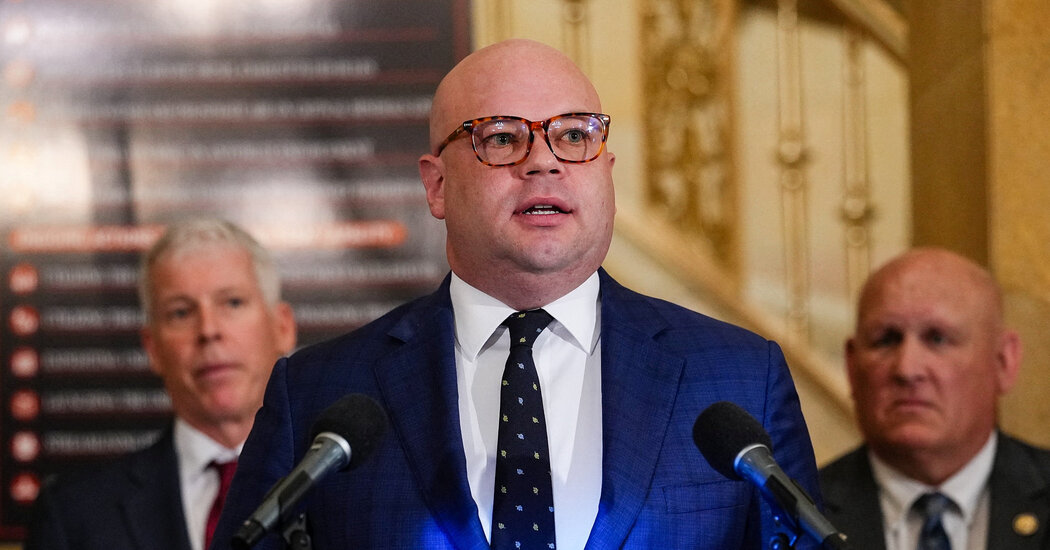
President Trump announced on Thursday the appointment of Adam R. Telle, currently the Assistant Secretary of the Army for Civil Works, to serve as the acting Secretary of the Army. This decision follows the resignation of the previous civilian Army leader, Daniel P. Driscoll, earlier this week. The appointment bypasses the traditional line of succession, which would typically see the Under Secretary of the Army assume the role in an acting capacity.
Mr. Driscoll tendered his resignation on Monday, a move that administration officials and reports suggest was prompted by escalating disagreements with Defense Secretary Pete Hegseth. These clashes reportedly centered on the Defense Secretary’s directives regarding personnel changes within the Army’s senior leadership, specifically what has been described by some as a “purge of top generals.” The exact nature and extent of these disagreements have not been fully disclosed, but they point to significant policy and leadership tensions at the highest levels of the Pentagon.
Under standard protocol for such high-level civilian positions within the Department of Defense, Michael Obadal, who serves as the Under Secretary of the Army and principal deputy to the Secretary, would ordinarily step into the acting role. Mr. Obadal has a long career in defense policy and administration, having served in various capacities before his current appointment. President Trump’s decision to elevate Mr. Telle directly to the acting secretary position, bypassing Mr. Obadal, signals a deliberate choice to install a specific individual into the critical leadership role of the Army, rather than adhering to the established chain of command for interim appointments. This move is consistent with previous instances within the administration where officials outside the traditional succession line have been appointed to acting roles.
Mr. Telle’s current role as Assistant Secretary of the Army for Civil Works places him as the senior official overseeing the U.S. Army Corps of Engineers. This agency is responsible for a vast array of public engineering and construction projects across the nation, including vital infrastructure related to navigation, flood control, environmental restoration, and disaster response. The Corps plays a crucial role in maintaining and developing the nation’s waterways, protecting coastal communities, and managing water resources. For example, earlier this summer, Army engineers from the Corps were instrumental in erecting temporary barriers stretching for miles to protect Juneau, the capital of Alaska, from significant flooding threats.
Significantly, the Trump administration has previously utilized the Army Corps of Engineers to advance specific policy objectives. Last year, the administration issued directives instructing the Corps to expedite environmental reviews and approvals for various fossil fuel projects, including oil and gas pipelines, mining operations, and power plants. This initiative was explicitly part of President Trump’s broader agenda to increase domestic oil, gas, and coal production, aiming for what the administration termed “energy dominance.” Mr. Telle, in his capacity overseeing the Corps, has been directly involved in implementing these directives, which have sometimes drawn criticism from environmental groups and state-level regulators.
Before his tenure as Assistant Secretary for Civil Works, Mr. Telle built a career primarily in legislative and political roles. He served as chief of staff to Senator Bill Hagerty, a Republican from Tennessee, providing him with extensive experience in congressional operations and policy formulation on Capitol Hill. During President Trump’s first term, Mr. Telle was also a key member of the White House Office of Legislative Affairs, where he headed the Senate team, serving as the president’s principal liaison to the upper chamber of Congress. These roles equipped him with deep knowledge of federal policymaking, political strategy, and inter-branch relations, though less direct experience in military command or broad defense policy.
The Secretary of the Army is the senior civilian official responsible for the overall management of the U.S. Army, one of the largest branches of the U.S. armed forces. This role involves critical responsibilities such as setting policy, managing the Army’s multi-billion dollar budget, overseeing personnel matters for millions of active-duty soldiers, reservists, and civilian employees, and ensuring the Army’s readiness for global operations. The Secretary works closely with the Chief of Staff of the Army, who is the senior military officer, to address strategic challenges, modernize forces, and maintain troop morale and welfare. The frequent turnover or contentious departures from such a pivotal leadership position can have significant implications for the stability and long-term planning of the force.
Mr. Telle’s appointment as acting Secretary means he will not undergo Senate confirmation at this stage, allowing the administration to quickly fill the vacancy. However, acting officials generally operate with less long-term security and may face constraints on certain policy decisions compared to a Senate-confirmed secretary. The administration has not indicated whether it plans to nominate Mr. Telle for permanent confirmation or if this is an interim appointment pending a different nominee.
President Trump’s selection of an official with a background primarily in civil works and legislative affairs, rather than traditional military or defense policy, to lead the Army at a time of internal friction within the Pentagon underscores a potential shift in the administration’s approach to military leadership, prioritizing individuals with a demonstrated alignment to the President’s policy agenda.
Why This Matters
The appointment of Adam R. Telle as acting Secretary of the Army, following the contentious resignation of Daniel P. Driscoll, carries significant implications for civil-military relations, the leadership of one of the world’s most powerful military forces, and the broader policy direction of the U.S. defense establishment. Firstly, the circumstances surrounding Mr. Driscoll’s departure—reportedly due to clashes with Defense Secretary Pete Hegseth over the “purge of top generals”—signal potential instability and deep-seated disagreements within the Pentagon. Such public friction at the highest levels can undermine morale within the armed forces and raise questions about the coherence of defense policy. For the U.S. Army, this means a period of leadership transition at a critical time, potentially impacting long-term strategic planning, modernization efforts, and personnel management.
Secondly, President Trump’s decision to bypass the traditional line of succession, opting for Mr. Telle over the Under Secretary of the Army, Michael Obadal, underscores a deliberate effort by the White House to place individuals aligned with its specific policy objectives into key roles. Mr. Telle’s background, particularly his experience overseeing the Army Corps of Engineers and its role in fast-tracking fossil fuel projects, suggests a potential emphasis on leveraging military-adjacent agencies to further domestic economic and energy policies. While his legislative experience provides him with an understanding of federal governance, his limited direct background in military command or broad defense strategy could present challenges in leading an organization as complex and globally engaged as the Army.
Finally, the appointment of an “acting” secretary, rather than a Senate-confirmed one, has implications for accountability and long-term policy implementation. Acting officials often have less authority and political capital to enact significant reforms or make permanent decisions, potentially leading to a period of uncertainty for the Army. This pattern of relying on acting officials in high-level positions has been a hallmark of the current administration and can affect the stability and effectiveness of federal agencies. For the Army, this transition means navigating not only internal leadership changes but also potential shifts in its strategic priorities and its relationship with the civilian leadership, all of which are crucial for maintaining national security and military readiness.