
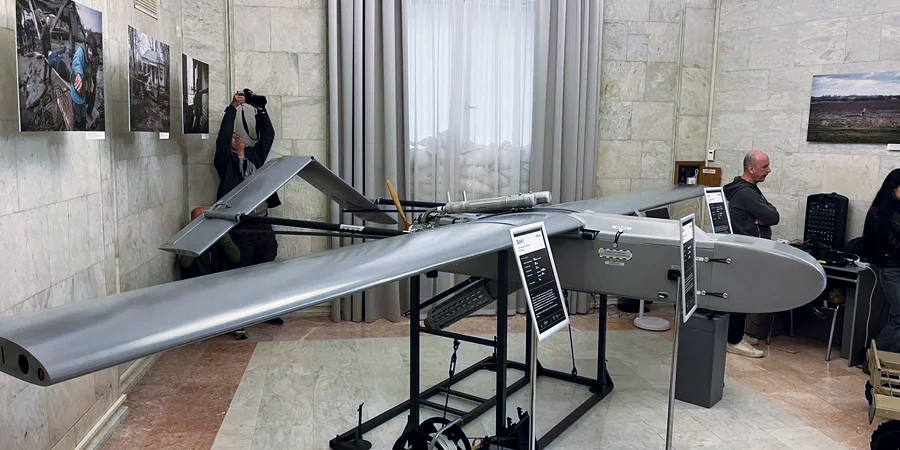
Since the 2022 full-scale invasion by Russia, observers have often gauged Ukraine’s military prospects primarily by territorial gains or losses on the ground. By this metric, the conflict frequently appears static, characterized by attrition and immense costs. However, Ukraine is now employing an alternative and increasingly impactful strategy: extending the war deep into Russian territory. This approach is designed not merely to retaliate, but to systematically disrupt the infrastructure and systems that enable Russia’s military to sustain its operations.
This concept is not entirely new; it echoes one of the foundational tenets of airpower theory: to directly attack the sources of an enemy’s military strength, paralyze its critical support systems, and impose costs significant enough to alter the adversary’s strategic calculations. What marks a significant development is the method of execution. Ukraine is conducting these strategic attacks using improvised, long-range, one-way uncrewed aircraft—often described as low-cost cruise missiles. Complementing these are special operations, maritime strike systems, cyber-enabled intelligence, and adaptive targeting methodologies.
Recent analyses suggest Kyiv is pursuing a strategy of “strategic neutralization,” shifting its focus from measuring success solely by ground movements to the broader objective of rendering Russia’s aggression operationally futile. This concept aims not just to deplete Russian forces at the front lines, but to consistently disrupt the systems that allow Moscow to regenerate combat power, export energy resources, produce weaponry, launch missiles, and maintain the political narrative that the war remains distant from Russian society.
Ukraine’s targeting of oil refineries, export terminals, military production facilities, command-and-logistics nodes, air defense systems, airfields, semiconductor manufacturing facilities, and cruise missile production centers directly aligns with this objective of systemic disruption rather than relying solely on battlefield attrition.
Ukraine’s long-range strike campaign successfully adapts classic airpower theory to its own present-day constraints.
This strategic logic has roots in the early military aviation theories of the 1920s and 1930s. Figures such as Giulio Douhet, Billy Mitchell, Hugh Trenchard, and the Air Corps Tactical School each argued, in varying ways, that modern industrial states had become inherently vulnerable due to their dependence on interconnected industrial, transportation, energy, and command systems. The Air Corps Tactical School’s “industrial web” concept, for instance, postulated that a nation’s war-making potential could be debilitated by striking critical nodes within its manufacturing, power generation, transportation networks, fuel supply, food distribution, steel production, and other essential sectors vital for state function. Historical military analyses, including a 2001 monograph on the Desert Storm air campaign, explicitly highlight this point: the preference for destroying or paralyzing national organic systems like electric power, railroads, fuel, and heavy industry crucial for a state’s war-making capacity.
The theory saw its initial large-scale application during World War II. However, the technology of the era was not yet sufficiently advanced to fully realize its potential. While strategic airpower could reach deep into enemy territory, it struggled to reliably hit precise aimpoints without deploying an overwhelming number of aircraft. Even after Allied forces achieved air superiority over Germany in 1944, precision bombing often necessitated hundreds of aircraft to destroy a single target, with only an estimated 20 percent of bombs aimed at precision targets landing within 1,000 feet of their intended point. The underlying strategic insight was valid, but its practical execution remained rudimentary.
This paradigm shifted dramatically with the 1991 Desert Storm air campaign. This operation attacked Iraqi leadership, command-and-control, air defenses, electricity infrastructure, transportation networks, oil production, and fielded forces in a parallel fashion, designed to produce cascading effects throughout the enemy’s system. While much of Desert Storm’s success is rightly attributed to stealth technology and precision-guided munitions, a crucial factor was its “effects-based approach” to planning and execution. Planners began with desired strategic and operational outcomes, then worked backward to identify the key systems and critical nodes whose disruption would achieve those effects—such as paralyzing decision-making, neutralizing air defenses, isolating ground forces, degrading mobility and logistics, and collapsing Iraq’s ability to conduct coherent military operations. The objective was to orchestrate integrated attacks that would impose rapid, system-wide paralysis with speed, precision, and economy of force. The strategy proved effective: the 43-day air campaign swiftly degraded Iraq’s fighting capacity, thereby paving the way for the subsequent removal of Iraqi forces from Kuwait by ground forces.
Operation Allied Force in 1999 further reinforced these lessons, albeit under different operational conditions. Though constrained by political considerations and not a pure example of parallel warfare, the defense of Kosovo from Serbian aggression demonstrated how precision attacks against selected systems could achieve coercive effects. NATO’s own historical accounts describe Allied Force as an air campaign launched after diplomatic efforts failed; a RAND assessment, “NATO’s Air War for Kosovo,” characterized it as a 78-day air campaign engineered to compel Slobodan Milosevic to cease ethnic cleansing in Kosovo. Allied Force combined global attack capabilities, parallel precision engagements, and elements of an effects-based approach to achieve these objectives.
Ukraine now operates under significantly harsher constraints. It lacks the air superiority enjoyed by the coalition in Desert Storm and by NATO in Allied Force. It cannot deploy large formations of manned aircraft deep into Russian airspace, nor does it possess the sheer scale of a superpower air force. Nevertheless, it has recognized the enduring principle that modern warfare is fundamentally dependent on complex systems, and these systems invariably contain vulnerable nodes.
This understanding explains the strategic importance of Russian oil infrastructure. Oil serves as Russia’s primary economic engine, crucial for generating revenue, consolidating political power, and providing fuel for transportation capacity and industrial output. Ukrainian long-range strikes against refineries, oil terminals, pumping stations, and export infrastructure are designed to curtail Moscow’s freedom of action. Recent attacks on facilities near Moscow, Crimea, Krasnodar, and even as far as Tyumen illustrate Ukraine’s steady expansion of both the reach and strategic ambition of its long-range campaign. In doing so, Kyiv aims to impose significant costs: reduced throughput, disrupted exports, increased repair and insurance burdens, the diversion of valuable air defense assets, and growing uncertainty within Russia’s political and industrial systems.
This campaign has already yielded strategic economic effects. Ukrainian President Volodymyr Zelenskyy asserted that in March alone, Russia incurred an estimated $2.3 billion in lost revenue as a direct result of intensified long-range attacks against Russian port and energy infrastructure. Sustained disruption to revenue streams, fuel supplies, transport networks, and repair capabilities is intended to diminish Moscow’s capacity to finance, supply, and politically normalize the ongoing war.
The same strategic logic underpins strikes on airfields, air defense systems, military production facilities, and electronics plants. Long-range attacks against facilities such as Angstrem Microelectronics in Zelenograd and MKB Raduga in Dubna are integral to a broader campaign targeting the industrial and technological foundations of Russian military power. This represents a classic application of strategic attack principles: identifying and striking the systems that enable an adversary’s war effort.
Why This Matters
Ukraine’s evolving strategy holds significant implications for global security and military doctrine. Firstly, it showcases how a nation facing a more powerful adversary can adapt and innovate to conduct effective strategic warfare using asymmetric means. By leveraging low-cost uncrewed systems and precision targeting against critical infrastructure, Ukraine demonstrates a potential blueprint for other nations to defend themselves against larger, conventionally superior forces without necessarily achieving air superiority or matching their opponent’s resource scale.
Secondly, this approach underscores the increasing importance of economic pressure as a core component of modern conflict. The focus on disrupting Russia’s energy exports and military-industrial complex illustrates that economic vitality and logistical resilience are as crucial to a nation’s war-fighting capability as its frontline forces. The asserted financial losses for Russia highlight the tangible strategic impact that targeted economic disruption can achieve, influencing the adversary’s ability to sustain military operations and maintain domestic stability.
Finally, the campaign reshapes understanding of the future of warfare. It solidifies the role of sophisticated, long-range uncrewed aerial and maritime systems as critical tools for projecting power and imposing costs across vast distances. This development is likely to influence military planning, defense investments, and geopolitical strategies worldwide, as states assess their own vulnerabilities and capabilities in light of these emerging tactics. The expansion of the battlefield into an aggressor’s heartland also raises questions about escalation risks and the boundaries of international support in prolonged conflicts.
**Kyiv’s Evolving Strategy: Targeting Russia’s War Machine Deep Behind Lines**
Ukraine is increasingly adopting a strategic approach to warfare, focusing on identifying critical vulnerabilities within Russia’s war effort and launching targeted attacks designed to produce operational and strategic effects disproportionate to the cost of the weapons employed. This shift marks a notable evolution from purely defensive operations, aiming instead to disrupt the systems that enable Russia’s ongoing aggression.
A prominent example of this evolving strategy is “Operation Spiderweb,” a series of covert Ukrainian drone operations that struck Russian long-range combat aircraft deep inside Russian territory. These attacks, utilizing remotely operated drones, served to underscore Ukraine’s capacity to project power beyond the front lines. The Center for Strategic and International Studies (CSIS) described Operation Spiderweb as delivering a significant blow to Moscow’s long-range bomber fleet. Furthermore, the Washington Post reported claims from Ukrainian intelligence suggesting that up to 12 bombers, including Tu-95 aircraft frequently used in strikes against Ukrainian cities, were damaged or destroyed. While final battle damage assessments may vary, the strategic message conveyed by these operations is clear: Ukraine is actively targeting Russia’s ability to project air and missile power, rather than merely reacting to its impacts.
This strategic attack doctrine has been adapted to account for the unique limitations and capabilities of Ukraine’s military. Unlike the sophisticated, high-tech air campaigns seen in conflicts such as Desert Storm, which relied on stealth aircraft, cruise missiles, precision-guided munitions, advanced command and control systems, and extensive logistics, Ukraine is leveraging a different set of tools. Its efforts involve commercially influenced electronics, adapted airframes, distributed launch methods, maritime uncrewed systems, and advanced intelligence fusion to achieve similar strategic effects. Due to restrictions on the provision of certain deep-attack systems from Western allies, Ukraine has significantly invested in domestically producing its own long-range capabilities, such as the FP-1 Firepoint, RS-1 Bars, and Bars-SM Gladiator, designed to penetrate Russia’s dense air defenses and strike military-related facilities, including those in the Moscow region.
Ukraine’s campaign is not a direct replication of past airpower doctrines but rather a translation of their underlying logic into a new operational context. This conflict is characterized by the absence of air supremacy for either side, Ukraine’s relative scarcity of advanced weaponry, and the formidable challenge of facing a nuclear-armed adversary with considerable strategic depth. Consequently, Ukraine’s strategic attack campaign is more episodic, improvised, and constrained. Nevertheless, its fundamental principles are recognizable: exerting parallel pressure against Russia’s military, industrial, energy, and psychological systems; employing precision to target specific critical nodes; and operating with a theory of victory that seeks to alter Russia’s behavior by progressively increasing the costs of its aggression.
Evaluating the effectiveness of this campaign requires understanding that strategic attacks rarely achieve their full objectives with a single strike. Instead, their impact accumulates over time. These operations compel Russia to divert valuable air defense assets from the front lines to defend its homeland. They force the dispersal of aircraft and production facilities, leading to increased operational costs related to insurance, transport, repair, and security. They can reduce refinery throughput, complicate military logistics, and impose political costs by fostering uncertainty among Russian commanders, industrial managers, political elites, and the general populace.
This approach aligns with the principles of effects-based operations, where strategy involves orchestrating available means to achieve desired ends. Target selection is thus focused not merely on the destruction of a list of targets, but on generating specific desired effects upon target systems. Kyiv is not attempting to bomb Russia into submission in a rudimentary sense. Rather, it is endeavoring to deny Russia the capacity to wage war cheaply, confidently, and indefinitely.
A crucial moral and legal distinction underpins Ukraine’s strategy: strategic attack does not equate to indiscriminate attack. The historical evolution of airpower, from the broad area destruction tactics of World War II to the more precise targeting of military and war-sustaining systems in Desert Storm, highlights this progression. This distinction is evident in the contrasting long-range strike campaigns conducted by Ukraine and Russia. Russian attacks have frequently targeted civilian areas, residential buildings, hospitals, schools, and civilian power grids, suggesting either deliberate terrorism, flawed intelligence, inadequate target development, or a disregard for civilian harm. In contrast, Ukraine’s legitimacy rests on its continued adherence to international law, focusing on military objectives and war-supporting infrastructure, utilizing accurate and timely intelligence, and applying disciplined target planning to minimize civilian casualties.
While Russia possesses a proportionally greater long-range strike capacity, observers suggest it often lacks the leadership, training, and strategic doctrine required to translate this capacity into decisive strategic advantage. Ukraine, despite having fewer resources, is demonstrating an increasing ability to employ its means effectively. This represents a fundamental divergence between the two combatants: one largely uses strikes as punishment and coercion against civilian society, while the other is progressively applying strikes as a targeted method for disrupting the systems that underpin its adversary’s aggression.
This strategic development holds significant lessons for the United States and its allies. Ukraine’s campaign demonstrates that long-range strike capability is not merely a luxury but a strategic necessity in modern conflict. A nation confined to defending solely at the front lines is vulnerable to absorbing continuous punishment. Conversely, a state capable of reaching enemy arsenals, refineries, command nodes, ports, airfields, and industrial production bases can fundamentally alter the dynamics of a war. Therefore, sustained support for Ukraine’s long-range attack capabilities should not be universally viewed as escalatory. When properly bounded, legally employed, and strategically directed, it can serve as a means of shortening the conflict by eroding Russia’s capacity to sustain it.
Western nations have, at times, treated long-range strike systems as a reward to be rationed rather than as a core requirement to be integrated into a coherent theory of victory. This cautious approach has incurred costs; every delay in providing Ukraine with the means to hold Russia’s war-sustaining systems at risk has afforded Moscow valuable time to adapt, repair, disperse, and continue its assault. Recent initiatives to expand Ukraine-based and European production of long-range missiles and air-defense systems are welcome. However, the overarching strategic logic must be clearer: Ukraine requires the sustained ability to impose recurring costs on the systems that enable Russia’s aggression. The objective should not be symbolic retaliation or indiscriminate punishment, but rather the systematic disruption of the military, industrial, logistical, energy, and command systems that facilitate Russia’s ability to continue fighting. The Airmen of the 1930s interwar period conceptualized the vulnerabilities of modern industrial states before the technological tools existed to effectively exploit them. World War II highlighted both the ambitious scope and the practical limits of these early theories. The Desert Storm air campaign later demonstrated the convergence of precision, stealth, information, and operational design. Operation Allied Force further illustrated how airpower could contribute to coercive political outcomes even under severe constraints. Ukraine is now contributing a new chapter to this history: conducting strategic attack without air superiority, employing improvised yet sophisticated long-range systems to impose systemic costs on a larger aggressor.
**Why This Matters**
Ukraine’s strategic shift toward long-range strikes signifies a critical evolution in modern warfare. It demonstrates how a nation, even without air superiority or overwhelming resources, can leverage innovation and asymmetric capabilities to target an adversary’s deep strategic assets. This approach has several key implications:
- **Changing War Dynamics:** By striking deep inside Russia, Ukraine challenges the conventional notion of a front line and forces Russia to divert resources and attention from offensive operations to homeland defense. This complicates Russia’s strategic planning and resource allocation.
- **Impact on Russia’s War-Fighting Capacity:** Disrupting key military, industrial, and logistical nodes directly impairs Russia’s ability to sustain its war effort. Damaging aircraft, fuel depots, and production facilities degrades its offensive capabilities and raises the economic cost of the conflict for Moscow.
- **Future of Asymmetric Warfare:** Ukraine’s reliance on domestically developed, often commercially influenced, uncrewed systems for long-range attacks offers a blueprint for how smaller, less technologically advanced forces can challenge larger, conventional militaries. This highlights the growing importance of drone technology and adaptable platforms in future conflicts.
- **Implications for International Support:** The success and strategic necessity of these strikes reinforce arguments for continued and expanded Western support, particularly in providing long-range capabilities and assistance for domestic production. It frames such aid not as escalation, but as a means to accelerate the conclusion of the conflict by weakening Russia’s ability to fight.
- **Ethical Considerations and International Law:** The emphasis on distinguishing between military targets and civilian infrastructure is vital for maintaining international legitimacy and adherence to the laws of armed conflict. Ukraine’s ability to maintain this distinction contrasts with Russia’s documented targeting of civilian areas, shaping international perceptions of both combatants.
- **Potential for Shortening the Conflict:** By imposing significant and recurring costs on Russia’s war-sustaining systems, Ukraine aims to change Moscow’s strategic calculus, potentially leading to a re-evaluation of its war aims and a more rapid end to hostilities. This moves beyond simply holding defensive lines to actively degrading the adversary’s will and capacity to continue the fight.
The ongoing conflict in Ukraine continues to serve as a real-world crucible for modern military doctrine, prompting defense analysts and strategists to re-evaluate conventional wisdom regarding warfare. A central theme emerging from observers is the critical role of strategic application over sheer technological superiority, with Ukraine’s evolving battlefield tactics drawing particular attention.
According to military strategists, including retired U.S. Air Force Lt. Gen. David A. Deptula, Dean of the Mitchell Institute for Aerospace Studies, Ukraine’s principal achievement is not merely its development of longer-range weapons, but rather its adept strategic deployment of these capabilities. This strategy, as described by Deptula, adheres to a coherent logic: systematically target the infrastructure and systems that underpin and sustain Russian aggression, thereby complicating Moscow’s operational choices, diminishing its capacity to generate combat power, and ultimately strengthening Ukraine’s position for any future settlement negotiations.
This approach involves striking key Russian logistical hubs, command centers, ammunition depots, and other high-value targets within Russian-occupied territories and, at times, within Russia itself. By disrupting supply lines and command-and-control networks, Ukraine aims to degrade the enemy’s ability to wage sustained offensive operations and maintain its occupying forces effectively. This strategy seeks to impose significant costs on the aggressor, both in terms of material losses and operational friction, making the continuation of hostilities increasingly unsustainable.
Proponents of this strategic framework suggest that if the United States and its allies aim to expedite the conflict’s resolution, their efforts should focus on enabling Ukraine to expand this operational logic, rather than imposing limitations. Providing Ukraine with enhanced long-range attack capabilities, they argue, would allow it to consistently hold Russia’s war machine at greater risk. The premise is that by significantly increasing the cost of continued aggression, a tipping point could be reached where negotiation becomes a more strategically viable and less costly option for Russia than prolonging the war. This perspective suggests that unrestricted access to advanced long-range weaponry could accelerate the conclusion of the conflict by shifting the calculus in Moscow.
Beyond the immediate objective of influencing the war’s trajectory, another crucial imperative highlighted by defense experts is the unprecedented learning opportunity presented by the conflict. Ukraine is currently paying a steep price in human lives and resources to acquire real-world lessons across a spectrum of modern warfare domains. These include the efficacy of long-range precision strike capabilities, the evolution of sophisticated air defense systems against various threats, the transformative impact of uncrewed aerial and ground systems (drones) in reconnaissance, targeting, and direct engagement, and advancements in electronic warfare tactics and counter-tactics.
Further critical lessons encompass the complexities of precise targeting and intelligence fusion – the synthesis of data from diverse sources to create actionable intelligence. The conflict also offers profound insights into military resilience, the importance of force dispersal to minimize vulnerability to attack, and the effective use of deception operations to mislead a larger, technologically advanced adversary. Moreover, Ukraine is refining the operational art of fighting a superior force under conditions of persistent attack, a scenario that holds immense relevance for many nations considering future peer or near-peer conflicts.
Lt. Gen. Deptula and others argue that even a comparatively modest increase in investment from the U.S. and its allies—potentially including the deployment of U.S. military observers to Ukraine—could yield invaluable lessons. Such direct observation and analysis could help American and allied forces avoid having to relearn these critical combat lessons at potentially far greater human and material cost in a future conflict. This proposition underscores a broader strategic benefit: supporting Ukraine is not solely about influencing the outcome of the current war, but also about proactively absorbing and integrating the hard-won lessons of this conflict into Western military doctrine and preparedness before a future confrontation might impose them directly on allied forces.
The core theory underpinning these observations is that while the specific weapons systems and technologies deployed on the battlefield may continuously evolve, the fundamental principles of sound strategic logic remain enduring. Ukraine’s experience, according to these analyses, demonstrates that even through improvised means and against a numerically and often technologically superior foe, a coherent and intelligently applied strategic framework can achieve significant effects previously thought to be exclusive to major global air forces or highly advanced militaries.
Consequently, U.S. and allied leaders are urged to consider that facilitating Ukraine in achieving its strategic attack objectives could represent the most expeditious route to concluding the war. This approach, it is argued, could translate battlefield strength into decisive leverage in negotiations, bringing the conflict to a resolution sooner than alternative courses of action. Crucially, it is also seen as a vital mechanism for ensuring that the profound and costly lessons Ukraine is currently acquiring are effectively internalized by American and allied forces, preventing the need to re-experience them in any future conflicts.
Lt. Gen. David A. Deptula, USAF (Ret.).is the Dean of the Mitchell Institute for Aerospace Studies. He has been involved in planning and executing multiple major coalition air campaigns and was a Joint Task Force commander twice during his long military career. His insights are frequently sought on matters of air power and strategic defense.
Why This Matters
The arguments presented by defense strategists like Lt. Gen. David A. Deptula carry significant weight for several reasons, touching upon the future of international security, military doctrine, and geopolitical strategy.
Firstly, the conflict in Ukraine serves as an unprecedented live laboratory for modern warfare. The rapid evolution of tactics, technology, and operational art—particularly in areas like long-range precision strike, integrated air defense, uncrewed systems, and electronic warfare—is directly shaping the strategic landscape for all major military powers. The insights gained from Ukraine’s experience are not merely academic; they are providing concrete, battle-tested data that will inform military procurement, training, and doctrine for decades to come. Understanding how smaller, less technologically advanced forces can effectively counter a larger adversary through strategic innovation is critical for nations seeking to deter aggression or defend their sovereignty.
Secondly, the debate around providing Ukraine with expanded long-range strike capabilities directly impacts the potential duration and outcome of the war. If, as argued, such capabilities could accelerate the conflict’s end by making continued aggression prohibitively costly for Russia, it has profound implications for global stability, humanitarian concerns, and the world economy. The speed and nature of Western military aid thus become not just a matter of support for an ally, but a strategic lever with wide-ranging consequences for regional and global security.
Thirdly, the concept of absorbing “lessons learned” through observation rather than direct engagement represents a strategic foresight imperative for the United States and its allies. By understanding and integrating these lessons now, Western militaries can enhance their preparedness for future conflicts, potentially reducing future costs in both lives and resources. This proactive approach to military adaptation is vital in an era of renewed great-power competition and rapidly advancing military technologies, where complacency could lead to significant strategic disadvantages.
Finally, the emphasis on strategic logic over raw technological might challenges conventional assumptions about military superiority. It suggests that even with asymmetrical resources, a well-conceived and executed strategy can overcome significant disadvantages. This perspective offers hope for smaller nations facing larger adversaries, while also serving as a critical reminder for powerful nations that technology alone is not a guarantor of victory. It underscores that human ingenuity, adaptable leadership, and coherent strategic thinking remain paramount in the complex and dynamic environment of modern conflict.