
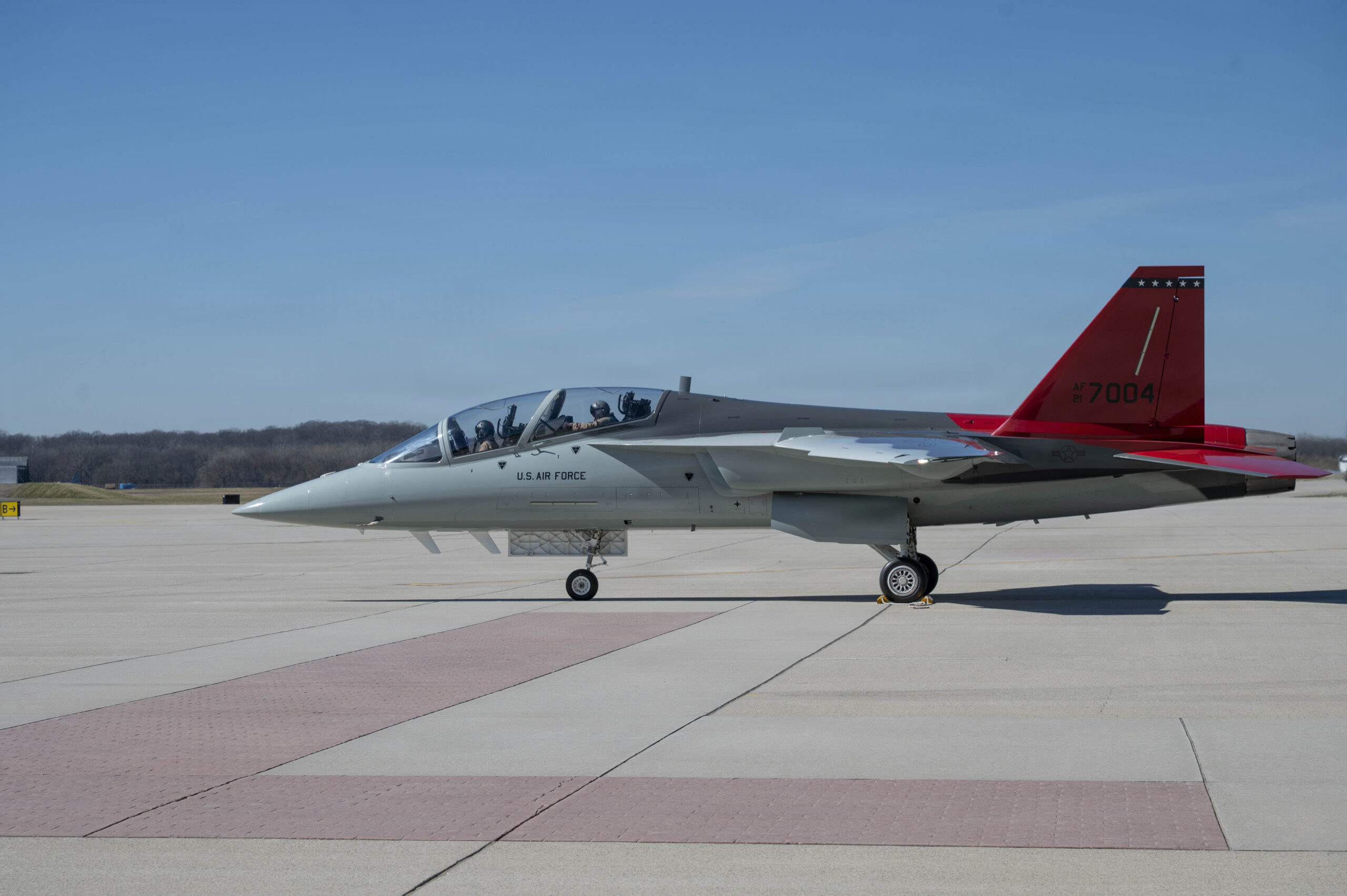
The United States Air Force has commenced operations with its first T-7A Red Hawk trainer jet, marking a significant milestone in its pilot training modernization efforts. Concurrently, Air Force officials are already outlining plans for a series of advanced upgrades for the new aircraft, some of which are designed to facilitate its use in training less experienced pilots, potentially expanding its role beyond advanced instruction.
On June 16, the T-7A program office issued a “sources sought notice” outlining its interest in “modernization and sustainment of the T-7 family of systems.” The notice specifically identifies five key areas for potential capability enhancements, though it notes that this list is not exhaustive:
- Terrain and air collision avoidance systems
- Barrier capability assessment
- Selectable G-limits for flight maneuvers
- Improvements to the pilot vehicle interface (PVI)
- An enhanced Embedded GPS and Inertial Navigation System (INS)
Work on these proposed upgrades and other sustainment activities could potentially commence as early as fiscal year 2029.
The T-7A Red Hawk program began in 2018 when the Air Force selected a contractor team comprising Boeing and Saab. Their mission was to develop a new, state-of-the-art platform for advanced pilot training, intended to replace the aging T-38C Talon, which has been in service since the 1960s. Officials from the Air Education and Training Command (AETC) anticipate that the T-7A will offer a generational leap in capability compared to its predecessor.
Despite initial aspirations for an exceptionally rapid development timeline, the T-7 program has encountered delays over several years. Nevertheless, the program recently transitioned to low-rate initial production, with the first two operational jets now stationed at Joint Base San Antonio-Randolph, Texas. In a notable development, AETC leaders are actively exploring the possibility of expanding the T-7’s utility beyond its primary role in advanced training to also include aspects of undergraduate pilot training for novice aviators.
Several of the modernization upgrades detailed in the sources sought notice are geared toward enhancing safety, particularly if the T-7A is to be utilized by less experienced pilots. For instance, regarding G-limits, the program office has expressed interest in a “Dial-a-G” capability. This feature would allow pilots to set a maximum number of G-forces below the T-7’s structural limit of 8 Gs.
The notice elaborates, stating, “A pilot-selectable G-limiter is desired with the ability to restrict inexperienced students to a lower G-capable aircraft.” It adds that this feature would enable a selectable function, allowing for increased G-load exposure as a student’s experience grows. Ideally, the system would incorporate a pilot-override switch; however, the jet’s response to such an input would be deliberately slow to mitigate the risk of G-induced loss of consciousness (G-LOC).
G-LOC is a critical concern that collision avoidance systems would also aim to address. The T-7 notice indicates that ground collisions can occur due to “inattention or G-induced loss of consciousness,” while the risk of air collisions intensifies during “dynamic air-to-air maneuvers, especially critical for solo students or dual crews.” Data from a 2006 study of Royal Air Force aviators highlighted that 77.4 percent of reported G-LOC incidents occurred in training aircraft, with 64 percent involving crew members with fewer than 100 hours of flight time—a figure often less than the flight hours accumulated by U.S. Air Force students during undergraduate pilot training.
Collision avoidance systems are designed to alert pilots to imminent impacts with terrain or other aircraft. Advanced automatic systems can even autonomously maneuver the jet to avert danger. The Air Force Research Laboratory, in collaboration with Lockheed Martin and NASA, has been actively developing both automatic ground and air collision avoidance systems.
Another safety-related feature mentioned in the notice concerns barriers—the nets and cables used to decelerate and stop aircraft on runways, particularly during emergencies or aborted takeoffs. The Air Force aims to gain a better understanding of how the T-7 interacts with these arresting systems. “Evaluation of T-7 aircraft with these systems will provide data needed to inform T-7 compatibility during high-speed engagements and development of appropriate procedures for the use or avoidance of such arresting systems,” the notice specifies.
Furthermore, an upgraded embedded inertial navigation system (INS) would grant pilots the capability to operate the aircraft effectively in environments where GPS signals are either degraded or entirely jammed, enhancing operational resilience.
Cockpit Aids for Advanced Training
Beyond safety enhancements, not all proposed modernization upgrades focus solely on pilot protection. The Air Force is also seeking improvements to the displays and controls within the cockpit, specifically aiming for features “that allow for fourth- and fifth-generation fighter/bomber skills to be trained.”
These proposed enhancements could include new functionalities for situational awareness and navigation, such as expanding touch selections on the T-7’s main Large Area Display screen. Other potential improvements involve the ability to cue sensors directly from a tactical situation display and the option to reprogram throttle and stick buttons for various commands, offering greater customization and flexibility during training scenarios. The sources sought notice identifies nine distinct avenues through which the pilot vehicle interface could be improved to better simulate advanced combat aircraft.
Why This Matters
The introduction of the T-7A Red Hawk and the Air Force’s immediate plans for its advanced modernization represent a critical juncture for U.S. military aviation and global defense posture.
Firstly, **Pilot Readiness and Training Modernization** are paramount. The T-7A is designed to replace the T-38C Talon, an aircraft that has served for over six decades. Its advanced digital capabilities, enhanced simulation, and modern cockpit are intended to bridge the gap between initial flight training and flying complex 4th and 5th-generation fighter aircraft like the F-22 and F-35. By investing in the T-7A and its upgrades, the Air Force aims to produce highly skilled pilots more efficiently, reducing the training burden and cost associated with transitioning to frontline fighters. Expanding its role to undergraduate pilot training could further streamline this process, exposing new recruits to advanced systems earlier in their careers.
Secondly, **Enhanced Aviation Safety** is a significant driver behind many of the proposed upgrades. Features like selectable G-limits, terrain and air collision avoidance systems, and improved barrier compatibility are directly aimed at mitigating risks, especially for less experienced pilots. G-induced loss of consciousness (G-LOC) and mid-air collisions are serious hazards in high-performance aviation training. Implementing technologies that automatically intervene or allow instructors to progressively introduce challenges can save lives and protect valuable aircraft, ensuring a safer learning environment for the next generation of combat aviators.
Thirdly, this initiative underscores **Adaptability in Modern Warfare**. The inclusion of an upgraded Embedded GPS and Inertial Navigation System highlights the increasing necessity for military aircraft to operate effectively in environments where GPS signals may be degraded or jammed by adversaries. Training pilots with resilient navigation capabilities from the outset prepares them for the complexities of modern and future combat zones, where electronic warfare capabilities are continually evolving.
Finally, the T-7A program and its future upgrades have implications for **Defense Industrial Base and Technological Innovation**. The collaboration between Boeing and Saab in developing the T-7A showcases international partnership in defense procurement. The ongoing “sources sought notice” signals future contract opportunities for defense contractors specializing in avionics, flight control systems, and simulation technologies. This continuous investment in upgrades fosters innovation within the defense sector and ensures that the U.S. Air Force maintains a technological edge in pilot training, which is foundational to its operational capabilities worldwide.