
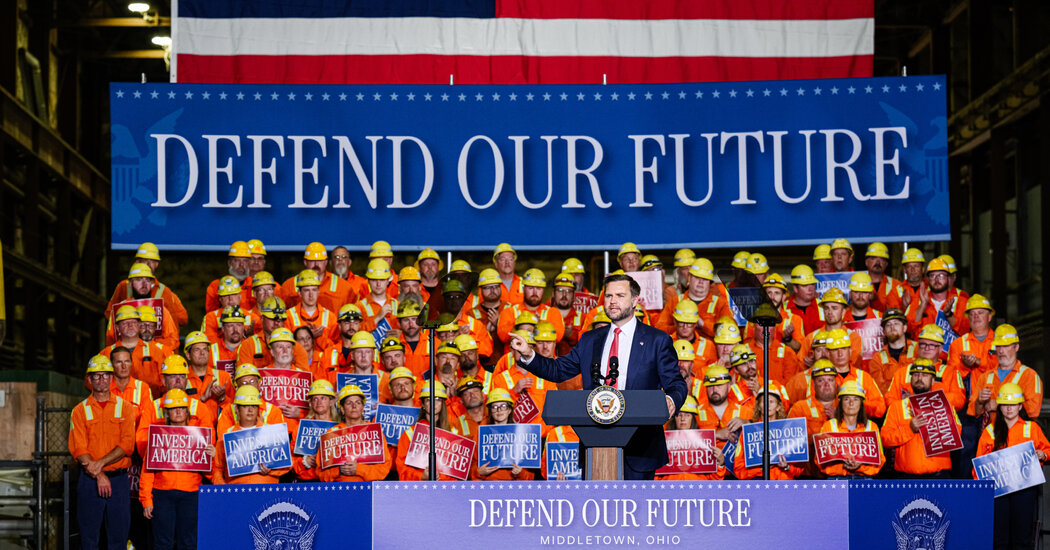
Middletown, Ohio – Senator J.D. Vance returned to his hometown of Middletown, Ohio, on Friday, delivering a speech that underscored his political narrative linking the decline of American manufacturing to specific trade and immigration policies. The visit highlighted his ongoing effort to position himself as a champion for the working class, a theme central to his 2016 memoir, “Hillbilly Elegy,” which depicted Middletown as a community grappling with the loss of industrial prosperity.
Vance’s memoir described the city as “little more than a relic of American industrial glory” following the layoffs at the steel mill where his grandfather had worked for nearly four decades. He characterized the prevalent sentiment in such communities as “a lack of agency… A feeling that you have little control over your life and a willingness to blame everyone but yourself.” During his recent visit, Vance offered a vision for a better future, but also attributed blame for past economic struggles to external factors.
Speaking to a gathering of union workers at the very factory that once employed his grandfather, Vance contended that politicians from both major parties had, for decades, pursued pro-immigrant and free trade policies that, in his view, diverted jobs away from industrial towns like Middletown. He asserted that the contemporary Democratic Party no longer aligned with the values and interests of working-class individuals, including his own grandfather. This narrative forms a cornerstone of his political identity, as he navigates the complex landscape of American politics.
With the upcoming November midterm elections and his own political trajectory in mind, Vance leveraged his Rust Belt origins to advocate for policies associated with former President Donald Trump, specifically his stance on tariffs and immigration. Vance argued that these policies would safeguard factory jobs and contribute to the revitalization of struggling industrial towns. “The future of our homes and communities is going to be built right here in Middletown,” Vance stated. He invoked the memory of his grandfather, saying, “My Papaw hated the politicians who ignored this place. He hated the people who saw this as the place of the past. He hated the people who forgot about this town when they should have been fighting for this town.”
Senator Vance has consistently utilized his personal background in Middletown as a means to articulate the grievances of the white working class, a strategy he has maintained despite his well-documented evolution from a critic of Donald Trump to one of his most fervent supporters. This return to his “origin story” comes as he intensifies his travel schedule ahead of the midterm elections, which are expected to significantly influence the political dynamics of the coming years.
During his speech, Vance, who was joined by Senator Jon Husted, Republican of Ohio, posed a rhetorical question to the audience: “Who do these Democrats put first? Everyone else.” He then contrasted this with the Trump administration’s approach, stating, “You know who the Trump administration puts first? Americans.” This framing aligns with the “America First” agenda that characterized the Trump presidency, which also prioritized the resurrection of the U.S. manufacturing industry.
However, the practical application of these policies has presented complexities. While former President Trump campaigned on revitalizing manufacturing, his fluctuating tariff policies have been cited as a contributing factor to rising consumer prices. For instance, even as Vance promised investments in Ohio’s steel workers, reports indicated that the Trump administration and its aides had previously considered a proposal to reduce tariffs on some Canadian steel from 50 percent to 25 percent, a move that prompted opposition from U.S. steel mills concerned about increased foreign competition.
Furthermore, Vance’s assertion that immigration threatens American jobs in the heartland also faces nuanced local perspectives. Ohio’s Republican governor, for example, has publicly criticized the Trump administration’s plans to deport Haitians residing in the state, arguing that such actions would negatively impact the local economy, highlighting a divergence in Republican viewpoints on immigration’s economic effects.
During his Friday address, Senator Vance sought to garner support for the Trump administration’s manufacturing strategy, highlighting a purported $500 million federal funding injection for the Cleveland-Cliffs factory, which operated under a different name when his grandfather was employed there. Vance presented this investment as a Trump administration initiative designed to bolster American industry.
However, the origins and purpose of this grant are subject to differing interpretations. The $500 million allocation was initially offered by the Biden administration with the explicit goal of transforming the steel mill into a more environmentally sustainable factory. At the time, this plan, along with its anticipated job creation, was welcomed by the local union. Under the Trump administration, which has previously dismissed such green investments as “scams,” the funding’s focus has reportedly shifted to upgrading the factory’s existing coal-fired furnace. While the Energy Department stated it would also equip the factory with artificial intelligence to enhance energy efficiency, questions regarding whether this investment would lead to permanent job growth have remained unanswered.
The environmental implications of this shift have drawn criticism from local residents. Donna Ballinger, a 62-year-old Middletown resident and climate activist whose home is located approximately 800 feet from the facility, expressed frustration over the pivot away from clean energy initiatives. She described frequently waking to find a silver powder on her car and voiced concerns about the polluted air, which she fears impacts her grandchildren’s ability to play outdoors. “We are bombarded everyday by fallout, by noise, by toxic emissions,” Ms. Ballinger stated, holding a sign at Vance’s speech that read: “we deserve clean steal.”
In response to such environmental concerns, Senator Vance dismissed complaints from activists as coming from the “far left,” asserting that the federal funds would instead improve the factory’s technology to “optimize furnace operation and improve Middletown’s air quality.” Lourenco Goncalves, Cliffs’ chief executive, confirmed that the investment is projected to preserve approximately 2,300 jobs at the facility.
The effectiveness of the Trump administration’s investment in improving the quality of life and economic prospects in Middletown will be a critical measure, not only for local residents and Republican electoral outcomes in November but also for Senator Vance’s own political trajectory. Widely considered a potential successor within the “Make America Great Again” (MAGA) movement, Vance and his deeply personal origin story are likely to face increased scrutiny should he pursue higher office.
Concluding his remarks, Senator Vance acknowledged the challenges ahead but expressed optimism: “I’m not saying it’s going to be easy or it’s all going to happen overnight. But in just 18 months, we have seen an explosion of rebuilding in the American heartland.”
Why This Matters
The narrative surrounding communities like Middletown, Ohio, and the political responses to their economic challenges, carries significant weight for national and global understanding. This particular event highlights several interconnected issues:
Economic Policy Debate:The discussion around job losses in manufacturing centers like Middletown fuels a broader debate on international trade, globalization, and protectionist policies such as tariffs. Senator Vance’s arguments reflect a growing sentiment that free trade policies have disadvantaged domestic industries and workers, prompting calls for more nationalistic economic strategies. Understanding this perspective is crucial for comprehending shifts in global economic policy and trade relations.
Political Strategy and Messaging:The strategic use of personal narratives and appeals to working-class grievances, as exemplified by Senator Vance, is a powerful tool in contemporary politics. His evolution from a critic of former President Trump to a key ally demonstrates the adaptability of political figures in navigating changing party dynamics and voter sentiments. This approach is particularly effective in mobilizing voters in regions feeling left behind by economic shifts, influencing election outcomes and the broader political discourse.
Environmental vs. Industrial Priorities:The controversy surrounding the federal grant for the Cleveland-Cliffs factory underscores the ongoing tension between industrial job preservation and environmental sustainability. The pivot from a green energy transformation to an upgrade of a coal-fired furnace highlights a fundamental policy divergence on how to revitalize industrial areas—whether through embracing new green technologies or by extending the life of traditional, often more polluting, industries. This debate has profound implications for climate change efforts and public health in industrial communities worldwide.
Scrutiny of Political Claims and Funding:The discrepancy in the origin and intended use of the $500 million federal grant illustrates the importance of fact-checking political statements, especially concerning public funds and policy initiatives. Such instances raise questions about transparency, the manipulation of information, and the effective allocation of resources, which can impact public trust in government and political institutions.
Future of the American Heartland and National Politics:The struggles and proposed solutions for communities like Middletown are emblematic of challenges faced by many industrial regions globally. The political response to these issues, particularly the focus on immigration and trade as root causes, shapes not only regional development but also national political alignments and the potential trajectory of major political movements. Senator Vance’s role in this narrative, and his potential for higher office, reflects the ongoing realignment of American political parties and the evolving priorities of a significant segment of the electorate.