
**U.S. and South Korean Forces Conduct First Medium-Drone Defense Drills Amid Rising Regional Threat**
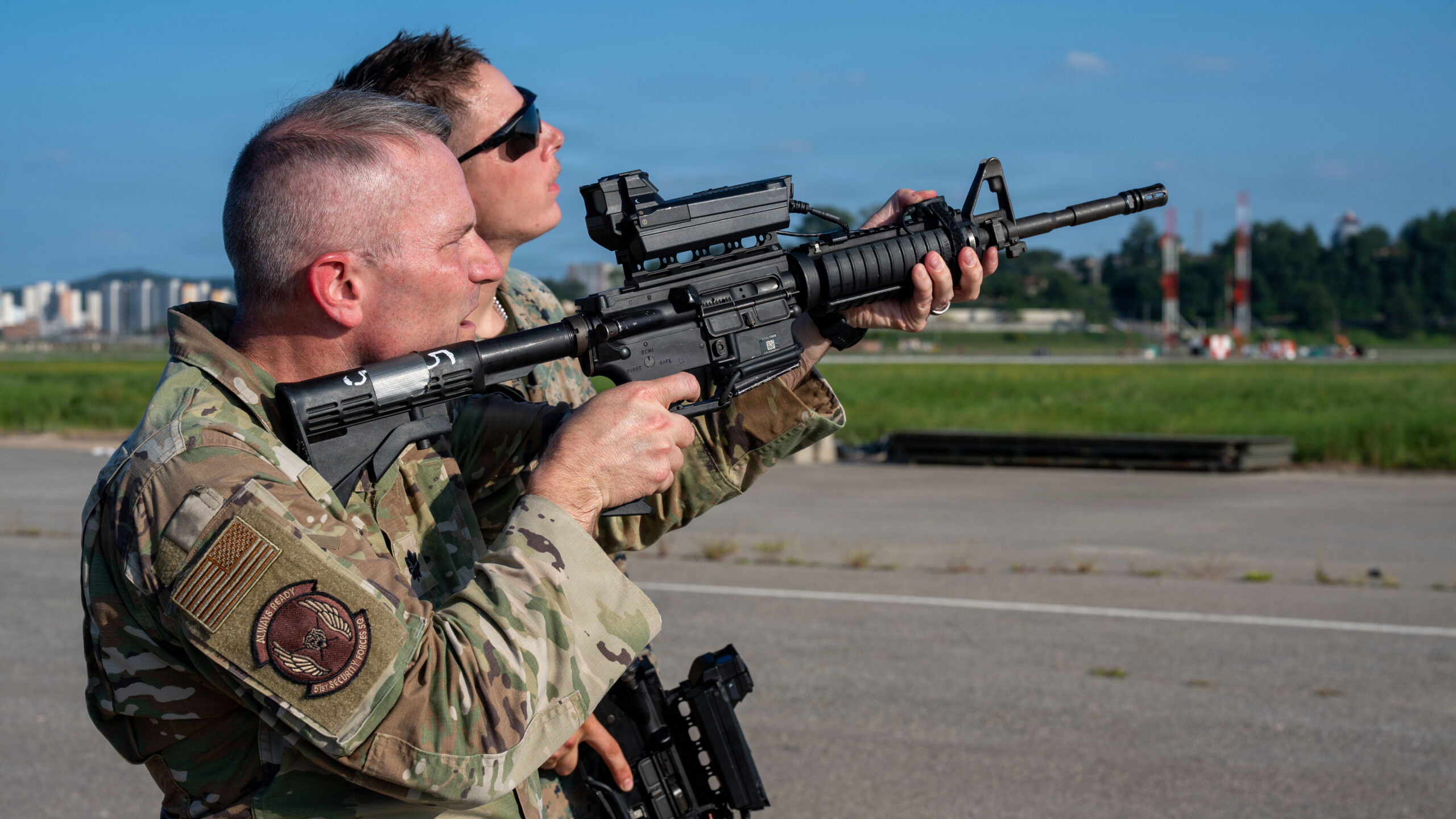
United States and Republic of Korea (ROK) forces recently concluded their inaugural counter-drone defense drills specifically targeting medium-sized uncrewed aerial systems (UAS), approximately 50 miles from the inter-Korean border. The exercise, dubbed Dragon Flight, was held from August 2-6 at Osan Air Base, a critical forward operating location in South Korea.
These drills represent a focused response to evolving aerial threats, particularly North Korea’s increasing emphasis on developing and deploying drones, reportedly drawing inspiration from Russian and Iranian models. The timing of the exercise occurred during a period when larger, peninsula-wide annual exercises, such as Ulchi Freedom Shield, had been subject to scaling back.
The primary objective of Dragon Flight was to enhance the defensive capabilities of Osan Air Base, whose mission includes launching waves of F-16C/D fighter jets in the event of a conflict. These fighters are integral to deterring and responding to regional threats, including those posed by North Korea.
“This exercise helped all the involved agencies assess and validate their respective C-UAS defense systems,” stated 1st Lt. Thu Le of the 51st Security Forces Squadron in a release from the 51st Fighter Wing. “I hope that this event gives the 51st Fighter Wing confidence in its current air defense capabilities and just shows how crucial such systems are to the defense of the base, its assets, and all 16,000 joint-force personnel.”
Dragon Flight marked a significant shift in training focus for Osan, concentrating on what are known as Group 3 drones. These systems occupy a unique threat category, being larger than smaller Group 1 and 2 threats, yet distinct from the larger, conventional ballistic missiles that personnel at Osan and Kunsan Air Bases have traditionally trained to counter. Group 3 drones typically weigh between 50 and 1,320 pounds, can fly at altitudes up to 18,000 feet, reach speeds under 250 knots, and cost an estimated $20,000 to $50,000 to produce. Their capabilities place them in a complex operational space, requiring specialized defense mechanisms.
During the exercise, contractors from Griffin Aerospace were instrumental in simulating hostile aircraft, operating their Outlaw Drone system to present realistic aerial threats. U.S. service members employed a range of counter-UAS technologies to intercept these simulated incursions.
Members of the 51st Security Forces Squadron utilized the Expeditionary Mobile Air Defense Integrated System. Soldiers from the 35th Air Defense Brigade deployed the AN/TWQ Avenger system, known for its short-range air defense capabilities. Marines with the 2nd Low Altitude Air Defense Battalion engaged the simulated threats using Stinger man-portable air-defense systems, augmented with Smart Shooter SMASH optics for improved targeting. Republic of Korea personnel also actively participated, integrating their own counter-drone equipment and expertise into the joint exercise.

**The Bigger Picture: An Evolving Asymmetric Threat**
These focused counter-drone exercises unfold against a backdrop of a rapidly escalating global drone threat, with Group 3 drones posing a particularly acute challenge to U.S. bases and forward-deployed units worldwide. The relatively low cost and significant operational impact of these systems make them an attractive weapon for state and non-state actors alike.
Reports indicate the extensive use of such systems in various conflicts. For instance, in what the release refers to as “Operation Epic Fury,” Iran is estimated to have launched approximately 2,000 Shahed-136 drones – a prominent Group 3 system – against U.S. and allied forces in the region. These attacks have reportedly compelled the U.S. to expend costly munitions to neutralize the incoming threats, highlighting an asymmetric cost-exchange ratio that favors the aggressor. Further underscoring the lethality of these systems, the release mentions an Iranian one-way attack drone striking a U.S. facility in the Port of Shuaiba, Kuwait, on June 1, resulting in the deaths of six U.S. service members.
The proliferation of this technology is a major concern. Russia has reportedly leveraged Iranian technology to develop its own one-way attack drones for use in its conflict against Ukraine. In a reciprocal dynamic, North Korea has provided troops and weaponry to Russia, and in return, Russia is reported to have assisted North Korea in reverse-engineering the Shahed drones. Intelligence assessments suggest North Korea could begin mass production of these knockoffs by 2025. North Korean leader Kim Jong Un has explicitly designated drone production as an “essential requirement” and a “top priority and important task” in the modernization efforts of the nation’s military.
The Korean Peninsula has already experienced direct drone incursions. In December 2022, North Korea utilized its own drones to conduct perimeter incursions into the Demilitarized Zone. Subsequent local news reports have detailed sightings of smaller reconnaissance drones in South Korean border cities during 2024 and 2025, signaling a persistent and growing threat.
While both Osan and Kunsan Air Bases in South Korea are equipped with sophisticated air defense systems, such as the MIM-104 Patriot Systems designed to counter ballistic missiles, cruise missiles, and fighter jets, and short-range air defense systems like the AN/TWQ Avenger, these systems are primarily optimized for different threat profiles, largely geared toward low-altitude aircraft, cruise missiles, and helicopters. The current capabilities are not always ideally suited for the specific flight characteristics and target signatures of Group 3 drones. While Kunsan Air Base has conducted exercises like Beverley Sentinel, employing “red teams” to test defenses against Group 1 and 2 drones, it has yet to hold a dedicated counter-drone exercise focusing specifically on the Group 3 threat, underscoring the evolving nature of air defense requirements.
**Why This Matters**
The recent counter-drone drills by U.S. and ROK forces are highly significant for several reasons, reflecting a critical adaptation to modern warfare. Firstly, they acknowledge the undeniable rise of drones as a potent and pervasive threat across global conflict zones. These systems, particularly Group 3 drones, offer adversaries an asymmetric advantage: they are relatively inexpensive to produce but can inflict significant damage or gather intelligence, often requiring far more expensive munitions or sophisticated systems to counter. This cost imbalance strains defense budgets and resources, making efficient and effective counter-UAS strategies paramount.
Secondly, the drills directly address the evolving security landscape on the Korean Peninsula. North Korea’s declared commitment to drone development, coupled with reported technological assistance from Russia and inspiration from Iranian models, signals a dangerous escalation in its offensive capabilities. Such drones could be used for surveillance, targeted attacks on critical infrastructure, or even swarm tactics, posing a direct threat to U.S. and ROK military installations and civilian populations. Preparing specifically for medium-sized drones fills a crucial gap in existing air defense, which has historically focused on larger aircraft, ballistic missiles, or very small, low-tech drones.
Thirdly, the exercise highlights the necessity for continuous adaptation and joint interoperability among allied forces. Modern warfare demands that allies not only operate their own advanced systems but also integrate seamlessly to form a cohesive defense network. The participation of U.S. Airmen, Soldiers, Marines, and ROK personnel with diverse equipment demonstrates a commitment to a unified front against complex and rapidly evolving threats. This integrated approach is vital for enhancing collective security and deterrence in a volatile region. Ultimately, these drills are not just about defending a single base; they are about safeguarding personnel, critical assets, and regional stability against a future where aerial drones are increasingly central to military strategy.