
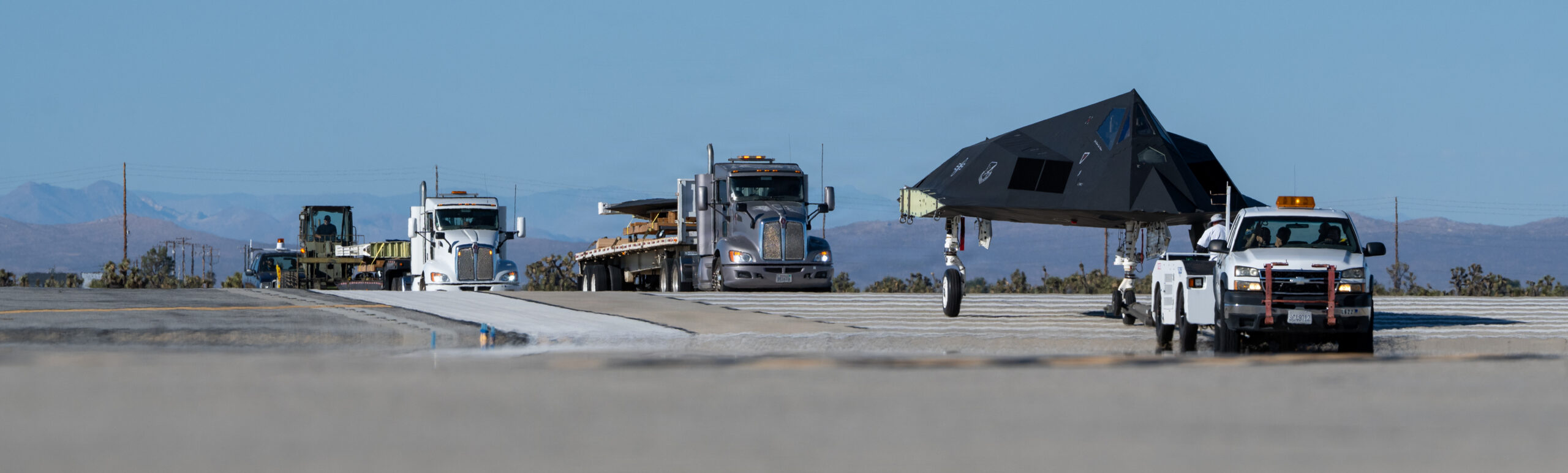
EDWARDS AIR FORCE BASE, Ca.—A flat-black F-117 Nighthawk fuselage was moved from its hangar at Lockheed Martin’s Skunk Works facility in Palmdale, California, by an aircraft tug. This maneuver initiated the aircraft’s journey to the Smithsonian’s National Air and Space Museum.
More than a mile away, a C-5M Super Galaxy transport aircraft awaited, its nose cone open to receive the unique cargo. Against the desert backdrop, the distinctive faceted design of the wingless airframe presented an unmistakable silhouette. This particular F-117, designated “the Overachiever,” holds the distinction of being the only Nighthawk to have participated in all four major conflicts in which the type was deployed.
Over 40 years after the original YF-117 operational prototype conducted test flights from the highly classified Lockheed facility, “the Overachiever” returned to its Palmdale origin. There, it underwent a $1 million refurbishment to prepare it for permanent exhibition at the National Air and Space Museum’s Stephen F. Udvar-Hazy Center in Chantilly, Virginia, adjacent to Washington Dulles International Airport. The extensive restoration aimed to present the aircraft in its best possible condition as it joins other iconic historical aircraft.
The F-117’s 2,254-mile cross-country transport was carried out by a C-5M from the Air Force Reserve Command’s 512th Airlift Wing.
The F-117 Nighthawk was conceived in the 1970s to provide the U.S. Air Force with a tactical advantage against advanced Soviet air defenses. Its design focused on radar evasion, specifically to penetrate airspace protected by Russian-made, radar-guided anti-aircraft missiles that had presented significant challenges during the Vietnam War.
The aircraft’s faceted exterior radically reduced its radar cross section, a characteristic confirmed through radar detection testing. While its initial combat deployment during Operation Just Cause in Panama in 1989 yielded limited tactical success, the Nighthawks’ subsequent performance in Operation Desert Storm was highly effective. On January 17, 1991, F-117s successfully penetrated heavily defended Iraqi airspace undetected, destroying their assigned targets and marking the opening phase of the Gulf War’s aerial campaign.
Michael Hankins, curator of modern military aviation at the Udvar-Hazy Center, stated, “This aircraft was specifically designed to be able to penetrate heavily defended areas that have radar-based defenses … which gave it a huge tactical advantage on the battlefield.” He added, “This will be the [museum’s] first example of the earliest generation of stealth aircraft. A lot of new aircraft that are in service today—like the F-22 Raptor, the F-35 Lightning—really built on the foundation that was set by the F-117.”
The U.S. Air Force officially retired its F-117 fleet in 2008, following the F-22 Raptor achieving initial operating capability in 2005. However, some Nighthawks have remained in “flyable storage” and, since approximately 2020, have participated in various exercises, including Red Flag, and other undisclosed activities.
The acquisition of “the Overachiever” for the National Air and Space Museum involved months of coordination among the Air Force, the Smithsonian Institution, and Lockheed Martin. Jeffrey Corbets, who oversaw the aircraft’s restoration at the Skunk Works Special Systems department, noted that preparing Tail No. 818 for its museum role required extensive restoration work by a dedicated team of over a dozen Skunk Works employees.
Corbets explained that the specialists involved in the restoration are not typical aircraft technicians. “They’re kind of different people,” Corbets said. “The team that’s actually working the bulk of this also supports our U-2 program, so they’re really familiar with supporting some of our longer-term, historical legacy products.”
Due to its previously highly classified status, the F-117 could not fly directly to Dulles Airport and taxi to the Udvar-Hazy Center, as some other historical aircraft have done. Instead, it underwent a complete de-militarization process, which involved removing its most sensitive classified components and technologies, according to Corbets.
From late January to early August, the Skunk Works team utilized bead-blasting techniques to remove the jet’s radar-absorbing material (RAM) coating, exposing the bare metal underneath. The aircraft’s unique edges on the wings and rudders, integral to its stealth capabilities, were replaced with replica, non-functional edges.
Corbets detailed the labor-intensive process: “It’s a lot of manual labor. The first thing you have to do is actually get access to all the connectors, the bolts, and whatnot that hold edges on.” These fasteners were concealed beneath the stealth coating. “You have to very carefully dig out the RAM, so you can get to those to take them off. And then once you have all the edges removed, then we can actually go into a bead blasting type operation to get the rest of the coatings off.”
The de-militarization also necessitated the removal of classified technical components from the cockpit, though Corbets did not specify which systems were extracted.
“The cockpit is mostly intact, so they have, I’d say, 95 percent of the avionics are still in there—the screens and the displays are still in there, the hub system is still in there, the ejection seat, etc., etc. To even the educated observer, it would look like an operational F-117,” Corbets clarified. “The museum wanted it to be as representative a configuration as we could leave it, so if it didn’t absolutely have to come out, we didn’t take it out.”
Several other F-117s are already on public display at various institutions, including the National Museum of the U.S. Air Force in Dayton, Ohio. Lockheed’s Skunk Works previously performed similar de-militarization and restoration work in 2019 for an F-117 now exhibited at the Ronald Reagan Presidential Library and Museum in Simi Valley, California.
To prepare the Nighthawk for transport within the C-5, its wings were removed. They were then secured onto wheeled dollies and loaded separately onto the transport aircraft. Air Force loadmasters utilized an electric winch and cable system to carefully pull each dolly onto the ramp and into the rear cargo bay. Airmen completed this task in the desert heat without incident.
The loading of “the Overachiever’s” freshly painted fuselage onto the C-5 for safe transport presented an unexpected challenge. Although the combined weight of the wings and fuselage, approximately 24,000 pounds, was well within the C-5’s maximum cargo capacity of 285,000 pounds (sufficient to carry two M1A2 Abrams tanks), a discrepancy arose.
A miscommunication during the restoration process meant the aircraft lacked a sufficient number of bolt-on anchoring points required for secure tie-down in the cargo bay. This necessitated the attachment of special anchoring collars to each of the three landing gear struts to prevent the jet from shifting during flight.
A maintenance technician explained the solution: “We decided to use the collars that we use on the struts to help secure it down, but in order for that to work, we had to raise the struts so we get the right angle to use the collar.” Obtaining clearance to raise each strut by approximately four inches was crucial to implement this securing method effectively.
Why This Matters:
The F-117 Nighthawk represents a pivotal achievement in military aviation and engineering. As the world’s first operational stealth aircraft, its declassification and display at the National Air and Space Museum hold significant historical and educational value. The F-117 fundamentally changed military strategy and aircraft design, demonstrating the feasibility and effectiveness of radar-evading technology. Its success laid the groundwork for subsequent generations of stealth aircraft, such as the F-22 Raptor and F-35 Lightning II, which continue to form the backbone of modern air forces.
By preserving and exhibiting “the Overachiever,” the museum provides public access to a formerly highly classified piece of technology, allowing visitors to understand the technological advancements made during the Cold War and their enduring impact. It serves as a tangible link to a critical period in geopolitical history and showcases American innovation in defense. The painstaking restoration process itself highlights the dedication required to maintain and honor these technological legacies, ensuring that future generations can learn directly from these artifacts about the evolution of aerospace capabilities and the strategic implications of technological superiority.
**For Immediate Release**
**Historic F-117 Nighthawk Stealth Jet Transported to National Air and Space Museum**
**Dulles, Virginia – October 26, 2026** – A significant piece of aviation history, an F-117 Nighthawk stealth fighter known as “The Overachiever,” has been successfully transported to the Steven F. Udvar-Hazy Center, part of the Smithsonian’s National Air and Space Museum in Dulles, Virginia. The intricate operation involved a U.S. Air Force Reserve C-5M Super Galaxy cargo aircraft and specialized crews, culminating in the aircraft’s arrival for public display.
The F-117 Nighthawk, a revolutionary aircraft renowned for its stealth capabilities, played a pivotal role in the late 20th and early 21st century conflicts, most notably during Operation Desert Storm. Its distinctive angular design marked a paradigm shift in military aviation, allowing it to penetrate heavily defended airspace undetected. “The Overachiever,” specifically, is slated to join the museum’s extensive collection, offering visitors an up-close look at an iconic symbol of Cold War technological advancement and its subsequent impact on modern warfare.
The journey began with the meticulous loading process of the disassembled F-117, comprising its fuselage and wings, onto the massive C-5M Super Galaxy. This phase presented an unexpected challenge, requiring the ingenuity and experience of the Air Force Reserve loadmaster team.
“Mounting the collars took time,” noted personnel involved in the operation. Air Force Reserve Senior Master Sgt. Vasean Townsend, a C-5 loadmaster with 13 years of experience, described the issue. “Basically, one of the tie-down points was missing on each side,” Townsend explained. Having participated in the transport of another F-117 years prior, Townsend and his team were prepared for potential contingencies. “We as loadmasters have to find a way to create other tie-down points. If something is missing… we’ve just got to be creative. That’s part of the job.” The problem was subsequently resolved through the team’s adaptive measures, securing the invaluable cargo for its flight.
Following the resolution of the tie-down issue, Lockheed staff and the aircrew quietly observed as “The Overachiever” was carefully lashed down within the C-5M’s expansive cargo bay, ready for its journey to Dulles. The atmosphere was one of solemn pride and accomplishment, marking the end of one chapter and the beginning of another for the stealth aircraft.
For C-5 pilot Maj. Dean Mouritzen, the mission held profound personal significance. “This is my last flight in the military,” he stated, reflecting on his career. “It’s my last mission, and doing something this—taking an F-117 to a museum and being able to tell my kids, my grandkids, that I was just one of the peons to take it some place where it’s going to sit forever—it’s pretty awesome.” His sentiment underscored the historical weight of the task and the honor felt by those directly involved.
The sentiment was echoed by the Lockheed team responsible for the aircraft. According to Corbets (a Lockheed representative, though full name is not provided in the original text), watching the aircraft depart was “a little bit like watching a friend leave you, because obviously everyone’s been really excited to be part of the project, and now it’s going off to its new home.” This human element highlighted the deep connection between the engineers and technicians and the groundbreaking aircraft they helped create and maintain.

After several hours in the air, the C-5M Super Galaxy successfully landed at Washington Dulles International Airport. The aircraft’s ramp was lowered at 8:38 p.m. local time, and the crew expeditiously offloaded “The Overachiever’s” fuselage and wings onto the chilly ramp by 9:16 p.m. Museum officials then promptly transported the components to the nearby Mary Baker Engen Restoration Hangar. Here, the F-117 will undergo reassembly and preparation before its anticipated public exhibition.
“The Overachiever” is scheduled to be unveiled for public viewing at the Udvar-Hazy Center later this month. Roger Hankins, a museum official who has been involved with the project for “several years,” outlined the future display plans. “The current plan is to have this airplane on the floor next to all the other aircraft in our Cold War modern military section,” Hankins stated. “It’ll be right next to the F-15 Eagle, which it flew with during Operation Desert Storm. There’s a lot of a lot of historical significance there to having those two together on the floor.”
Hankins emphasized the profound importance of the aircraft’s acquisition. “This is a really big step and a very historic and important aircraft in the history of U.S. aviation,” he affirmed. “We’re so excited to have this on the floor and be able to show the public why this airplane is so unique and special and important and iconic.”
The successful transport and impending display of “The Overachiever” mark a significant moment for aviation enthusiasts, historians, and the general public, offering a tangible link to a pivotal era of technological innovation and military strategy.
Shaun Barrows, senior multimedia manager at Air & Space Forces Association, contributed to this story.
—
**Why This Matters**
The transfer of “The Overachiever,” an F-117 Nighthawk, to the Smithsonian’s National Air and Space Museum is more than just the movement of an old aircraft; it represents several critical aspects of historical preservation, technological legacy, and public education.
Firstly, its placement in a public museum ensures the **preservation of a vital piece of modern aviation history**. The F-117 was revolutionary, pioneering stealth technology that fundamentally altered aerial warfare. Its angular design, a stark contrast to traditional aerodynamic principles, was a visible manifestation of its groundbreaking radar-evading capabilities. By being displayed, future generations will be able to witness firsthand the engineering marvel that once defined the cutting edge of military aviation, offering a tangible link to the strategic innovations of the late Cold War and post-Cold War eras.
Secondly, the F-117’s exhibition highlights its **technological legacy and impact on global defense**. The Nighthawk’s successful deployment in conflicts like Operation Desert Storm demonstrated the effectiveness of stealth technology, prompting other nations to invest heavily in similar capabilities and shaping subsequent aircraft designs, including the F-22 Raptor and F-35 Lightning II. Its presence in a museum allows for educational opportunities to explain complex concepts of radar cross-section reduction, materials science, and mission planning, illustrating how scientific advancements translate into strategic advantages.
Thirdly, the operation itself underscores the **complex logistics and specialized skills required for military operations and historical artifact recovery**. The intricate process of disassembling, transporting, and reassembling such a large and unique aircraft highlights the capabilities of the U.S. Air Force Reserve and the versatility of platforms like the C-5M Super Galaxy. The problem-solving demonstrated by the loadmasters, adapting to unforeseen challenges, showcases the practical ingenuity essential to military and logistical personnel worldwide. This aspect provides insight into the often-unseen support structures that enable both military readiness and the preservation of national heritage.
Finally, this acquisition enriches the museum’s role in **public education and national storytelling**. By positioning “The Overachiever” alongside contemporaries like the F-15 Eagle, the museum can create a narrative that vividly explains the air combat environment of Operation Desert Storm and the complementary roles of different aircraft types. It allows visitors to contextualize historical events, understand the sacrifices and innovations involved, and reflect on the evolution of national defense strategies. Such artifacts serve as powerful educational tools, sparking interest in science, technology, engineering, and mathematics (STEM) fields, and fostering a deeper understanding of the nation’s past and its contributions to global security.